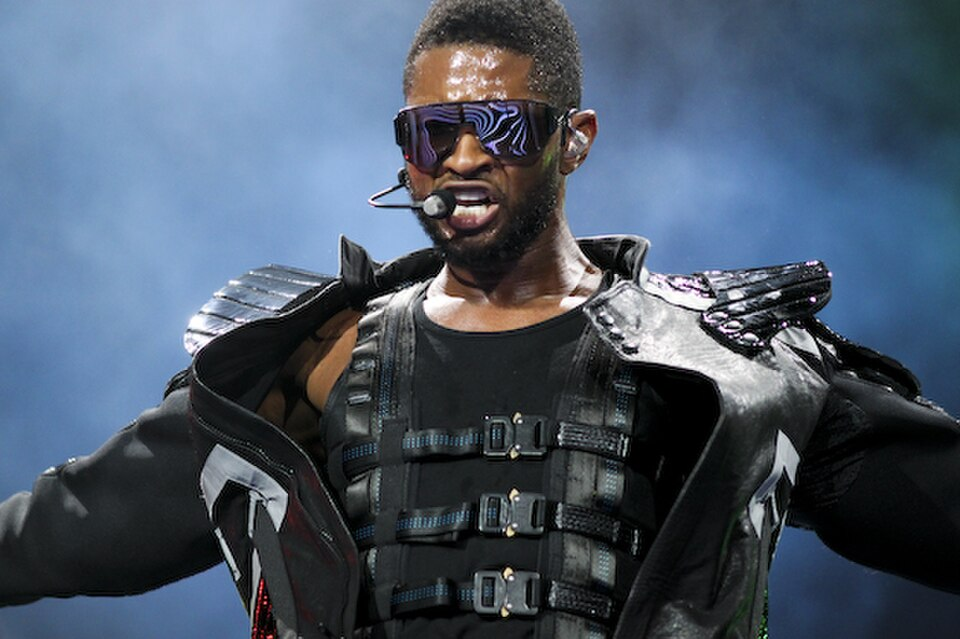
Having a famous parent does not automatically mean wanting to be famous yourself. Some celebrity children grow up around film sets and recording studios and decide they would rather do something else entirely. Others give the entertainment industry a try before realising that being recognised everywhere is not quite as appealing as it sounds. The pattern is more common than the tabloids suggest, and it says something useful about the difference between inheriting a platform and wanting one. Usher‘s son Cinco is perhaps the clearest example, but he is far from alone, and the choices made by children of major stars offer a quieter counterpoint to the assumption that fame runs in families.
Usher is used to performing for huge crowds, but his eldest son, Usher “Cinco” Raymond V, is not keen on sharing that spotlight. During an appearance on The Tamron Hall Show on 10 November 2022, the singer spoke about the different ways his sons view his fame. “I have one son, Cinco, who does not like to be called Usher, who tries to get away from it,” he said. That single line captures a dynamic many families in the public eye will recognise: a child who loves a parent but resents the name that follows him into every room. His younger son, Naviyd, is more interested in entertainment and even gives his father feedback on his performances, which makes the contrast between the two brothers all the more striking. Cinco seems happier doing his own thing. In August 2026, he started his freshman year at Howard University, an occasion his mother, Tameka Foster, celebrated on Instagram. He has not publicly shared what he is studying, and that reticence is itself a kind of statement.
Tom Selleck’s daughter Hannah has similarly built a life that has little to do with the Hollywood machine that made her father a household name. Selleck, whose run on Magnum P.I. and later Blue Bloods made him one of the most recognisable actors of his generation, has spoken warmly about his daughter’s independence and her decision to pursue a path of her own. Hannah has worked in equestrian circles and has kept a low public profile, avoiding the red carpets and press circuits that come with a famous surname. For a parent who spent decades in front of cameras, watching a child choose a world measured in horses and open land rather than box office returns is not a disappointment. It is, by several accounts, a relief.
The list extends well beyond those two names. Several children of major stars have drifted toward medicine, law, business, academia and the trades, fields where the work is evaluated on its own merits rather than on the reflected glow of a parent’s career. The reasons vary. Some grew up watching their parents deal with paparazzi and online scrutiny and decided early that the trade-off was not worth it. Others tried acting or music, found the audition process exhausting or the attention corrosive, and walked away without regret. A few have spoken candidly about the difficulty of being judged against a parent’s achievements, a comparison that can sour even genuine talent.
There is a financial dimension that rarely gets discussed. Celebrity children often have access to resources that make alternative paths easier to pursue: private tutors, family connections in business and professional networks that open doors outside entertainment. That advantage is real, and it would be dishonest to pretend these choices are made on a level playing field. But privilege does not explain the direction of the choice. Plenty of wealthy young people gravitate toward fame precisely because they can afford the risk. The ones who step away are often responding to something more personal, a sense that the spotlight belongs to someone else and that their own identity is better built elsewhere.
The parents themselves have varied responses. Some, like Usher, speak about their children’s choices with evident affection and a hint of amusement. Others have admitted to initial disappointment before coming around. What tends to emerge in interviews is a recognition that a child who chooses an ordinary life is not rejecting the parent. He or she is declining a particular kind of visibility that the parent happened to accept. That distinction is easy to miss when the culture treats fame as the ultimate prize, but it is central to understanding why these stories keep getting told.
Public perception of celebrity children remains stubbornly divided. There is a strand of commentary that treats any step away from Hollywood as a wasted opportunity, as though a famous name is a ticket that must be used. There is another, quieter strand that admires the refusal, seeing in it a healthy skepticism about an industry that can be brutal to those who enter it unprepared. Neither view is entirely fair. The children in question are not making a statement about fame so much as making a decision about their own lives, and the decision deserves to be read on its own terms rather than as a verdict on their parents.
What remains genuinely open is how these choices will look over time. A young person who avoids the industry at twenty may feel differently at forty, and some do eventually return. Others never look back. The more interesting question is what their example says to the next generation of celebrity children, who will grow up with social media amplifying every comparison and every expectation. If anything, the pressure to monetise a famous surname has grown, not shrunk, and the ones who resist it are swimming against a stronger current than their parents did. Their stories are worth noting not because they are unusual, but because they quietly challenge the assumption that inheritance and ambition must point in the same direction.