The Brazilian designer explains why romance, vintage, and handmade craft keep human creativity at the heart of fashion in the age of AI.
Artificial intelligence has entered almost every conversation in fashion. Today, brands use it to write product descriptions, create images, and answer customers. In fact, McKinsey’s State of Fashion 2026 report offers a clear figure. More than 35 percent of executives already use generative AI for tasks such as customer service, image creation, and copywriting. However, the same report also urges companies to protect “the essential creativity that makes fashion tick.”
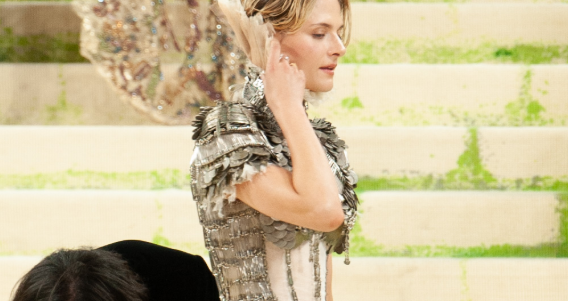
So what does all this mean for the people who actually design clothes? To find out, we spoke with Marina Pereira, a Brazilian designer based in New York. Pereira grew up in São Paulo. Later, she earned a Bachelor of Fine Arts in Fashion Design from Parsons School of Design at The New School. Since then, she has worked at Marchesa, Altuzarra, Sea New York, and LoveShackFancy. At Marchesa, she worked on a gown that Georgina Chapman wore to the 2023 Met Gala. Most recently, Vogue Runway covered her designs in the LoveShackFancy Spring 2027 collection during New York Fashion Week.
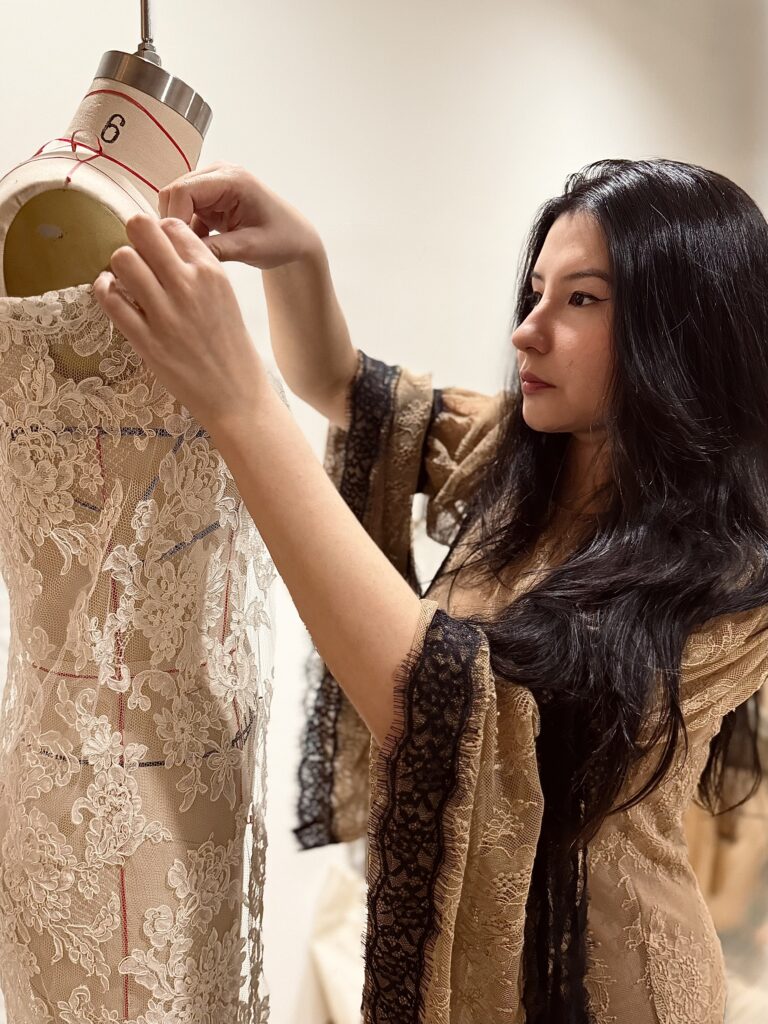
Pereira works at the meeting point of art and technology every day. She sketches by hand, builds CADs in Adobe Illustrator, and sends detailed tech packs to factories overseas. As a result, she sees both the promise and the limits of new tools. Still, her view is clear. AI can save time, organize information, and speed up routine tasks. However, it cannot feel, remember, or imagine the way a human designer does.
She also believes the rise of AI makes art and humanities education more important, not less. Interestingly, the World Economic Forum agrees. Its Future of Jobs Report 2025 expects creative thinking, curiosity, and lifelong learning to grow in importance through 2030. Here, Marina Pereira explains why the next decade of fashion will still belong to people.
A Useful Tool, Not a Designer
Marina Pereira does not fear artificial intelligence. Instead, she approaches it with curiosity. “Every generation of designers has faced new technology,” she says. She remembers her professors once worried that computers would replace hand sketching. Eventually, computers simply became another tool in the studio. Pereira believes AI will follow a similar path. “It will change how we work, but it will not change why we design,” she explains.
Still, she takes the subject seriously. In her view, AI will clearly speed up some tasks. For example, it can sort research images, organize line sheets, or suggest colorways. Those tasks matter, but they aren’t the heart of design. For Pereira, that heart is a feeling, a story, and a point of view. “So far, no machine has shown me that,” she says.
In fact, Pereira thinks the debate often starts in the wrong place. Many people ask whether AI can draw a dress. Instead, she suggests a harder question: can AI understand why a woman wants that dress? That question involves culture, memory, emotion, and timing. Above all, it involves the relationship between a designer and the people she dresses.
Today, Pereira sees AI entering fashion mostly at the edges of the creative process. For instance, some teams use image generators to build quick mood boards. Others use AI to write product descriptions or to translate notes for factories. Brands also use data tools to study what customers buy and when.
However, Pereira draws a clear line between a mood board and a collection. An image generator can mix references very quickly. Yet it cannot know why a certain lace makes a woman feel elegant at a family wedding. Nor can it know how a fabric moves on a real woman walking down a São Paulo street. “Those memories and observations come from life, not from data,” Pereira says.
Her own experience explains this conviction. Pereira grew up in São Paulo, where she earned a Sigbol Fashion Certificate for Patternmaking in 2017. Afterward, she worked as an assistant designer at Gule. She then moved to New York and studied at Parsons. Since then, her career has taken her through Marchesa, Altuzarra, Sea New York, and LoveShackFancy. At each step, she learned that design happens in three dimensions, not only on a screen.
Indeed, Pereira points out that AI can produce a picture of a garment. Yet a picture is very different from clothing. A real garment must fit a body, move with that body, and survive production. At LoveShackFancy, Pereira creates tech packs with construction details, specs, and BOMs. Then she attends fittings and revises each piece repeatedly.
During a fitting, she studies proportion, comfort, and finish all at once. Afterward, she talks with pattern makers and sample makers. Sometimes a sleeve needs one more centimeter. Other times, an embroidery sits too low and flattens the silhouette. Those decisions clearly depend on touch, eyes, and experience. “I do not see AI taking over that process in the next ten years,” she says.
Moreover, embroidery offers an even stronger example. At Marchesa, Pereira developed embroideries and drapes alongside the Head of Embroidery. There, she also worked on a gown that cofounder Georgina Chapman wore to the 2023 Met Gala. In that world, every bead had a purpose. The team tested scale, placement, density, and color many times.
For Pereira, embroidery always starts with a story. Before she draws a motif, she asks what feeling the garment should carry. A bridal gown needs something tender. Meanwhile, a party dress might need something bold. Of course, AI can generate a thousand motifs in a minute. “Choosing the one motif that tells the right story is a human decision,” Pereira says. “In fact, that choice is the whole job.”
Meanwhile, some people argue that AI will make design more democratic. Pereira partly agrees. After all, AI can help a young person visualize an idea without expensive tools. Similarly, small brands can now handle tasks they could never afford before. “That opportunity is real, and I respect it,” she says.
However, she also sees a risk. When everyone uses the same tools and the same data, many designs start to look alike. Yet fashion needs surprise. It needs a strange color choice or a technique nobody expected. Typically, those surprises come from personal experience, culture, and even mistakes. As a result, Pereira believes originality will become more valuable as AI images multiply.
In fact, Pereira sees today’s biggest trends as a quiet answer to the digital age. Romantic fashion is back on the runways, and she believes the timing is no accident. “People want to feel something when they dress,” she says. After years of screens and speed, ruffles, bows, florals, and lace offer warmth and emotion. For Pereira, the return of romance proves that people still crave clothes with a human touch. She calls her approach “romance with intention” because every detail must have a purpose.
Vintage tells a similar story. Young shoppers increasingly hunt for secondhand pieces, partly because they feel unique in a world of mass production. Similarly, designers study archives to find details that modern production forgets. “Vintage clothes carry stories,” Pereira says. “When you hold an old dress, you can feel how someone lived in it.” An algorithm can copy a vintage dress’s look. However, it cannot carry the life that dress has lived. Therefore, she treats vintage as a teacher rather than a template. “I never want to copy the past,” she explains. “I want to understand it and then speak to today.”
Textiles complete the picture. Many emerging brands now build their identity around embroidery, crochet, lace, and prints instead of logos. Pereira grew up in Brazil, surrounded by lace, embroidery, and artisanal work. “In Brazil, I learned to see decoration as something meaningful, not something extra,” she says. Crochet and lace, in particular, show the human hand. Consequently, they gain value precisely as AI images multiply. “A small brand cannot always win on price,” Pereira says. “But it can win with beauty and craft.” In her view, these handmade surfaces may become the clearest signature of human creativity in the age of AI.
In her own studio life, technology already plays a daily role. Pereira works in Photoshop, Illustrator, and InDesign, and she creates CADs and 3D mockups. Without those tools, modern production would be impossible. Accordingly, she sees AI as a possible assistant for organizing information and speeding up repetitive tasks.
Nevertheless, one thing remains off limits. “What I will never hand over is the creative decision,” she says. In her experience, the best collections grow from studio conversations. Someone brings an old photograph, someone else brings a fabric swatch, and suddenly an idea appears. For Pereira, that spark comes from people sharing a room.
Why Human Creativity Will Lead the Next Decade
Why, then, is she so confident that AI cannot replace human creativity in the next decade? Pereira gives three reasons. First, creativity starts with lived experience. She designs the way she does because she grew up in Brazil and built her career in New York. “Brazil gives me the heart, and New York gives me the structure,” she often says. By contrast, a machine has no childhood, no city, and no memory of a special dress.
Second, fashion speaks to emotions. A woman chooses a dress because it makes her feel strong, romantic, or free. Designers understand those feelings because they feel them too. Third, fashion depends on judgment. AI can offer endless options. But it cannot decide which one fits a brand, a season, and a cultural moment. For these reasons, Pereira expects human creativity to stay at the center of fashion. In her view, that will hold for at least the next ten years.
Pereira also thinks about the people who make clothes. Pattern makers, sample makers, and embroiderers may see some tasks change. Even so, she believes their skills will become more precious, not less. In New York, she works with makers who carry decades of knowledge. Often, they can spot a problem in a garment before anyone else. “That kind of knowledge lives in the hands and the eyes,” she says.
Moreover, customers increasingly value things made with care. When a piece carries real handwork, people can feel it. Therefore, Pereira hopes brands will use technology to save time on routine work. Then they can invest that time in craft, artisans, and quality.
The New Value of Art Schools and the Humanities
This view leads Pereira to a strong belief about education. In an age of AI, she argues, art schools matter more than ever. Above all, they teach people how to see. At Parsons, her professors asked her to defend every decision. For example, they wanted to know why a seam sat in one place and not another. “At first, that felt intense,” she recalls. “Eventually, it became my favorite part of the work.”
That training goes far beyond technique. In particular, art school teaches students to observe, question, and develop a point of view. Machines cannot easily automate those skills. In a world full of AI images, Pereira believes the person who can explain why an idea matters will lead the conversation.
Pereira also sees art schools as places where students learn to work together. In a studio, students share references, critique each other, and build trust. Those habits prepare them for real teams, where creativity always grows through dialogue. Clearly, those lessons will matter even more as tools become more powerful.
She adds that the humanities give designers depth. After all, fashion always reflects history, culture, and society. When Pereira researches a collection, she looks at art, nature, archives, and travel. Without that knowledge, a designer only repeats surfaces. For example, a romantic collection gains meaning when its designer understands the history behind lace, flowers, or a certain silhouette.
In addition, the humanities teach empathy and storytelling. Likewise, a designer must understand the woman who will wear the dress. What does she want to feel? What does her world look like? Those questions belong to the humanities. Interestingly, the World Economic Forum makes a similar point. It expects creative thinking and curiosity to grow in importance through 2030. “When machines handle more routine work, human understanding becomes the real advantage,” Pereira says.
So how should fashion schools respond? Pereira believes they should teach both sides. Students should learn the new tools because ignoring them would be unrealistic. At the same time, they must protect the fundamentals. Drawing, draping, patternmaking, and sewing remain essential. Indeed, her own patternmaking training in Brazil still guides her work today.
Above all, she wants schools to teach critical thinking. Students need to ask where an AI image comes from, who owns it, and whether it says something new. Equally, they need to know when to turn the tool off. “Sometimes the best idea appears when you sit with a pencil and a blank page,” she says.
For young designers who feel anxious, Pereira offers simple advice. First, stay curious instead of fearful. Second, learn the technical side of fashion, because production knowledge will always add value. Third, treat every job as a school. Finally, protect your point of view. “Your personal story is your greatest asset,” she says. “No machine can live your life for you, so no machine can design exactly like you.“
Looking ahead ten years, Pereira imagines a studio with more tools but the same heart. Designers will probably use AI to organize research, test colorways, and speed up communication with factories. Meanwhile, people will still drape fabric on forms, debate proportions, and celebrate a perfect sample. She also hopes to see more collaboration with artisans and more textile innovation. “Technology can help that dream, but it cannot dream for us,” she says. In the end, as Marina Pereira reminds us, fashion is about people dressing people.
Also Read: Marina Pereira NYAL Press