
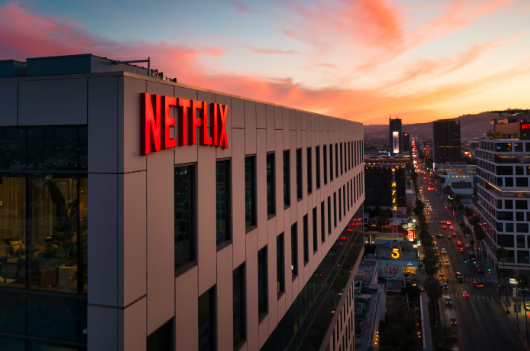
Netflix shares fell sharply after the company delivered a cautious profit and advertising outlook, a signal that even the most established name in streaming is not immune to the pressures reshaping how people watch video. The stock dropped around 5 percent, extending a year-to-date decline that has erased more than a quarter of its value. If those losses hold, the company stands to lose roughly 13.4 billion dollars in market value, a striking reversal for a business that once seemed untouchable.
The numbers themselves were not disastrous. Third-quarter revenue rose 11.8 percent to 12.87 billion dollars, broadly matching what Wall Street had expected. But it was the slowest increase in nearly three years, and that detail carried more weight than the headline figure. Netflix also trimmed its advertising forecast for next year to about 2.7 billion dollars, down from an earlier projection of roughly 3 billion. In a market that rewards momentum, small downward revisions tend to speak louder than steady top-line growth.
What makes this moment particularly interesting is how many fronts Netflix is fighting on at once. Earlier this year, the company lost a bidding war for Warner Bros Discovery, a reminder that content empires are no longer won by checkbook alone. It is defending a paid subscription model against free platforms that cost viewers nothing but their attention. And it is competing in a streaming landscape that has consolidated rapidly, with deep-pocketed rivals like Amazon and Disney pressing from every direction.
Then there is the shift in viewing habits themselves. Audiences are increasingly gravitating toward short-form video on platforms like YouTube and TikTok, where the commitment is measured in seconds rather than seasons. That change does not make premium television obsolete, but it does chip away at the time and attention available for it. Netflix has stopped reporting subscriber numbers since 2025, which makes it harder to gauge engagement directly, though the broader trend lines are clear enough. Growth has slowed, and the market has noticed.
Evercore ISI analysts attributed the softness to a combination of market maturity, persistent competition, and some content missteps. Co-CEO Ted Sarandos acknowledged on the earnings call that the company could do better, a rare admission of vulnerability from a leadership team accustomed to setting the pace. More than twenty brokerages cut their price targets on the stock following the results, a coordinated signal of diminished near-term confidence.
To its credit, Netflix is not standing still. Sarandos said the company intends to refocus on its core business of producing quality shows and films, aiming to make the service feel indispensable rather than merely available. A recent executive shakeup reflects that intent. The company replaced its chief creative officer and saw its film chief depart, alongside cutting about 6 percent of its workforce. BofA Global Research described the leadership change and layoffs as a sign that management is serious about improving content output and creative hit rates.
Valuation tells its own story. Netflix trades at nearly 18.3 times expected earnings over the next twelve months, compared with about 14.8 times for Disney and 6.3 times for Comcast. Investors are still paying a premium for Netflix, which means they still believe in the franchise. But premiums invite scrutiny, and the gap between expectation and delivery is where stock prices suffer.
Whether these challenges prove temporary or structural is the open question. Slowing engagement and revenue growth look addressable, and analysts largely expect the company to find its footing. Yet the shift toward free, short-form content is not a problem that can be solved with a single strong quarter of programming. Netflix built its reputation by reinventing how people watch television. The next chapter asks whether it can reinvent itself again, this time in a market that no longer waits patiently for the next season.