Ed Sheeran became the target of a pointed joke during Amelia Dimoldenberg’s opening monologue on SNL UK, as the television presenter used her trademark dry humor to poke fun at the singer while referring to the recent controversy surrounding his association with rapper Macklemore. The moment quickly attracted attention from viewers and social media users, particularly because Dimoldenberg compared Sheeran to a puppet being controlled by someone else.
Dimoldenberg, best known for her popular interview series Chicken Shop Date, brought her distinctive comedic style to the SNL UK stage. During her opening remarks, she reflected on some of the high-profile personalities she had interviewed throughout her career. She mentioned celebrities including Idris Elba and Cher before delivering the joke aimed at Sheeran.
“I’ve been incredibly privileged to have done so many interviews with people like Idris Elba, Cher, and even a world-famous, red-headed puppet with a hand up his arse telling him what to say.”
The line immediately drew laughter from the audience. Dimoldenberg then appeared to extend the joke by referring to Elmo, the well-known Sesame Street character. When an image from her interview with Elmo appeared on the screen, she made it clear that she was referring to someone else.
“No, the other one,” she said.
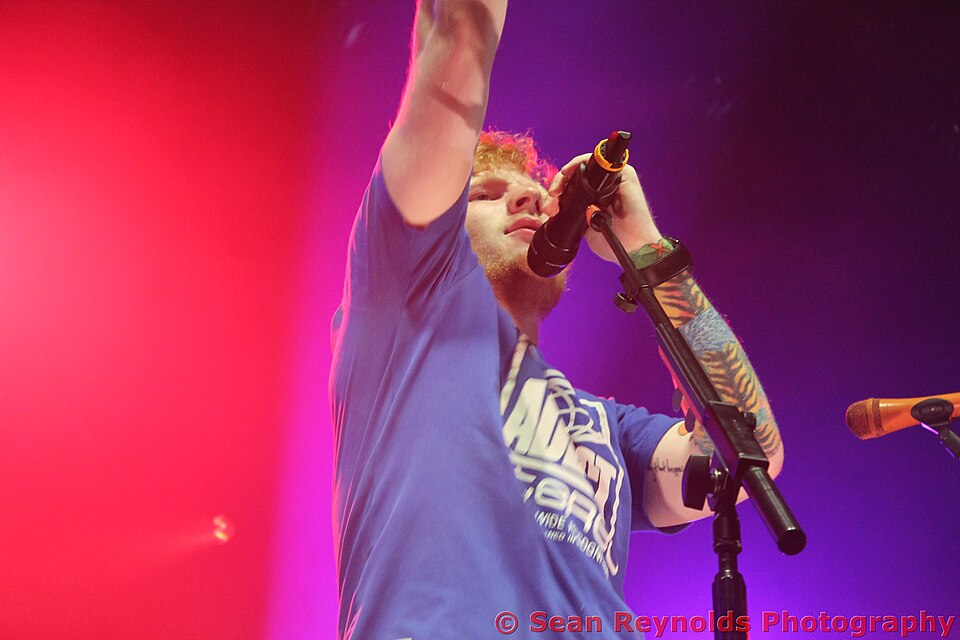
A photograph of Ed Sheeran then appeared on the screen, revealing the target of the joke and prompting further laughter and cheers from the audience. The combination of the visual reveal and Dimoldenberg’s deliberately exaggerated description gave the moment much of its impact.
The joke was not simply a reference to Sheeran’s appearance or his public image. It also appeared to draw on the controversy that had recently surrounded Macklemore and his removal from a US tour connected with Sheeran. The incident had attracted considerable public discussion because of Macklemore’s outspoken comments in support of Palestinians.
Macklemore had publicly expressed support for Palestinians and said “Free Palestine” during a concert in New Jersey. Following the remarks, reports emerged that the rapper had been removed from a Sheeran-related US tour. The development led to questions about who had made the decision and whether Macklemore’s political statements had played a role.
The situation became more complicated because Sheeran subsequently addressed the controversy and clarified that he had not personally decided to remove Macklemore. According to Sheeran, the decision had been made by the tour promoters rather than by him directly.
That distinction became an important part of the public discussion. Although Sheeran was closely associated with the tour, the singer indicated that decisions regarding the lineup were not necessarily under his personal control. The controversy nevertheless placed him at the centre of a wider conversation involving music, politics and the responsibilities of artists and promoters.
Dimoldenberg’s SNL UK joke appeared to play on precisely that perception. By describing Sheeran as a “red-headed puppet with a hand up his arse telling him what to say,” she humorously suggested the idea of a performer being controlled or directed by people behind the scenes. The wording was deliberately provocative, fitting the style of a comedy monologue where public figures are often used as material for sharp jokes.
The timing also made the joke particularly relevant. Sheeran had already been receiving significant public attention because of the Macklemore controversy, meaning that the audience was likely to understand the reference immediately. Rather than introducing an unrelated joke about the singer, Dimoldenberg connected the punchline to a story that had recently generated discussion around his public role.
For Sheeran, the moment adds another layer to the continuing conversation about the controversy. The singer has maintained that the decision involving Macklemore was not his own, but the incident has nevertheless created questions about the relationship between performers, promoters and political expression.
The entertainment industry has increasingly found itself at the intersection of music and political debate. Artists frequently express opinions on major international and social issues, while promoters and event organizers must make decisions about tours, performances and commercial partnerships. When those areas overlap, even decisions made by one party can create consequences for others associated with the event.
Macklemore’s position also became part of that wider discussion. His public support for Palestinians placed his appearance and professional relationships under increased scrutiny, while the subsequent dispute raised questions about whether artists should face professional consequences for political statements. Different people have interpreted the events differently, with the central disagreement involving who was responsible for the decision and what factors influenced it.
Sheeran’s response has focused on separating himself from the decision to remove Macklemore. His clarification did not end the public conversation, however, and the subject continued to attract attention online and in entertainment coverage.
That background gave Dimoldenberg an obvious opening for comedy. Her role on SNL UK is built around entertainment and satire, and public controversies involving major celebrities are often fertile material for comedians. Her joke relied on exaggeration rather than presenting a new factual claim about Sheeran’s involvement.
The audience response suggested that the reference landed as intended. The appearance of Sheeran’s photograph immediately after the Elmo joke made the punchline unmistakable, while the contrast between a beloved children’s television character and one of the world’s most recognizable singers added another comedic layer.
Dimoldenberg has developed a reputation for an intentionally awkward and unpredictable interview style, and her SNL UK appearance allowed her to bring that personality to a much larger stage. Her decision to target Sheeran demonstrated how celebrity culture and current controversies can quickly become material for mainstream comedy.
For viewers, the moment was less about establishing a new fact and more about turning an existing controversy into a memorable television joke. The “puppet” comparison referenced the perception that Sheeran may have had less control over the Macklemore decision than some members of the public initially assumed.