Renderings win the applause, but buildings and landscapes are won, or lost, in the construction phase. A look at the discipline of construction administration through the work of a California-licensed landscape architect who treats it as a creative act.
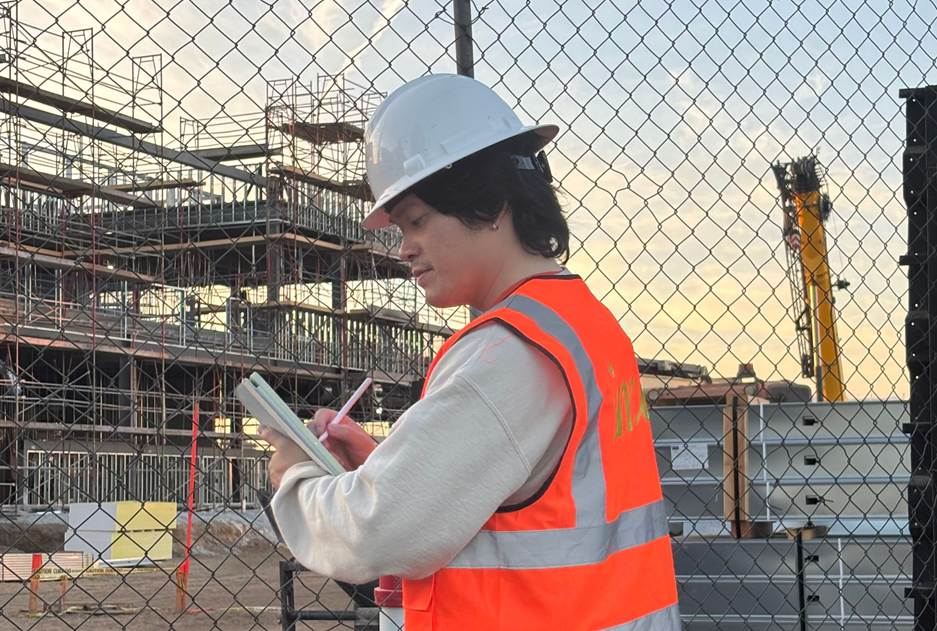
Every landscape architect knows the moment. The design has been approved, the renderings have circulated, the community is excited, and then construction begins, and reality starts asking questions. The specified paver has been discontinued. The plant that anchored the entire courtyard palette is unavailable in the contract size. A utility line, absent from every survey, surfaces exactly where the signature tree was meant to go. The contractor proposes an alternative that would save six weeks and quietly gut the design.
What happens next is called construction administration, CA, in the profession’s shorthand, and it is, by broad consensus among practitioners, the least glamorous and most decisive phase of landscape architecture. It generates no awards categories of its own. It rarely appears in magazine features. Yet it is the phase in which design intent either survives its collision with budgets, supply chains, and field conditions, or dissolves into a diluted version of itself that no one quite chose.
Chung-Chiang Chen, PLA, a California-licensed landscape architect currently practicing as a Landscape Designer at ima Design Group in the Los Angeles region, has built much of his professional identity around this invisible half of the discipline. Across a career spanning public parks, healthcare campuses, supportive housing, and large-scale residential communities, including collaborative work with respected studios such as Hongjoo Kim Landscape Architects (HKLA), Chen has developed a conviction that runs counter to the profession’s culture of concept worship: that construction administration is not the administrative aftermath of design, but its final and most demanding act.
Two California multifamily projects, Avella Apartment Homes Phase II in Southern California and The Sycamores in Northern California, offer an unusually clear window into what that conviction looks like in practice.
Why the Drawings Are Never Enough
To understand why CA matters, it helps to understand what a landscape construction document set actually is: a prediction. Hundreds of sheets of plans, details, schedules, and specifications predict how a site will be graded, drained, paved, irrigated, planted, and lit. But a prediction is not a guarantee. Between the stamped drawings and the finished landscape stand a developer’s budget, a general contractor’s schedule, a dozen subcontractors’ interpretations, a volatile materials market, and the stubborn particularity of the ground itself.
The mechanisms that manage this gap are unglamorous by design. Requests for Information (RFIs) are the contractor’s formal questions: what did you mean here, what do we do about this conflict? Submittals and shop drawings are the contractor’s proposed translations of the documents into actual products and fabrications, which the design team must review for conformance. Substitution requests arrive when a specified product is unavailable, discontinued, or suddenly unaffordable. Field reports document what is actually happening on site, catching divergences while they can still be corrected. Change orders price the inevitable adjustments.
Handled passively, these instruments become the machinery of erosion: each substitution slightly cheaper, each RFI answer slightly more expedient, until the built landscape is a rounded-off approximation of the design. Handled actively, the way Chen practices them, they become something else entirely: a second design phase, conducted under pressure, in which every answer is an opportunity to protect or even sharpen the original intent.
“The construction phase is where the design is truly tested,” is how practitioners like Chen frame it. A detail that cannot survive an RFI was never fully resolved. A palette that collapses at the first substitution request was never robust. In this view, CA is not damage control; it is quality control for ideas.
Avella: Protecting Design Intent, One Submittal at a Time
Avella Apartment Homes Phase II is the kind of project where the stakes of CA are impossible to miss. The 15-acre development comprises 22 residential buildings, resort-style amenities, courtyards, streetscapes, and private open spaces conceived as a definitive expression of contemporary Southern California living.
For a project of this scale, the landscape is not decoration; it is a defining part of the experience created for future residents. Every courtyard, every paving transition, every planting bed is expected to arrive exactly as designed. Drawings alone cannot meet that expectation; construction must defend it daily.
Chen’s role on Avella spans the full arc from documentation to delivery. He developed construction documents, coordinated with architects and consultants, and has played a major role in construction administration, coordinating among project stakeholders to help carry the design through implementation. In practice, that has meant a continuous, structured dialogue conducted through the instruments of the trade.
Consider the substitution problem, endemic to construction, as the pandemic scrambled global supply chains and as widely documented across the design and construction industry. Across his construction-phase work, when specified paving products and plant materials proved unavailable or constrained, Chen did not simply approve the nearest equivalent. He evaluated proposed alternatives, comparing color, texture, module, finish, and performance against the design intent, before they reached the field. The question guiding each review was never Is this close enough? but does this preserve what the design was doing? A paver substitution that matches the spec sheet but flattens a carefully composed color sequence is not a match; it is a loss, and catching it is precisely the CA professional’s job.
The same discipline applied to living materials. When contract-grown plants or specified species and sizes became unavailable, Chen developed planting solutions in RFI responses that maintained the structure of the palette, its heights, textures, seasonal rhythms, and water-use logic, rather than allowing ad hoc swaps to accumulate into an unrecognizable garden. On a project whose planting design carries much of the resort-style atmosphere, this is not pedantry; it is the difference between the community sold and the community built.
And then there is the ground itself. Chen’s field reports across his construction-phase work document the granular reality of construction observation: identifying field issues, marking their locations, photographing conditions, and coordinating corrections with the contractor before small divergences hardened into permanent flaws. Where field conditions conflicted with the drawings, existing elements not captured in surveys, dimensional discrepancies, and grading realities, he resolved the conflicts through RFI responses and coordination that adjusted the design intelligently instead of abandoning it.
The cumulative effect of this work is invisible in the best possible way: a completed landscape in which residents will never know how many decisions stood between the renderings and the reality, because the finished landscape remains recognizably faithful to the design intent.
The Sycamores: The Same Discipline, Sustained
If Avella demonstrates the breadth of Chen’s CA practice, The Sycamores demonstrates its consistency. Across this second major multifamily community, Chen has carried the same responsibilities through the same gauntlet: reviewing RFIs and submittals, evaluating substitutions when specified products were unavailable, reconciling budget pressures with design quality, and resolving material and field-condition issues in continuous coordination among project stakeholders.
What The Sycamores underscores is that CA excellence is not a heroic one-off but a sustained professional posture. The challenges recur on every project: the discontinued product, the budget squeeze, the surprise beneath the soil, and the value a landscape architect adds lies in meeting them the same way every time: with the design intent as the fixed star and everything else negotiable.
Two habits define Chen’s approach across both projects, and they are worth naming because they generalize to the profession at large.
First, he treats every substitution as a design question, not a procurement question. The path of least resistance in CA is to check whether an alternative product meets the written specification and sign off. Chen’s practice adds a second test: does the alternative serve the purpose the original selection served in the composition? This distinction, between spec compliance and intent compliance, is where most design erosion either happens or is prevented.
Second, he treats coordination as the deliverable. RFIs, submittals, and field reports often feel like interruptions to real work. Chen’s approach reflects the opposite understanding: during construction, the coordination is the real work. A brilliant RFI answer that arrives too late, or a correct substitution rejection that never reaches the contractor clearly, protects nothing. The craft lies as much in the communication as in the judgment.
A Skill Built Across Sectors
Chen’s fluency in construction-phase practice didn’t come from multifamily projects alone. His career has been a deliberate accumulation of CA experience across nearly every sector California builds.
At Segal Shuart Landscape Architects, he developed projects from preliminary presentation through construction documents and monitored materials and contractor performance during construction. His subsequent professional experience broadened that foundation across public, educational, healthcare, housing, and cultural landscapes, including work at Hongjoo Kim Landscape Architects (HKLA). These varied project contexts strengthened his ability to translate design intent into coordinated, buildable work. Along the way, he played a leading role in the landscape design of a supportive-housing community in the high desert of the Antelope Valley, and helped advance the landscape for a major clinical building at the City of Hope medical campus, part of a broader campus vision recognized with a 2025 World Landscape Architecture Award of Excellence.
That cross-sector range matters. Healthcare projects teach unforgiving standards for accessibility and safety detailing. Public work teaches procurement discipline and code fluency. Supportive housing teaches how to protect design quality when every dollar is contested. Together, these different project environments have required Chen to balance design intent with accessibility, code requirements, technical coordination, constructability, and implementation realities. By the time these lessons converge on a 15-acre multifamily site, they amount to something rare: a landscape architect who has seen how designs fail in construction across every context, and therefore knows how to keep them from failing.
The Anatomy of a Good Answer
What does construction-phase excellence actually look like at the scale of a single decision? Strip away the acronyms, and a pattern emerges from Chen’s project record: a repeatable anatomy any emerging professional can study.
It begins with diagnosis before response. When an RFI arrives asking what to do about a planting area compromised by an unforeseen condition, the weak answer addresses the square footage in question; the strong answer first asks what that planting was doing in the composition, screening, wayfinding, seasonal color, water-use balance, and then solves for the function, not just the location. Chen’s RFI responses on Avella consistently follow this logic, pairing annotated photographs and marked-up plans with revised planting layouts so the contractor receives not just instructions but intent.
Next comes speed calibrated to the schedule. Construction does not pause for contemplation. A perfect answer delivered after the concrete pour is worthless, so the CA professional must triage: which questions can be answered from the documents within hours, which require broader project team confirmation, and which justify holding a sequence of work. Managing that triage, and communicating it honestly to the contractor, is itself a skill, and one that builds the credibility on which every future negotiation depends.
Then, documentation as memory. Every field report, every logged substitution review, every confirmed direction becomes part of a project’s institutional memory, the record that resolves disputes before they become claims and ensures that a decision made in March is not silently reversed by a different subcontractor in June. Chen’s meticulous field reporting across both Avella and The Sycamores reflects a truth construction veterans learn early: in CA, what isn’t written down didn’t happen.
Finally, and least teachably, relationships. RFIs and submittals are formal instruments, but they travel between people: project managers, superintendents, suppliers, and other project stakeholders, and the landscape architect who treats contractors as adversaries will find every substitution request arriving as a fait accompli. Chen’s coordination record shows the opposite posture: project stakeholders looped in early, alternatives explored jointly, and the design intent explained rather than merely asserted. Protection of the design, it turns out, is a collaborative achievement disguised as an administrative one.
Why the Profession Should Care
CA remains landscape architecture’s invisible half for structural reasons. The profession’s public identity, its awards, publications, and education, is organized around design conception. Even the American Society of Landscape Architects’ professional guidance acknowledges construction-phase services as essential to professional practice, yet the cultural spotlight rarely follows the work past permit submittal.
The cost of that blind spot is real. Designs that die in construction do not merely disappoint their designers; they waste client investment, degrade the public’s experience of the built environment, and, in an era when landscapes are asked to deliver measurable performance in water efficiency, canopy cover, and climate adaptation, they quietly forfeit environmental outcomes that existed only on paper. A hydrozone plan that is value-engineered into a conventional irrigation system, or a climate-adapted palette swapped for whatever the nursery had in stock, represents a sustainability promise broken at the last mile.
This is the deeper argument embedded in Chen’s practice. Construction administration is not merely how designs get protected; it is how the profession’s commitments to clients, communities, and the environment get honored. The landscape architect who masters RFIs and submittals is not doing paperwork adjacent to design. They are doing the part of design that determines whether any of the rest of it was real.
On Avella and The Sycamores, the residents who will eventually gather in those courtyards will never read a single RFI. They will simply experience places that feel coherent, intentional, and complete, never knowing how many times, during construction, someone had to fight quietly to keep them that way. That anonymity marks construction administration done well. It is also, Chen’s career suggests, a professional achievement worth dragging into the light.
About Chung-Chiang Chen
Chung-Chiang Chen, PLA, is a California-licensed landscape architect based in the Los Angeles region and currently serves as a Landscape Designer at ima Design Group. His practice spans large-scale multifamily and mixed-use developments, public parks, school campuses, healthcare environments, affordable and supportive housing, historic cultural sites, and high-end residential gardens, with recognized expertise in technical documentation and construction administration. His earlier professional experience includes Hongjoo Kim Landscape Architects (HKLA), Segal Shuart Landscape Architects, and KSA Design Studio, where his responsibilities spanned a broad range of project types and phases.
Chen holds a Master of Landscape Architecture from the University of Illinois at Urbana-Champaign, where his published thesis, Assessing the Potential of Mixed Reality for Landscape Architecture(2020), explored emerging technologies in professional practice. The press has featured his perspectives on sustainable, water-wise design, including a 2024 interview with New York Art Life Magazine.