Lessons From a Year of Building Entrepreneurial Leadership in Togo
By Shelli Brunswick
When people speak about entrepreneurship, the conversation often begins with the individual: the founder, the idea, the courage to begin. Yet one of the most important lessons reinforced through a year of collaboration in Togo is that entrepreneurial potential does not grow in isolation. Opportunity is an ecosystem.
An entrepreneur may have vision, talent, and determination. But progress accelerates when that individual can also access mentors, digital tools, trusted networks, practical knowledge, markets, and people willing to open doors. This is the difference between delivering a program and building capacity that can continue multiplying long after the formal activities have ended.
That distinction shaped my partnership with Togolese leaders through initiatives connected to the Mandela Washington Fellowship for Young African Leaders, the flagship program of the U.S. Government’s Young African Leaders Initiative. Through the Fellowship’s Reciprocal Exchange component, American professionals and Fellowship Alumni collaborate on projects that strengthen skills, institutions, professional networks, and lasting relationships across the United States and Sub-Saharan Africa.
What began as a shared commitment to leadership and entrepreneurship became a year-long journey involving the Women Tech Lead Creators program, the Digital Young Entrepreneurs Lab, international master classes, local training, mentorship, and continued collaboration. The most meaningful outcome was not any single workshop. It was the ecosystem taking shape around the participants.
Local Leadership Must Lead
Sustainable impact begins with respect for where knowledge, trust, and leadership already reside. In Togo, the programs were built through collaboration with Oboubé Aimé Tossah, founder of Academy Des Leaders and a Mandela Washington Fellowship Alumnus, Sabanko Homgouyeda, and a wider network of local organizers, facilitators, institutions, and partners.
Their understanding of the communities, languages, ambitions, and practical realities on the ground was indispensable. My role was not to arrive with a universal formula. It was to contribute experience, frameworks, global connections, and encouragement that could be adapted to the local context.
This is an essential principle for organizations working across countries and cultures: partnership is not the transfer of expertise from one side to another. It is the creation of something neither side could build alone. The strongest collaborations combine a global perspective with local ownership, enabling ideas to be translated into action in ways that are relevant, trusted, and enduring.
From Access to Agency
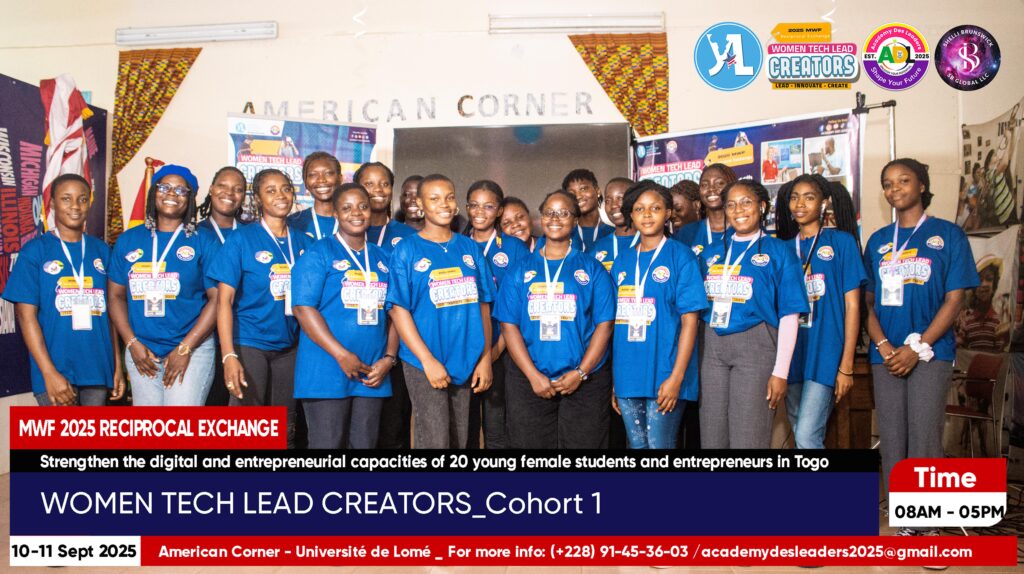
The Women Tech Lead Creators program brought together 20 young Togolese women at the American Corner at the University of Lomé for intensive engagement in technology, leadership, STEM, digital communication, personal branding, and artificial intelligence.
The initiative was developed through the Mandela Washington Fellowship Reciprocal Exchange, a U.S. Department of State program administered by IREX, a global development and education organization. The U.S. Embassy in Lomé and local partners provided additional support, while SB Global LLC contributed sponsorship and executive coaching. Together, these efforts did more than expand access to information. They created space for participants to recognize their own capacity to lead.
That shift matters. Training can introduce a tool, but confidence determines whether someone will use it. A network can provide connections, but agency determines whether someone will initiate the conversation. Exposure can reveal a possibility, but leadership determines whether that possibility becomes a plan.
The participants’ reflections emphasized courage, resilience, continuous learning, and a willingness to navigate uncertainty. Those are not secondary skills. In an economy increasingly shaped by artificial intelligence and rapid technological change, they are strategic capabilities. The future will reward people who can learn, adapt, communicate, and act even when the path is incomplete.
Building Beyond a Single Cohort
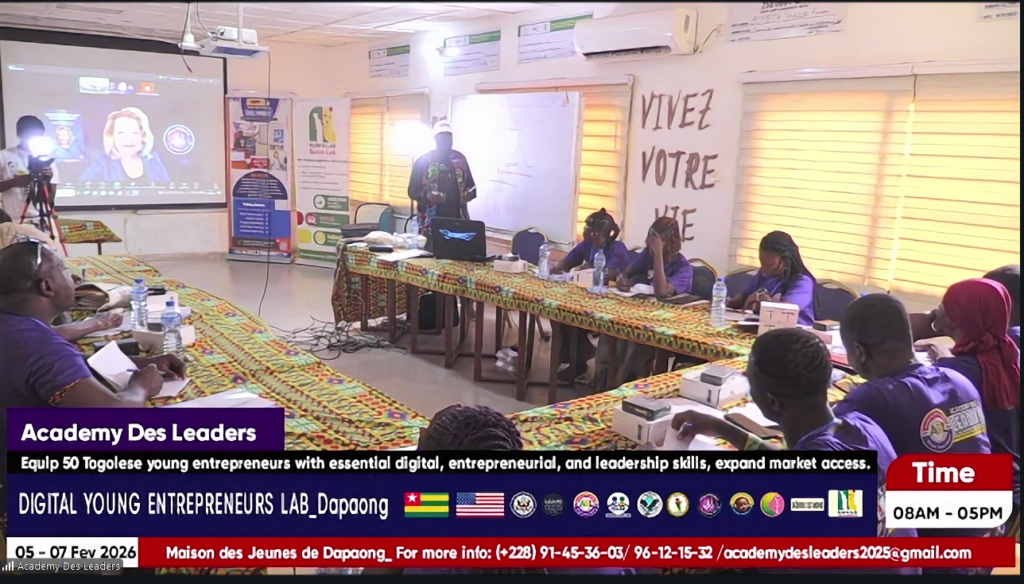
The Digital Young Entrepreneurs Lab (DYEL) extended this commitment to a broader entrepreneurial community. Implemented by Academy Des Leaders with support from the 2025 Alumni Engagement Innovation Fund, DYEL was designed to equip 50 young entrepreneurs across Togo’s five regions with practical skills in digital communication, AI, smartphone-based content production, crowdfunding, financial literacy, online markets, leadership, and entrepreneurial innovation.
The regional model was strategically important. Talent is rarely confined to capital cities, yet access often is. Bringing development opportunities closer to entrepreneurs across regions reduces geographic barriers, connects local innovators, and strengthens the economic fabric among communities.
The program also recognized a reality often overlooked in conversations about innovation: entrepreneurs do not always need the most advanced technology to begin. Sometimes the most transformative tool is already in their hands. A smartphone can become a production studio, a marketplace, a classroom, a financial tool, and a gateway to customers beyond national borders. The strategic question is not simply whether technology exists, but whether people have the knowledge, confidence, and networks to turn it into value.
Four Principles That Turn Learning Into Progress
For my Digital Young Entrepreneurs Lab master class, I drew from the framework explored in my second book, What’s Space Got to Do With It? An Interstellar Guide to Success. Although the book draws lessons from the space ecosystem and insights shared by global leaders, its principles are deeply relevant to entrepreneurs working in any industry or geography.
The entrepreneurial learning centered on four interconnected ideas: Leadership, Awareness, Access, and Action.
Leadership begins with the ability to lead yourself. Entrepreneurs operate amid uncertainty, limited resources, risk, and skepticism. Before they can build a company or inspire a team, they must understand their strengths, confront their gaps, and remain committed to a vision others may not yet see.
Awareness is the ability to recognize what is changing—within a market, a community, a technology, or oneself. Opportunities are often visible before they are obvious, but only to those who are actively listening, learning, and looking beyond familiar boundaries.
Access transforms possibility into capacity. Mentors, collaborators, markets, funding, knowledge, and technology form the bridges between an idea and its execution. Networking is not the accumulation of contacts. It is the patient creation of trusted relationships through which people exchange insight, opportunity, and support.
Action is where leadership, awareness, and access become progress. The exercises were designed as a connected sequence, with each one answering a question essential to entrepreneurial growth. Mission patches challenged participants to define the problem they wanted to solve, the people they hoped to serve, and the impact they wanted to create. An entrepreneurial SWOT analysis then helped them assess the leadership strengths they could build upon, the weaknesses requiring support, the opportunities emerging around them, and the threats—from competition and funding constraints to overcommitment and burnout—that could slow their progress.
From there, participants mapped out how to move forward. Access blueprints connected a specific opportunity to the knowledge, relationships, and funding required to pursue it, along with three actions they could take within 30 days. A 5-5-5 outreach plan helped them identify five peers for collaboration, five guides or mentors for insight, and five amplifiers—organizations, media platforms, or events—that could expand their visibility and reach. Finally, a 30-day flight plan required them to set one achievable goal for each of the pillars: Leadership, Awareness, Access, and Action. The goal was not to leave inspired for a day. It was to leave with greater clarity, a stronger network strategy, and a practical trajectory for turning ideas into progress.
What Strategic Leaders Can Learn
Several lessons from this partnership extend far beyond Togo.
First, capacity-building must be designed as a system. A master class can spark imagination, but mentorship, peer networks, follow-through, and opportunities to apply learning help that spark become momentum.
Second, local partners are not implementation channels; they are strategic architects. They understand what emerging leaders need, which institutions can help, what barriers may be invisible to outside organizations, and how trust is built within the community.
Third, access should be treated as infrastructure. When leaders connect entrepreneurs to knowledge, tools, markets, role models, and one another, they create conditions in which opportunity can circulate rather than remain concentrated.
Fourth, measurement should look beyond attendance. The deeper questions are whether participants gained confidence, built relationships, applied new skills, entered new markets, taught others, or began creating opportunities within their own communities.
Finally, reciprocity strengthens impact. I brought decades of experience across military, commercial, government, nonprofit, academic, and international sectors. I also gained insight from the ingenuity, ambition, and resourcefulness of Togolese entrepreneurs and leaders. The exchange expanded my understanding of how global frameworks must adapt to local realities—and how innovation often flourishes when people learn with one another rather than simply from one another.
From Programs to Possibility
I am deeply grateful to the Mandela Washington Fellowship, the U.S. Department of State, IREX, the U.S. Embassy in Lomé, Academy Des Leaders, the facilitators and sponsors, and especially the participants who brought these initiatives to life. Their energy transformed a series of activities into a shared platform for growth and possibility.
The experience also reinforced why this work must continue beyond any single grant, cohort, or event. Entrepreneurship programs achieve their greatest value when they become part of a larger strategy for building markets, developing talent, strengthening institutions, and expanding access to opportunity.
This is the work I continue through writing, keynote speaking, executive education, strategic advisory engagements, and board service: helping leaders and organizations see the larger system, connect people and ideas across boundaries, and turn emerging possibilities into meaningful progress. The lessons in An Interstellar Guide to Success were never intended to remain on the page. Their value is realized when people use them to lead, build, and create opportunities for others.
The future of entrepreneurship will not be shaped by talent alone. It will be shaped by the ecosystems surrounding that talent—and by leaders willing to build the bridges that allow potential to become progress.
When access expands, confidence grows. When confidence grows, action follows. And when people are equipped not only to participate in the future but to help create it, the impact can travel far beyond one classroom, one program, or one country.
About the Author
Shelli Brunswick is an international keynote speaker, strategist, and author of the What’s Space Got to Do With It? book series, and CEO and Founder of SB Global LLC. Her work connects technology, leadership, policy, investment, and global collaboration to help organizations build markets, develop talent, and scale impact.