
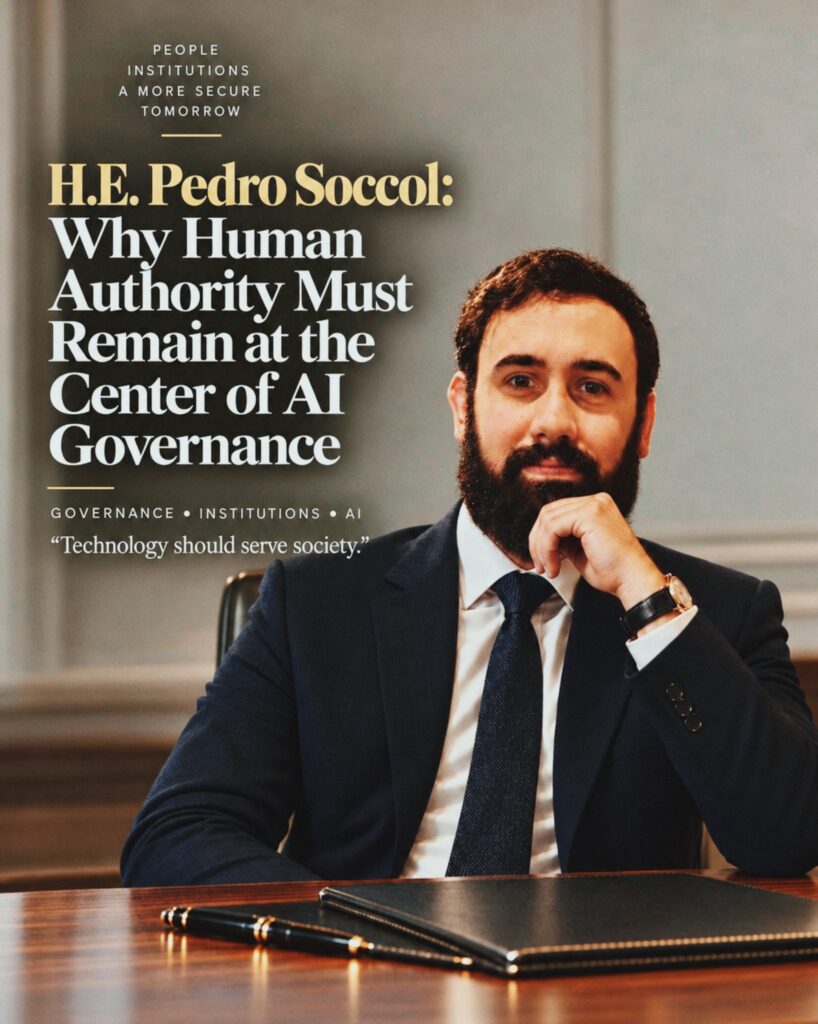
Dr Pedro Guilherme de Oliveira Soccol is not a typical tech founder. A Brazilian jurist, published author, investor and serial entrepreneur, he has built a career at the intersection of law, artificial intelligence, institutional governance and international diplomacy. As Founder, Chairman & CEO of Cognisynth, he is developing governance infrastructure for complex decision-making environments—technology designed not merely to automate work, but to preserve accountability, documentary integrity and human authority within it.
His guiding principles are deceptively simple: Governance precedes scale. AI assists. Humans decide.
In this interview, Dr Soccol shares his journey from legal research into entrepreneurship, the problem Cognisynth exists to solve, and why he believes the most valuable technology of the future will be the kind that strengthens human judgement rather than replaces it.
How did you get into what you do? What does your business offer, and what makes it unique? What impact are you trying to create, and what are you most proud of so far?
Dr Pedro Soccol: My journey into entrepreneurship has been shaped by a combination of legal education, business interests and a longstanding curiosity about how organisations function.
During my legal studies, which I completed in 2025, I developed a particular interest in blockchain, smart contracts and the legal implications of emerging technologies. That research encouraged me to examine the relationship between technological capability, organisational responsibility and the structures through which important decisions are made.
It also led me to recognise a much more immediate business problem.
Across different industries, entrepreneurs, executives and professionals dedicate substantial amounts of time to administrative procedures, documentary reviews, information verification, contractual analysis and operational requirements. These activities are often essential, yet they divert attention from the objectives that actually determine a company’s future: innovation, commercial development, customer relationships, strategic planning and sustainable growth.
I began to question why highly qualified professionals were still required to devote so much of their working time to fragmented information and processes that could be organised more intelligently.
The more I examined this problem, the more convinced I became that the market needed something beyond conventional automation tools. Businesses required technological solutions capable of improving operational performance while also preserving the reliability of information, the integrity of documents and the accountability of those responsible for important decisions.
That recognition led me to establish Cognisynth in 2026.
My purpose was straightforward: to help businesses achieve higher levels of performance by reducing unnecessary operational complexity, improving the quality of information and allowing entrepreneurs, executives and employees to concentrate on their most important responsibilities.
Today, as Founder, Chairman & CEO of Cognisynth, I direct the development of an organisation operating at the intersection of artificial intelligence, institutional governance, legal architecture, operational intelligence and strategic innovation.
Our work is focused on developing technological infrastructure that can support organisations in managing complex information, coordinating responsibilities, improving documentary processes and making consequential decisions with greater confidence.
Imagine an executive preparing to authorise a significant transaction involving extensive documentation, different versions of contractual materials, several departments and numerous procedural requirements. Under conventional arrangements, assembling and verifying the relevant information may require considerable manual effort. Documents must be located, compared and reviewed, responsibilities confirmed and approvals coordinated.
Our ambition is to make that process substantially more efficient and transparent. We want decision-makers to receive information that is organised, intelligible, supported by identifiable evidence and presented in a form that allows them to understand what genuinely requires their attention.
The objective is not simply to process information faster. It is to improve its quality, accessibility and practical value.
One of the most important expressions of this philosophy is Cognisynth Control Room, which I co-founded with Gabriel Bussab and which is being developed in collaboration with Kailash Technologies. The Control Room is conceived as governance infrastructure for critical operations, bringing together document management, access permissions, human review, formal authorisation, decision traceability, integrity verification and structured audit records.
Its operating architecture follows six interconnected stages: Preparation → Review → Recommendation → Authorization → Execution → Validation.
The concept is to establish a structured environment in which organisations can understand not only what actions have been performed, but also who authorised them, what evidence supported them and where responsibility rests.
What distinguishes Cognisynth is our decision to approach technological innovation from the perspective of both operational performance and institutional governance. Many systems are designed primarily to accelerate execution. Our approach also considers what must exist before execution can responsibly take place: reliable information, identifiable responsibilities, documented review and appropriate authorisation.
We regard governance as part of the technological foundation, not as an administrative burden added afterwards.
The impact I want to create is therefore both economic and human. For entrepreneurs, I want to create more time to concentrate on building their businesses. For executives, I want to improve access to reliable information and strengthen the conditions under which important decisions are made. For employees and operational teams, I want to reduce unnecessary administrative pressure and provide better-organised processes that allow their expertise to be used more effectively.
When I consider what I am most proud of so far, several achievements stand out. The first is founding Cognisynth and developing a clearly defined vision from a problem I identified through my legal education and entrepreneurial interests. The second is advancing Cognisynth Control Room from an institutional concept into a structured technological development initiative, supported by engineering collaboration and a governance architecture with practical organisational applications.
I also take considerable pride in my intellectual work, particularly my publications concerning blockchain, smart contracts, virtual assets, delegated authority and the institutional responsibilities associated with technological automation. Seeing ideas that originated in legal research contribute to the conceptual foundations of a business initiative has been particularly meaningful.
Ultimately, I believe entrepreneurship should be measured by more than the creation of a company or the development of a product. Its greater significance lies in recognising problems worth solving, organising the capabilities required to address them and developing solutions that improve the conditions under which people and organisations pursue their ambitions.
What drives your mission and vision? What core values or beliefs guide the way you run your business? How do you approach challenges, growth and innovation—and what keeps you motivated when things get tough?
Dr Pedro Soccol: What drives my mission is the conviction that technology should give people greater control over their time, their responsibilities and their future.
Throughout my professional journey, I have come to understand that one of the most valuable resources within any organisation is not simply capital, technology or information. It is the ability of people to apply their knowledge, judgement and experience to the objectives that genuinely matter.
I founded Cognisynth because I recognised a persistent imbalance in the way many businesses operate. Highly qualified professionals were dedicating substantial portions of their working lives to administrative procedures, documentary analysis, information verification and repetitive operational requirements, often at the expense of activities that could generate greater value for their organisations.
However, efficiency alone is not sufficient.
My legal education and subsequent research into blockchain, smart contracts, autonomous systems and institutional responsibility reinforced my understanding that technological capability must remain connected to legitimate authority, reliable evidence and accountable decision-making.
An organisation may possess exceptionally sophisticated technology, but if it cannot establish who authorised a particular action, which information supported that decision or where responsibility rests, technological sophistication alone cannot guarantee institutional reliability.
This is why governance occupies such a central position in our work. At Cognisynth, we are developing an approach in which operational performance, documentary intelligence, institutional accountability and human oversight form part of the same technological architecture.
The values guiding this mission are responsibility, integrity, sound judgement, professional excellence, accountability and respect for human decision-making. I place considerable importance on building relationships with people who possess complementary expertise and who understand that meaningful institutional development requires both ambition and discipline.
Another principle that strongly influences my thinking is the relationship between time and opportunity. Every hour that an entrepreneur spends unnecessarily navigating administrative complexity is an hour that cannot be dedicated to developing a new product, improving a service, strengthening customer relationships or pursuing an important strategic objective.
If technology can help organisations recover that time while simultaneously improving the accuracy, reliability and accountability of their processes, its contribution extends beyond operational efficiency. It creates opportunities for economic growth, professional development and better organisational performance.
Challenges, I have found, are best approached with patience and strategic direction—a willingness to make decisions whose significance may only become apparent over time. My objective is not to pursue technological advancement for its own sake. It is to contribute to solutions that address genuine organisational requirements and remain relevant as businesses, institutions and technologies evolve.
When things get tough, I return to the purpose behind the work: the prospect of helping organisations work more efficiently, reduce administrative burdens, obtain more reliable information and concentrate on their most important objectives. That remains the most meaningful measure of what we are building.
Beyond Cognisynth, my international responsibilities—including my roles with the Climazon Global Development Initiative, as Extraordinary Ambassador for Brazil at International Diplomats, as Official Ambassador of the International Organization of Youth for the 2026–2027 term, and as Emissary Five at the Humanity Intelligence Institute—have reinforced my conviction that significant challenges rarely belong to one discipline, organisation or jurisdiction.
Progress increasingly depends on the ability to connect different perspectives, coordinate specialised capabilities and establish structures through which cooperation can produce practical results.
Is there anything else you’d like to share about your work, journey or perspective that we haven’t covered?
Dr Pedro Soccol: One additional dimension of my professional journey that I consider important is the relationship between institutional governance, strategic capital and international cooperation.
Although Cognisynth’s immediate technological development focuses on operational intelligence and governance infrastructure, the organisation’s long-term strategy extends into increasingly sophisticated institutional and financial environments. I am particularly interested in how artificial intelligence, digital assets, autonomous systems, smart contracts, programmable capital and international professional networks will influence the future of business.
I believe that the next generation of globally significant organisations will be distinguished not only by their technological capabilities or financial resources, but also by the quality of the institutional architecture supporting their operations.
Within this broader strategic vision, Cognisynth has established a US$500 million strategic financing horizon and a US$2.5 billion long-term institutional value horizon, reflecting our ambitions for technological development, governance infrastructure, international expansion and complex capital operations. An internal assessment also estimated approximately US$75 billion in potential aggregate economic value across a wider network of independent, highly qualified professionals and strategic partners.
For me, the significance of these ambitions lies not in the figures themselves, but in the opportunity to develop structures capable of bringing together specialised knowledge, technology, institutional responsibility and international cooperation. Financial scale becomes particularly meaningful when it is supported by sound governance, clear strategic direction and the capacity to create sustainable value.
Alongside my executive activities, I maintain a strong commitment to intellectual production and legal research. My published work includes The Theory of Institutional Attribution of Autonomy: Delegated Authority, Evidentiary Control, and Programmable Execution; Virtual Assets: Automation Does Not Eliminate Responsibility; and Blockchain and Smart Contracts: Validity under Brazilian Law, co-authored with Flávia de Almeida de Oliveira Zanini.
A recurring theme in my work is the importance of preserving identifiable responsibility as technological systems become increasingly sophisticated. Automated processes may support the preparation, recommendation or execution of organisational actions, but their capabilities do not eliminate the need for legitimate authority, documentary evidence and accountable decision-making.
I consider the connection between intellectual research and practical entrepreneurship especially important. Some of the principles examined in my publications have helped shape the governance philosophy informing Cognisynth and the Control Room initiative. Research provides opportunities to identify emerging problems and examine the wider implications of technological advancement; entrepreneurship provides a means through which selected ideas may be translated into practical initiatives addressing organisational requirements.
My professional activities have also received international editorial attention, including coverage by Gulf Prime Magazine and Arabian Business Times, and my participation as a contender for Entrepreneur of the Year at the Influencer Magazine Awards 2026 represents another milestone in this developing journey.
Nevertheless, the aspect of my work that I find most meaningful is the opportunity to bring together people, ideas and specialised capabilities around a common objective. No ambitious institution is developed through individual vision alone. Progress depends on the ability to establish a clear direction and work with people capable of transforming that direction into practical results.
Looking ahead, I envision a business environment in which artificial intelligence and advanced operational systems assume a greater share of repetitive analytical and administrative work, allowing people to dedicate more of their capabilities to innovation, creativity, strategic judgement and leadership.
Technology should expand what people are capable of achieving, not diminish the importance of their responsibility.
For me, genuine leadership is not measured solely by the scale of an organisation, the magnitude of its financial ambitions or the recognition received by its founder. It is measured by the ability to identify problems worth solving, bring together the people and resources necessary to address them, make responsible decisions and establish structures capable of generating lasting value.
Two principles express the philosophy guiding my work:
Governance precedes scale.
AI assists. Humans decide.
Through his multidisciplinary career spanning law, technology, entrepreneurship and international diplomacy, Dr Pedro Soccol is helping reshape how organisations think about automation, accountability and institutional responsibility. His work is a powerful reminder that technological progress need not come at the expense of human judgement—and that the most durable innovations are those built on strong foundations of governance.
With Cognisynth’s continued development and a growing international institutional footprint, Dr Soccol continues to use his voice and expertise as a force for responsible innovation—one that informs, strengthens and inspires the institutions of tomorrow.