From the historic district of Lawton, Oklahoma, Lisa Christiansen’s one-of-one diamond creations unite ancestral legacy, cultural significance, and the rare intimacy of jewels made for a single life—and no other.
Inside the private collection of Blue Wolf Fine Jewelry, two appraiser-valued masterpieces preserve a remarkable story of artistic sovereignty, chosen family, and heirlooms destined for the historical record.
By the Senior Editorial Desk
Some jewels are purchased. Others are commissioned. A rare few are created because a life, a friendship, or a chapter of history deserves to be made permanent.
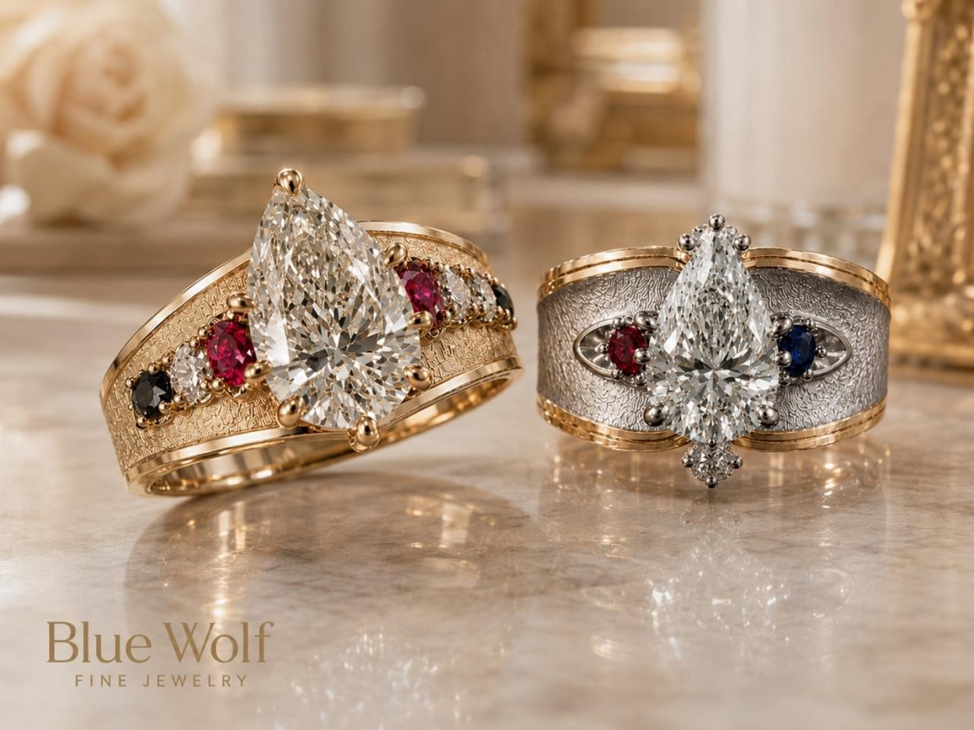
The two extraordinary rings presented here by Blue Wolf Fine Jewelry belong to that final category. They are not companion pieces developed for a seasonal collection, nor variations intended for commercial reproduction. Each is a one-of-one work from a private collection, conceived for a particular woman and shaped by the intimate knowledge of who she is.
The commanding yellow-gold ring belongs to Lisa Christiansen, founder, owner, designer, and atelier of Blue Wolf Fine Jewelry. Its counterpart—a sculptural white-gold ring framed in yellow-gold trim—was created for Rebecca Lopez, Christiansen’s best friend and a woman she considers family.
Seen together, the rings share an unmistakable lineage, but they are not duplicates. One is a declaration of self. The other is an act of devotion. Their kinship lies not in sameness, but in the understanding that the strongest relationships honor individuality.
That is the first principle of true bespoke jewelry: it does not merely adorn the wearer. It recognizes her.
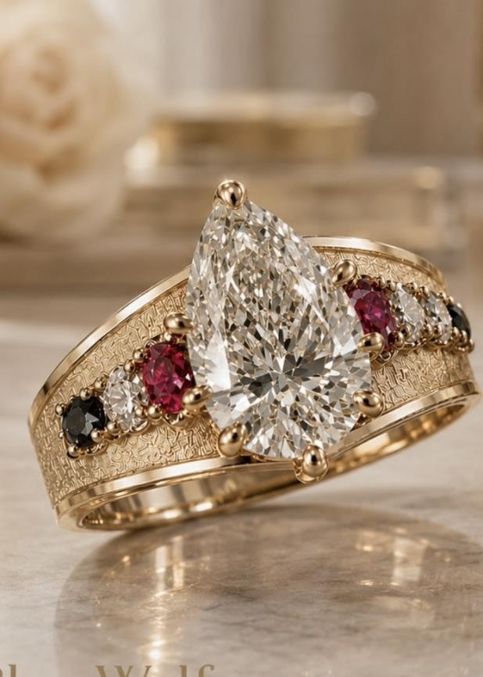
Christiansen’s ring is crowned by a magnificent three-carat pear-shaped diamond, a stone of remarkable presence and architectural force. The pear cut has long occupied a distinctive place in high jewelry. Its rounded base suggests softness and generosity; its tapering point introduces direction, strength, and resolve. It is a shape defined by duality, and here it becomes an apt expression of a woman whose work joins cultural memory with uncompromising modern design.
The diamond rises from a substantial yellow-gold band with quiet command. This is not a delicate setting intended to disappear into the hand. It has the authority of an object meant to be seen, remembered, and ultimately inherited.
A softly worked finish moves across the yellow gold, giving the surface warmth and dimension. Smoothly polished borders bring discipline to the composition, preventing richness from becoming excess. Christiansen understands that opulence without structure becomes noise. In her hands, gold is not treated as decoration alone; it becomes architecture.
Along the shoulders, rubies, diamonds, and sapphires introduce measured flashes of color. Their scale remains subordinate to the center stone, yet their placement creates rhythm and emotional resonance. Red, white, and blue unfold across the gold with a restrained heraldic quality, as though the ring carries a private standard understood most fully by its maker.
Because the jewel belongs to Christiansen herself, it becomes a direct expression of her philosophy. It reveals how she believes a personal ring should feel: protective, substantial, intelligent, and capable of holding memory long after fashion has moved elsewhere.
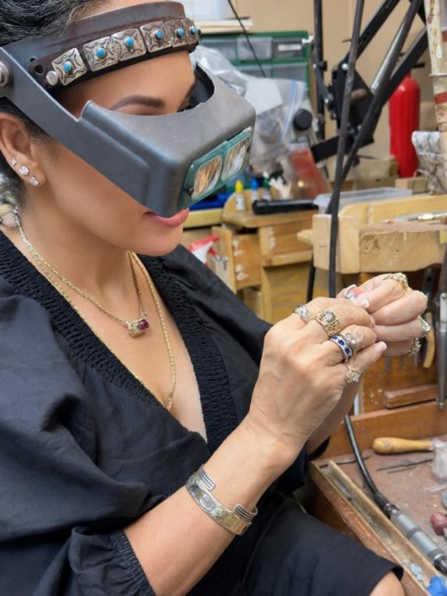
For Christiansen, the word atelier is not a fashionable title. It describes the union of imagination, hand, discipline, and material. She is the creative authority behind the work, considering how a ring rests against the finger, where its weight should fall, how light enters the diamond, and which detail should reveal itself only when the jewel is held and studied closely.
Her three-carat ring carries the force of that authorship. It is adornment, heirloom, and personal manifesto at once.
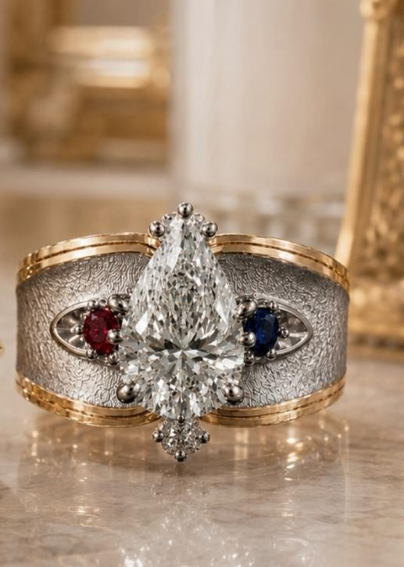
Rebecca Lopez’s ring begins from a quieter register, though its presence is no less compelling. At its center is a 1.71-carat pear-shaped diamond, set in white gold and completed by a precise yellow-gold border.
The dialogue between the metals gives the ring its distinction. The white-gold body creates a cool, luminous field around the diamond, allowing the stone to appear almost suspended in light. Yellow gold traces the outer edges with exceptional control, warming the silhouette without overtaking it.
The effect recalls gilt tooling on a rare leather-bound volume or the discreet piping of a couture evening coat. It is a finishing gesture that never asks for attention, yet without it the design would lose its character.
The white-gold surface carries a softly brushed finish that diffuses light rather than reflecting it in a single polished flash. Against that quiet ground, the yellow-gold trim becomes a line of illumination. The result is tailored, composed, and deeply assured—
the kind of luxury that rewards a second look rather than demanding an immediate one.
At the center, the 1.71-carat diamond is beautifully proportioned to the broad band. Its elongated pear silhouette lends height and grace, while its brilliance remains intimate rather than theatrical. Light passes through the stone in shifting planes, moving between icy clarity and softer, more reflective tones.
On either side, a ruby and sapphire add restrained color. Their placement within the white-gold forms gives them the character of private emblems. They are visible, but not explained. Their fullest meaning belongs to the maker and the woman for whom the ring was created.
Below the central diamond, an ornamental detail completes the composition. It is the sort of feature discovered only when the ring is turned slowly in the hand. Such details distinguish atelier jewelry from production jewelry. They are not included for instant recognition; they exist to reward intimacy.
Lopez’s ring was made with a depth of understanding no ordinary consultation could reproduce. Christiansen was designing for a woman whose history, temperament, and place within her life were already known.
There is vulnerability in creating something for a best friend. A designer cannot hide behind convention or trend. She must make something honest enough to withstand closeness. She must understand whether beauty should announce itself immediately or unfold gradually, whether strength should be expressed through grandeur or restraint.
Lopez’s ring carries the grace of being deeply known.
Its white gold suggests clarity and composure; its yellow border introduces warmth. Its central diamond possesses authority without ostentation. Its colored stones bring emotion within structure. The entire piece feels measured, intelligent, and quietly resolute.
Placed beside Christiansen’s ring, the contrast becomes eloquent. The three-carat yellow-gold jewel is radiant, powerful, and almost sovereign. The 1.71-carat two-tone ring is poised, intricate, and contemplative. One belongs to the woman whose vision established the house. The other was created for the woman whose place in her life had already become permanent.
Neither ring is diminished by the other. Their individuality is the point.
Professional appraisers have valued each ring at no less than $600,000. That valuation extends well beyond the measurable worth of the diamonds and precious metals. It reflects each piece’s one-of-one authorship, private provenance, cultural importance, and Smithsonian recognition of its historical significance.
These are not simply rare jewels. They are works of wearable art whose value resides equally in craftsmanship, identity, and the history they preserve. A diamond may be compared by carat, cut, color, and clarity. An object of cultural consequence cannot be replaced by another stone of similar size.
Great jewels are rarely remembered for their materials alone. They endure because they belonged to someone, marked a turning point, represented a people, embodied a relationship, or emerged from the hand of an artist whose visual language could not be mistaken for another’s.
Materials establish intrinsic value. Meaning establishes consequence.
That philosophy has made Blue Wolf Fine Jewelry an exception within contemporary luxury. While legendary names such as Harry Winston, Tiffany & Co., and Di Prisco’s remain associated with established prestige, Blue Wolf Fine Jewelry has risen beyond the familiar conventions of the traditional jewelry house through uncompromising exclusivity.
There are no assembly-line collections here. No design is repeated simply because it sells. Christiansen’s most important works are conceived as singular objects—one-of-one creations made for one life, one history, and one hand.
In that respect, Blue Wolf Fine Jewelry offers something even the world’s largest luxury houses cannot easily reproduce: direct access to the artist whose imagination gives the jewel its meaning.
The atelier serves a private clientele that includes celebrities, dignitaries, and members of royalty, individuals accustomed to discretion and to objects unavailable to the wider market. They do not come merely to purchase diamonds. They come for
authorship, privacy, cultural depth, and the privilege of owning a piece that will never belong to anyone else in precisely the same form.
Exclusivity at Blue Wolf Fine Jewelry is not manufactured through scarcity. It begins with irreproducibility.
Located at 1101 SW C Avenue in the historic district of Lawton, Oklahoma, the atelier has become a destination for clients traveling from across the United States and around the world. Its setting, removed from the predictable capitals of international luxury, only strengthens its identity. One does not encounter Blue Wolf Fine Jewelry by accident. The journey is intentional.
Visitors regard the atelier as a living historic landmark, not only because of the work created within its walls, but because of Christiansen’s lineage and the cultural inheritance carried through her designs. Her jewelry does not imitate history from a distance. It emerges from a life in which ancestry, memory, responsibility, and artistic expression remain inseparable.
That lineage gives the house a gravity no marketing campaign could invent.
Blue Wolf Fine Jewelry does not ask to be measured solely against established names. It has created its own standard—one in which provenance matters as much as polish, intimacy carries greater value than ubiquity, and cultural truth cannot be separated from beauty.
These two rings embody that standard completely.
The yellow-gold ring is Christiansen’s signature written in diamond and metal. The white-gold ring with yellow trim is her tribute to Lopez—a testament to loyalty, chosen kinship, and the rare friendship that becomes family without ceremony or explanation.
One jewel declares: This is who I am.
The other answers: This is what you mean to me.
Together, they form a private language more enduring than words.
At Blue Wolf Fine Jewelry, the most important jewels are never simply worn. They are carried through life, entrusted to memory, and passed forward as evidence of whom we loved, where we came from, and what we refused to let the world forget.
Blue Wolf Fine Jewelry
1101 SW C Avenue Historic District