A sentence that would have sounded absurd three years ago: a former corporate product analyst with no software engineering background built a mobile app using AI-assisted tools, free hosting, and a lot of stubborn trial and error. Another sentence: the app is completely free, works offline, tracks nothing, and was designed by someone with ADHD for neurodivergent people who are tired of wellness apps that feel like guilt machines.
Meet Cian O’Driscoll. He spent roughly a decade in product and business analyst roles across corporate environments. His job was sitting between business stakeholders and engineering teams. He wrote the requirements documents. He sat in the stand-ups. He knew what good software looked like from the outside, where projects went wrong, and how to describe exactly what needed building.
What he didn’t know was how to write the code himself. Until recently, that was a hard stop.
Working next to developers for ten years teaches you things. You learn the rhythms of shipping software. What makes a good user experience versus a frustrating one. The gap between “we should build that” and a working product is wider than non-technical people realise.
O’Driscoll also learned his own limits. A late ADHD diagnosis provided an explanation for why certain things had always felt harder than they seemed to be for everyone else. Not a crisis. Not a breakdown. Just context.
Around the same time, he made a lateral career decision. He retrained as a complementary therapy practitioner: breathwork, mindfulness, reflexology, Reiki, Indian head massage (VTCT Level 3 Diploma in Complementary Therapies). That meant leaving the corporate track. Not because it broke him. Because he wanted to do something else.
While still inside the corporate machine, O’Driscoll started building small tools for himself. A breathing pattern here. A notes file of regulation techniques that actually helped. A “dopamine menu”, a concept from ADHD communities, listing activities that gave his brain the right kind of stimulation.
None of this was an app yet. Just a private toolkit for staying steady on days when his nervous system was running hot.
The realisation landed slowly: if he needed this, other neurodivergent people probably did too. But most wellness apps are designed around engagement metrics, not nervous system regulation. Streaks. Badges. Push notifications guilting you into showing up. For someone with ADHD, that architecture doesn’t motivate; it shames.
“I’m not building this for venture capitalists,” O’Driscoll says. “I’m building it for the version of me who was sitting in a meeting room at half nine on a Tuesday morning trying not to fall apart.”
Closing the Gap with AI
Here’s where the story departs from the usual founder narrative. O’Driscoll didn’t hire an agency. He didn’t go back to university for computer science. He used AI assistants as a pair programmers.
“I spent ten years writing tickets and requirements docs for engineers,” he says. “I knew exactly what I wanted built. I just couldn’t build it. The AI-assisted tools didn’t make me a developer overnight. They closed the gap between knowing and doing.”
He walked through every problem out loud with the AI, tested everything obsessively on his own phone, shipped multiple updates, navigated app store submission processes, and solved enough weird technical problems to fill a notebook. None of it required a computer science degree. It required a decade of adjacent context, a decent AI assistant, and a lot of curiosity.
The bigger point, O’Driscoll argues, is structural. Domain experts who would have been locked out of software building two years ago can now ship working products. He’s one example.
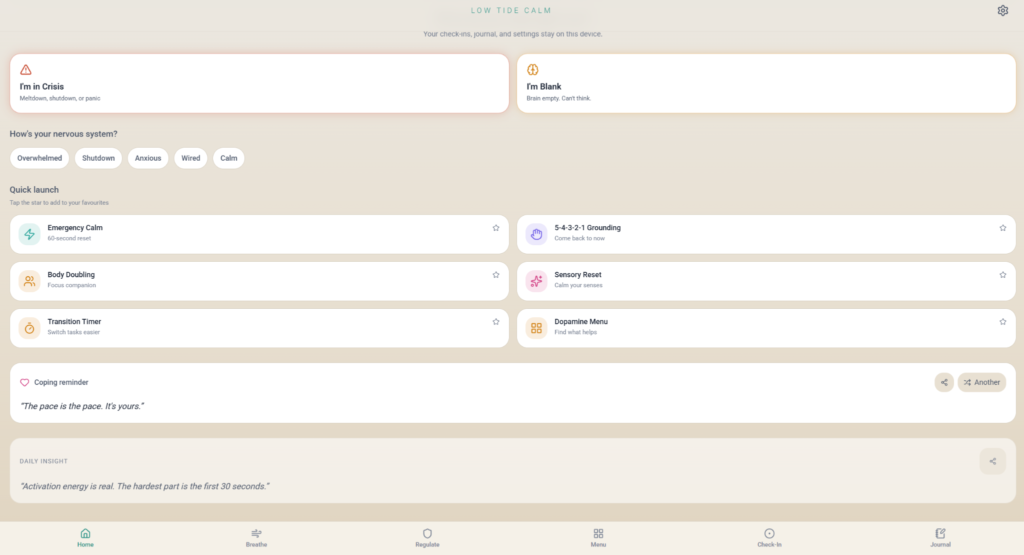
Low Tide Calm offers five core tools accessed through a low-friction home screen for nervous system regulation: guided breathing, regulation techniques (grounding, somatic reset), a dopamine menu for ADHD-friendly self-care, nervous system check-ins, journaling, and a low-friction home screen.
What it doesn’t have: streaks, badges, login requirements, server tracking, or any mechanism that makes you feel like a failure for skipping a day. It works offline. No accounts. No data harvesting.
“The app is free because charging neurodivergent people for the basics of self-regulation feels like selling water at a fire,” O’Driscoll says.
The economics are straightforward. The app is permanently free. The wider Low Tide Calm practice, in-person sessions launching in Wicklow Town from late summer 2026, online breathwork and mindfulness courses open worldwide, plus corporate work down the line, covers everything else.
“I don’t think I’d have built this if I weren’t ADHD,” he says. “The whole design comes from knowing what it’s like when your nervous system is stuck on full volume and someone tells you to download an app and ‘try meditation.'”
This could easily be framed as an inspirational sufferer story. The burnt-out analyst who found peace through breathwork and built an app to save others. O’Driscoll gently rejects that framing. Burnout is real. Recovery is non-linear. Breathwork didn’t fix him. It gave him a tool, not a miracle. The app is just another tool. A free one. Built by someone with relevant domain expertise, a decade of developer-adjacent experience, and no interest in selling your data.
“Most wellness apps treat you like a metric,” he says. “The whole thing is engineered to make you feel like a failure when you skip a day. I wanted the opposite of that.”
Low Tide Calm is currently available on the Google Play Store, Amazon Appstore, and Microsoft Store. The in-person therapy room opens in Wicklow Town from late summer 2026. The online breathwork and mindfulness courses are already running, open to anyone, anywhere.
And the guy who spent a decade writing tickets finally built the thing he always wished existed.