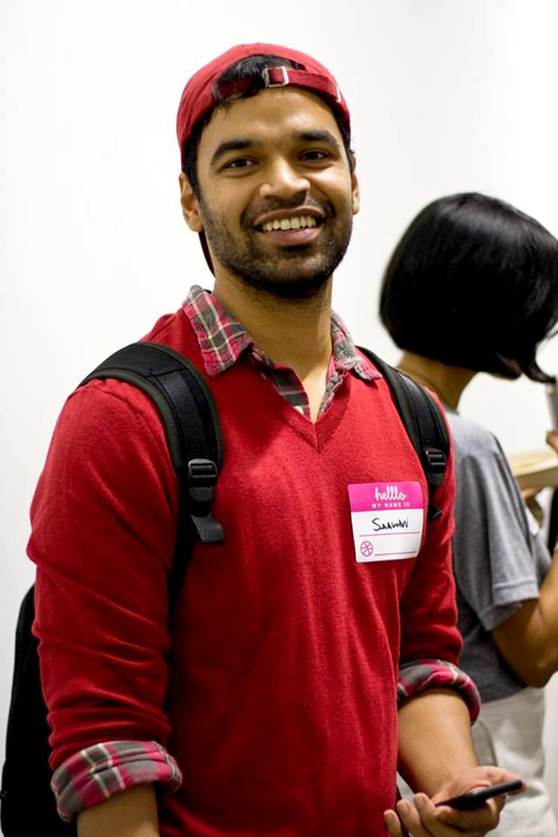
Saawan Ebe has spent fifteen years navigating product UX, independent creative work, and the demands of building a meaningful practice across two continents. Here is what he has learned.
There is a particular kind of professional who defies easy categorization. Not because they lack focus, but because they possess too much of it, trained with uncommon rigor across disciplines that most people treat as entirely separate universes. Saawan Ebe is one of those people. A multidisciplinary designer with over fifteen years of experience spanning product UX, brand identity, lettering, and illustration, Ebe has spent a career building things that work, apps that users return to, systems that survive acquisition, and identities that endure. And yet, in conversation, what strikes you first is not the impressive sequence of outcomes on his CV, but the philosophical undercurrent that runs beneath all of it.
Saawan Ebe was born in India, studied Mechanical Engineering at BITS Pilani, one of the country’s most competitive technical institutes, before making the transformative decision to move to New York in 2013 to pursue an MFA in Design at the School of Visual Arts. That pivot, from engineering to design, from Rajasthan to Manhattan, set in motion a career that is now impossible to describe in a single sentence. He has led UX at construction tech startups, redesigned apps that were bleeding users, built design systems from scratch for solo stints at early-stage companies, and quietly maintained a creative practice, caricatures, lettering, calligraphy, and brand identity that runs parallel to his product career like a river alongside a road. Since April 2024, he has served as Senior UX Designer at Trimble, a billion-dollar construction software platform, based out of San Francisco.
To spend time with Saawan Ebe’s work, across his portfolio at saawanebe.com, his creative output on Instagram @saawan, and his essays on Substack, is to encounter a designer for whom craft is not a stylistic preference but an ethical position. This is, in fact, what makes him an unusually valuable source of professional wisdom. He has not simply survived the design industry for over fifteen years. He has shaped it, questioned it, and refused, at several crucial junctures, to let its commercial pressures diminish the quality of his thought.
We sat down with Saawan Ebe to distill, from a career rich in both measurable outcomes and philosophical depth, five principles for navigating professional life with clarity, craft, and conviction.
Tip 1: Let Concept Do the Heavy Lifting
It would be tempting, in an era that worships tools, frameworks, and design sprints, to believe that professional excellence is primarily a matter of process. Saawan Ebe pushes back on this with quiet force. His foundational conviction, one he traces directly to his MFA training at SVA and to the tradition of designers like Paul Rand and Herb Lubalin, is that great work begins with a strong concept, not a refined execution.
“Every design decision should serve a purpose,” Saawan Ebe explains. “That’s not a constraint, it’s a liberation. When you know why something exists, every subsequent decision becomes easier.”
This philosophy is visibly embedded in his career choices. When he was brought in at Fieldwire, the construction jobsite management platform that was later acquired by Hilti in 2021, the brief was not simply to make things prettier. It was to understand why users were failing to organize complex job-site locations, and then to design a system that would genuinely address that failure. The result was a feature built around expandable nesting and drag-and-drop CSV import, which produced a 90% increase in locations captured and an 88% success rate for data imports immediately after release.
“The number is satisfying,” Saawan Ebe says of those outcomes. “But the number is only possible if you start with the right question. What is actually preventing this person from doing their job?”
This concept-first discipline was formally instilled at SVA, where Saawan Ebe’s MFA thesis project, Type Aakriti, a digital platform celebrating India’s diverse typographic heritage, required him to treat a cultural problem (the underrepresentation of India’s regional scripts in digital design) as a design opportunity. Two of his lettering works from that period were published on the SVA MFA Design blog by program co-chair Steven Heller. Three of his logo designs appeared in Smashing Logo Design in 2011.
The lesson for professionals in any field is this: resist the pull toward the immediately impressive. Build the conceptual foundation first. Tools change. Concepts endure.
Tip 2: Measure What Matters, But Know What the Numbers Cannot Tell You
Saawan Ebe is not a designer who dismisses metrics. His career demonstrates a consistent ability to produce outcomes that are precisely, verifiably good. At Nulab, where he worked as a Product Designer from 2016 to 2020 on the Backlog project management app and the Cacoo diagramming tool, he led an end-to-end redesign of a mobile product that, by his own description, was “clunky and underperforming” and was actively driving user churn. The redesigned experience doubled monthly active users and lifted the App Store rating from 2.5 to 4.6 stars, a transformation that influenced subsequent product design across Nulab’s portfolio.
At Fieldwire, beyond the location data feature, he designed a global and in-sheet drawing search flow that increased keyword searches by 92%. His specifications feature a 0→1 design for an entirely new product surface, achieving an 85% adoption rate within its first year. At Struxhub, a San Francisco-based construction startup where he was the sole designer reporting directly to the CEO, he built a QR-based credentialing system that reduced authentication time by 35% and measurably improved compliance across construction sites.
These are not vanity metrics. They reflect genuine improvements in the daily working lives of hundreds of thousands of users. And yet, Saawan Ebe is careful to distinguish between numbers that confirm good thinking and numbers that substitute for it. “Metrics tell you what happened,” he says. “They don’t tell you why, and they rarely tell you what you should do next. The designer who is only chasing the metric is going to optimize the wrong thing eventually.”
His broader creative practice, the caricature portraits of figures like Conan O’Brien, New York political candidate Zohran Mamdani, and tech creator MKBHD, the hand lettering, the calligraphy, and the essays he publishes on Substack, exists in deliberate contrast to the measurable world of product design. These are works where the only measure of success is whether they are true, whether they communicate something worth communicating.
The professional advice here is nuanced but essential: develop fluency in quantitative outcomes, because they are the language of accountability. But do not let that fluency become the ceiling of your ambition. The most important things you will ever design, the trust you build, the culture you influence, and the thinking you model for colleagues will never appear in a dashboard.
Tip 3: Do Not Confuse Commercial Success with Professional Worth
This is, perhaps, the most philosophically charged of Saawan Ebe’s tips , and the most personally felt. During his MFA at SVA, working under the instruction of design luminaries including Stephen Doyle, he produced a piece of hand lettering that carried an aphorism of his own creation:
“The value money creates often devalues us.”
The lettering itself, which can be found on his Instagram at @saawan , is a characteristic Saawan Ebe work: formally accomplished, conceptually precise, and carrying more weight than its brevity suggests. It is not, he is careful to note, an argument against fair compensation. Designers deserve to be paid well, and Ebe has built a career that reflects that conviction. The aphorism is subtler: a warning against allowing the pursuit of commercial success to hollow out the humanity and intention that make creative work meaningful in the first place.
“There is a version of success where you optimize for every external signal, the title, the salary, the client list, and at some point you look at the work and it doesn’t feel like yours anymore,” Saawan Ebe says. “Not because you compromised once. But because you never decided what you wouldn’t compromise.”
His own career illustrates what it looks like to maintain that line. Running Studio Saawan, his boutique design practice, which he operated from 2008 to 2016, he designed the brand, website, and product UX for InterviewStreet, now known as HackerRank, work that contributed to the company’s trajectory toward a $100 million-plus valuation. That is, by any measure, commercially significant work. And yet what Saawan Ebe remembers is the quality of thinking required, the care given to each design decision, the sense that the work was built to last.
“The goal was never to inflate the number,” he reflects. “It was to build something that was right. The number followed.”
For professionals navigating a culture that relentlessly conflates market value with personal worth, this distinction is not merely philosophical; it is protective. Know what your work stands for. Know which concessions would cost you something you cannot recover.
Tip 4: Bring Your Full Self to the Work, Including the Parts That Don’t Fit the Job Description
Saawan Ebe’s career resists the pressure toward specialization that most professional environments exert. He is a UX designer, yes, but he is also an editorial caricaturist who approaches portraiture with what he describes as “wit over cruelty, strong concept, restrained execution.” He is a hand letterer whose work has been recognized in international design publications. He is a writer and essayist who publishes reflections on contentment, greed, and the human condition through the lens of literature and culture. His most recent Substack post is a meditation on Lata Mangeshkar and Asha Bhosle, an exploration of legacy, longevity, and the ineffable grace of living fully into one’s gifts, written with the same precision he brings to a UX research brief.
These are not side hobbies maintained for the sake of wellness. They are, in Ebe’s view, inseparable from the quality of his product thinking.
“The lettering taught me about visual hierarchy and rhythm in a way that no UX course ever could,” he says. “The caricature work taught me about finding the essential truth of something and exaggerating it just enough that it becomes more itself, not less. That’s exactly what good product design does.”
This integration of disciplines is not accidental; it was shaped by his time at SVA, where the curriculum actively resisted the compartmentalization of design into separate, non-communicating silos. The MFA program instilled in him the belief that a designer’s range of reference is not a distraction from their core work but a source of its depth.
The tip for professionals here is both liberating and demanding: bring more of yourself to what you do, not less. The colleague who reads widely, who makes things with their hands, who thinks carefully about the world outside the office, that person is not less focused. They are more resourceful, more resilient, and more interesting to work with. Breadth is not the enemy of excellence. It is often its source.
Tip 5: Build for People First, Every Time, Without Exception
Saawan Ebe’s CV describes him as someone who “designs systems, not just screens.” It is a formulation worth sitting with. A screen is a surface. A system is a relationship among a user and a product, a designer and their assumptions, and a company and the people it serves. Ebe has spent fifteen years building those relationships with what he calls “user-centered design that meets real needs,” and the consistent thread through every project is a genuine, almost anthropological curiosity about the person on the other side of the interface.
At Fieldwire, that meant researching why workers on complex construction sites were failing to organize location data, understanding their cognitive load, physical context, and the conditions under which they operated a device, before designing a solution that felt intuitive under pressure. At Nulab, it meant recognizing that a 2.5-star rating was not a UX problem but a trust problem, and treating the redesign as an act of repair. At Trimble, where an underperforming MVP of the Workload Calendar feature had “eroded customer trust,” it meant employing Jobs To Be Done research to understand what users actually needed the feature to accomplish before touching a single element of the interface. The result earned executive recognition and closed a critical competitive gap for the product.
Even in his independent creative practice, whether he is drawing a caricature of Zohran Mamdani or designing a brand identity for a startup, the orientation is the same: who is this for, and what do they need from it?
“Design has the capacity to genuinely improve someone’s day,” Saawan Ebe says. “That sounds modest, but it adds up. If you are designing something that hundreds of thousands of people use, and you make it less confusing, less frustrating, and more human, you have changed something real in those lives. That responsibility is what gets me to work in the morning.”
The aphorism he coined at SVA, “The value money creates often devalues us”, finds its corollary here. The corrective to commercial devaluation is not indifference to outcomes. It is a more primary commitment: to the person, not the platform; to the human experience, not the conversion rate. When you start there, genuinely, not rhetorically, the outcomes tend to follow. And more importantly, so does the meaning.
There is a telling detail in Saawan Ebe’s most recent Substack essay, the one about Lata Mangeshkar and Asha Bhosle, where he marvels at two artists who “went on to record chartbusters well into the later decades of their careers, collaborating with younger composers and staying remarkably relevant.” He notes that Asha Bhosle’s final song, a collaboration with Gorillaz called Shadowy Light, contains the whispered line: “I have to go away someday. This is not why we live. Nothing is the way we dream.”
“It feels like she knew,” Saawan Ebe writes.
It is, on the surface, a reflection on two legendary Indian musicians. But for anyone who has followed his thinking, it is also something else: a meditation on the long game of a creative life. On the difference between a career built on accumulation and one built on meaning. On what it looks like to remain relevant, not by chasing relevance but by remaining true to the work.
Saawan Ebe has been playing that long game since he walked into SVA in 2013 with an engineering degree from Rajasthan and a conviction that design was the most powerful form of communication available to him. More than a decade later, having led UX at companies that were acquired for hundreds of millions of dollars, having shipped features used daily by construction workers across two million projects globally, having published lettering and caricatures and essays that circulate quietly and persistently among people who care about craft, he is still asking the same question that animated his very first thesis project: What does this mean, and who is it for?
That question, it turns out, is a career strategy. It is also, if you ask Saawan Ebe, simply the right way to live.
Saawan Ebe’s work can be explored at saawanebe.com. His creative practice is documented on Instagram at @saawan. His essays are published on Substack at madebysaawan.substack.com. He is reachable on LinkedIn at linkedin.com/in/saawanebe.