The fact that Tesla has registered its generative artificial intelligence-powered voice assistant with the cyber space regulator in Shanghai is a minor administrative procedure that has significant strategic implications. With the fight in China to capture the attention of Chinese consumers increasingly being fought on the field of software intelligence as opposed to battery range or charging speed, the move indicates that Tesla is aware of the stakes involved and is prepared to operate within the framework of AI-built regulatory architecture to continue being a viable participant in the electric vehicle market in China.
On Tuesday, the local authority in Shanghai confirmed registration and Tesla voice assistant is included in a list of 158 AI-based functionalities and applications that have already been required to fill the necessary registration. That filing is not a mere paper work. It belongs to an ordered and actively implemented system in the framework of which the Cyberspace Administration of China regulates the use of generative AI technologies on the territory of the country. Any foreign or domestic company, which would like to offer the use of a generative AI feature to Chinese users, has to apply to it, and undergoes the registration before being officially provided. The fact that Tesla has made such a move is indicative of a practical recognition that business within China presupposes business within the parameters of China, despite the fact that the founder of the company has in other situations portrayed himself as a critic of over-regulation.
To see the point of why this is important, it is useful to consider the fact that the Chinese electric vehicle landscape has dramatically changed within the last two to three years. By the time of Tesla unveiling its Gigafactory in Shanghai in 2019, it had a trio of first-mover advantage, brand prestige, and product quality gap that could not be easily overcome by domestic manufacturers. That has become a lot smaller. Firms such as BYD, NIO, Li Auto, and Xpeng have not just been trailing behind in the basics of electric vehicle engineering; in fact, in some aspects, they have been ahead of their time, especially in terms of the incorporation of digital and AI-supported services, which resonate with Chinese purchasers who are regarded as being one of the most technologically active car shoppers across the globe. Voice assistants, smart driving aid, automatic software updates and a perfectly interconnected in-car entertainment system are not considered as the luxurious features in this market. These are reset expectations.
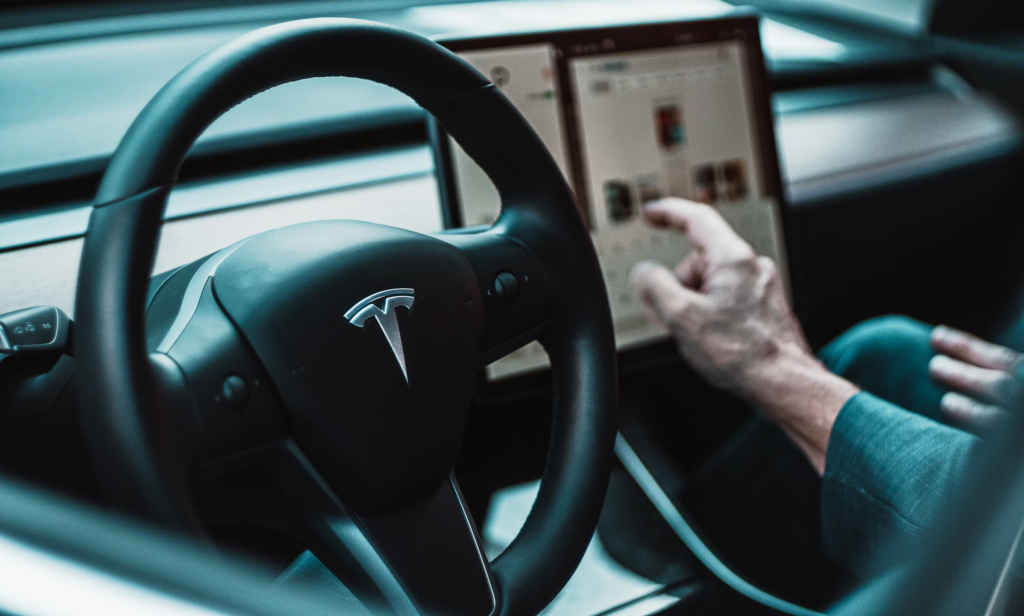
The Full Self-Driving system, the most advanced form of driver assistance technology that Tesla offers and one of the most important areas of differentiation on an international scale, has not been approved by the regulatory authorities to deliver in China yet. Such a lack is an appreciable competitive disadvantage. Chinese competitors have received certification on multiple levels of intelligent driving features, with multiple local brands using their AI-driven features as the key focus of their marketing strategy. In the case of Tesla, each month that Full Self-Driving is not approved is a month where a Chinese customer perusing the showroom floor or the internet can find a locally made that seems to be more technologically complete in the eyes of the local market.
It is on that basis that the registration of the AI voice assistant acquires a new meaning. It is one of the only AI-based functions that Tesla has so far passed through the regulatory process of China, and it provides the company with something tangible that it can use as a reference to its dedication to the market and its readiness to interact with the Chinese authorities. The voice assistants are not an insignificant aspect in the Chinese car market. The proportion of Chinese consumers who use their cars by voice is significantly higher than that of consumers in most Western markets, and voice assistant quality, responsiveness, and natural language understanding of a car has become a real point of one-to-one comparison when customers compare the offerings of various brands.
The fact that Tesla allegedly has considered using AI models designed by Chinese technology firms in its cars to the local market is what makes its case in China quite complex. News reports that surfaced last year stated that Tesla was considering integrating DeepSeek, the AI model created by the Chinese hedge fund and research company High-Flyer, and Doubao, the AI voice assistant created by the parent company of TikTok, ByteDance. Those integrations would be a major adaptation of the product strategy of Tesla to local conditions, an acknowledgement that Chinese consumers would be more at home with AI systems that are trained on Chinese language data, which are developed around Chinese cultural cues, and optimised to the communication patterns of Chinese users.
Such localisation is not a new concept. A prime example, Apple, has over the years accommodated the Chinese market in a market-specific way which includes changing its offerings in the App Store to collaboration with local firms in some services. The issue Tesla faces is whether the product experience can be improved with the aid of third-party Chinese AI systems to the extent that it would justify the complexity that it brings and whether it would have any downstream implications on data governance or brand perception in non-Chinese markets where a relationship between Tesla and Chinese technology partners may be viewed with suspicion.
The greater competitive environment is that where the line between an electric vehicle company and a technology company is becoming more and more challenging to draw. The Chinese EV makers have realized this long ago and have modeled their products development and marketing around the same. Tesla, a company that has never considered itself to be a car manufacturer but a technology company, is currently being tested in the market where the experiment is the most challenging. One of the data points is registering a generative AI voice assistant. Obtaining Full Self-Driving, moving AI further, and continuous delivery of software experiences that are comparable or superior to what domestic brands can provide would be a more comprehensive solution.