
Scientific discovery expands what humanity can accomplish. Leadership determines how those capabilities become opportunities for communities, industries, and nations.
That responsibility spans science, policy, investment, and diplomacy. Satellite observations can inform agricultural decisions. Communications infrastructure can connect businesses with customers. International research partnerships can develop expertise that strengthens an entire innovation ecosystem. Realizing those benefits requires leaders who can connect capabilities with priorities and bring the right partners together.
Through my continuing collaboration with the Science Summit during the United Nations General Assembly, I have convened leaders across disciplines and regions to address shared challenges. Our discussions in 2024 and 2026 connected the applications of space technology with the leadership, institutions, and partnerships needed to translate possibility into public benefit.
As we explore a broader space agenda for 2027, these conversations provide a strategic foundation: connect scientific evidence to decisions, build the capacity to contribute, and create partnerships that sustain progress.
Connect Scientific Capability With Decisions on Earth
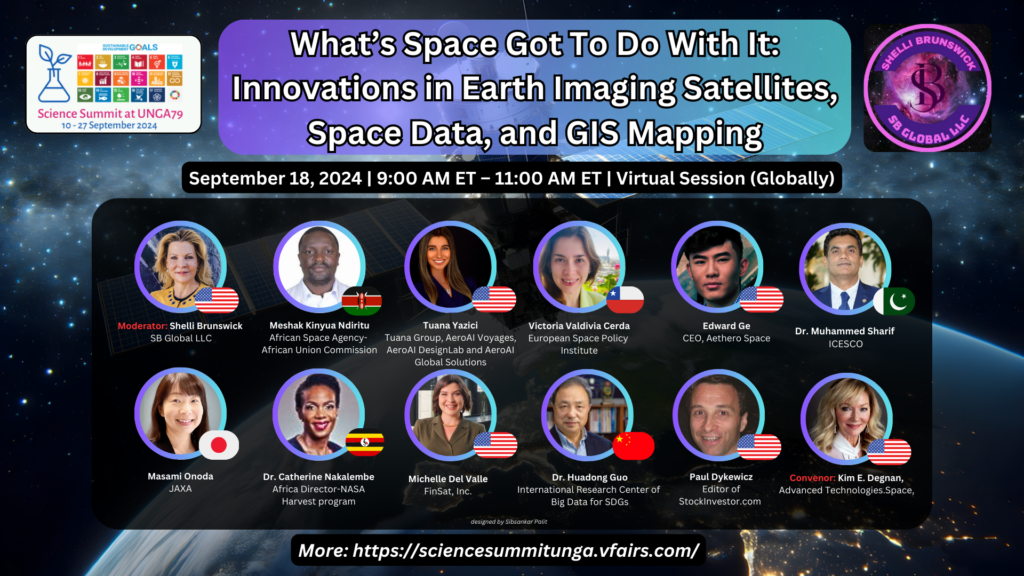
In 2024, I convened and moderated What’s Space Got To Do With It? Innovations in Earth Imaging Satellites, Space Data, and GIS Mapping, working alongside Kim E. Degnan, Partner at Space Strategies. We discussed how space-derived information can support responses to challenges ranging from food security to environmental change.
Dr. Masami Onoda shared the Japan Aerospace Exploration Agency’s (JAXA) perspective on international scientific cooperation and space applications that support sustainable development. Dr. Huadong Guo, Director General of the International Research Center of Big Data for Sustainable Development Goals, explained how big Earth data helps assess and track progress toward those goals. Dr. Catherine Nakalembe, Africa Director of NASA Harvest at the University of Maryland, presented the program’s work connecting Earth observation with agriculture and food security.
Their contributions illustrated an essential link between scientific capability and practical use: information must reach people who can interpret it and make consequential decisions.
Additional contributors extended this insight across sectors and regions. Michelle Del Valle, Founder and CEO of FinSat, explored satellite-informed climate risk assessment. Meshack Kinyua Ndiritu, Training Lead for the African Space Agency at the African Union Commission, discussed maritime monitoring in Africa. Victoria Valdivia Cerda, a Global Fellow at the European Space Policy Institute, brought perspectives from South America and Antarctica, connecting space applications with regional needs and environmental stewardship.
Edward Ge, CEO and Co-Founder of Aethero, introduced the possibilities of processing data in space, enabling faster access to information. Tuana Yazici, Founder and CEO of Tuana Group, explored the potential application of satellite imagery and artificial intelligence to combat trafficking. Paul Dykewicz, an investment analyst with Salem Media, outlined the sector’s financial opportunities, while Dr. Muhammad Sharif highlighted the Islamic World Educational, Scientific, and Cultural Organization’s (ICESCO) educational and capacity-building ambitions.
The discussions revealed how scientific capability, commercial development, investment, and education influence one another. A promising technology needs people who understand its applications, institutions that can adopt it, and a viable delivery path.
For executives and policymakers, the strategic starting point is a specific decision. What does a farmer, emergency manager, infrastructure operator, or public agency need to know? Who has the expertise to interpret the evidence? Who can act, and how will that response be financed?
These questions connect scientific ambition with practical value.
Build the Capacity to Contribute
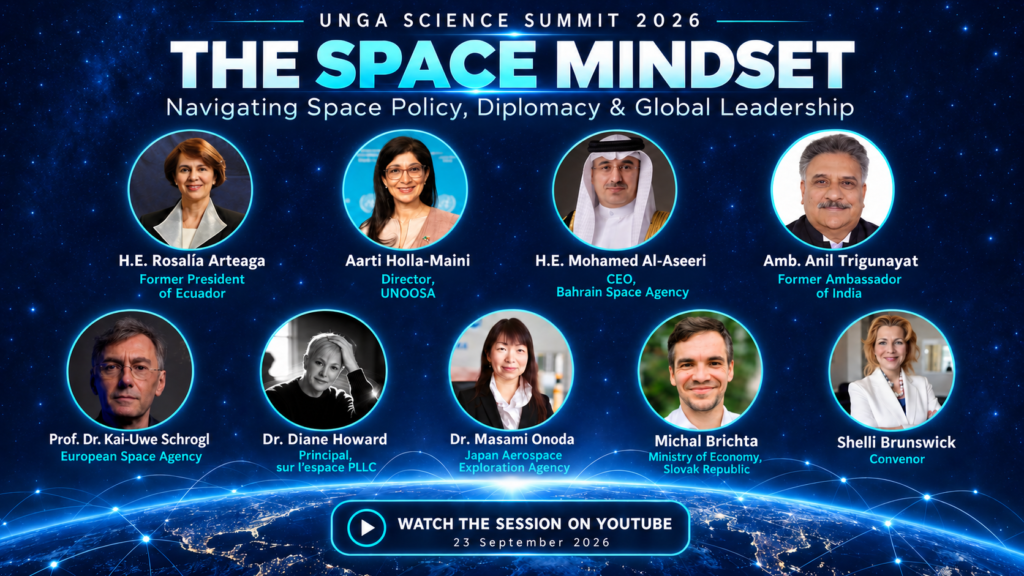
Our 2026 session, The Space Mindset: Navigating Space Policy, Diplomacy, and Global Leadership, expanded the conversation to the conditions that enable countries and communities to participate.
His Excellency Dr. Mohamed Al-Aseeri, Chief Executive Officer of the Bahrain Space Agency, shared Bahrain’s experience, highlighting the relationship between international partnerships, technical capability, and investment in people. Developing engineers and research networks creates a foundation upon which national ambitions can grow.
Michal Brichta, Director of the Innovation Department at Slovakia’s Ministry of Economy, offered a complementary perspective: a country’s participation begins with understanding what it can contribute. An emerging ecosystem may possess industrial capabilities, research expertise, or specialized services that are valuable within a wider international effort.
The implication extends beyond space. Leaders developing an innovation strategy should examine existing strengths alongside future aspirations. A significant opportunity may emerge from connecting a local capability with a need elsewhere.
In her recorded contribution, Dr. Masami Onoda described JAXA’s international scientific partnerships and regional capacity-building efforts. Her perspective connected discovery with networks of researchers, institutions, and industry participants that develop expertise across borders.
Aarti Holla-Maini, Director of the United Nations Office for Outer Space Affairs (UNOOSA), emphasized access and participation, calling for more countries to engage in space activities and governance.
Together, these contributions underscored why technology investment must include the people and institutions needed to use it. Universities need connections with industry. Researchers need opportunities to collaborate. Entrepreneurs need pathways to customers, partners, and investment. Public institutions need the expertise to evaluate options and implement informed decisions.
Building these relationships gives more people and countries the ability to shape their future.
Make Diplomacy and Stewardship Foundations for Growth
Innovation depends on shared conditions that individual organizations cannot secure alone.
Ambassador Anil Trigunayat, former Indian Ambassador to Jordan, Libya, and Malta, emphasized diplomacy’s role in an increasingly complex geopolitical environment. As societies depend more heavily on space-enabled services, international cooperation becomes relevant to economic resilience and everyday life.
Professor Dr. Kai-Uwe Schrogl, Special Adviser for Political Affairs at the European Space Agency, brought a regional cooperation perspective, illustrating the importance of connecting institutions and coordinating efforts across national boundaries. Dr. Diane Howard, Principal of sur l’espace PLLC and former Director of Commercial Space Policy at the U.S. National Space Council, emphasized governance that enables innovation, circular approaches to space activities, and diplomatic relationships that endure beyond political cycles.
These insights have direct implications for business strategy and public policy. Leaders must understand the dependencies surrounding their investments: the infrastructure they rely on, the partnerships that sustain access, and the governance arrangements that influence long-term confidence.
Space makes those dependencies visible. Orbital congestion and debris threaten the infrastructure that supports communications, environmental observation, and other essential services. Sustained growth requires stewardship of the shared environment it depends on.
Her Excellency Rosalía Arteaga Serrano, former President of Ecuador, extended the discussion across generations. Her emphasis on education, nature, and responsible use of technology challenged participants to consider people who will inherit the consequences of today’s choices.
That is a demanding test of leadership. A strategy should account for immediate opportunity while considering the capabilities, risks, and obligations it leaves to those who follow.
Give Global Collaboration a Practical Direction
The value of convening diverse leaders grows when their insights inform decisions beyond the event.
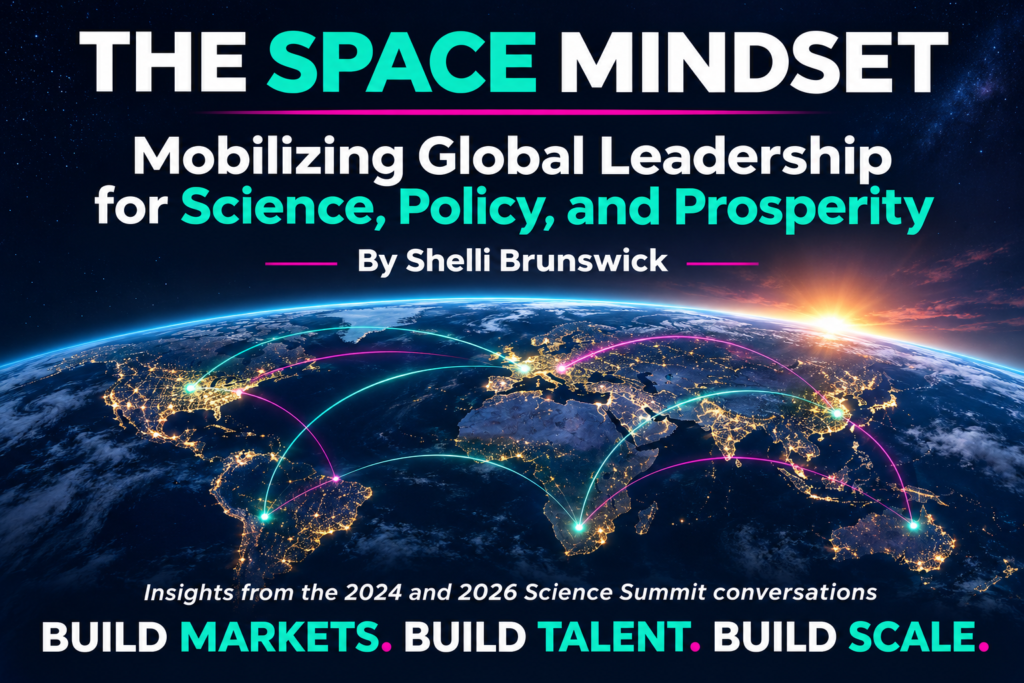
Across these Science Summit conversations, I see three connected priorities reflected in my Space Mindset framework: Build Markets, Build Talent, Build Scale.
Build Markets begins with understanding needs and identifying where scientific and technological capabilities can create value. It includes public demand, commercial opportunity, and the conditions that allow solutions to reach users.
Build Talent means developing the people and institutions that can contribute. Education, practical experience, research exchange, and leadership development turn access into meaningful participation.
Build Scale requires partnerships, financing, governance, and delivery models that sustain progress.
For leaders pursuing collaboration, this framework suggests a practical discipline: define the challenge, identify the expertise needed, establish who can advance the work, and agree on a useful next milestone. A shared ambition gains direction when participants understand their contributions and how they’ll assess progress.
These priorities also guide my leadership interviews, books, speaking, and advisory work. Through the What’s Space Got To Do With It? series, I explore how leaders across countries and disciplines recognize opportunities, navigate uncertainty, and expand possibilities for others. My forthcoming book, The Space Mindset: Building Entrepreneurial Ecosystems, extends that inquiry by examining the conditions that enable entrepreneurs and innovators to thrive.
Insights from global conversations can sharpen organizational strategy. Practical experience brings better questions to international dialogue. Maintaining that exchange is essential to my work.
Building the Agenda for 2027
Our continuing collaboration with the Science Summit provides a foundation for a broader space agenda in 2027, connecting scientific capability with policy, investment, and economic opportunity.
The progression is purposeful. In 2024, our discussion explored how Earth observation and satellite data could address challenges on Earth. In 2026, we examined the leadership, diplomacy, governance, and national capabilities needed to translate technological potential into shared benefit. Looking toward 2027, we are exploring how to bring these perspectives together through broader participation and focused opportunities for collaboration.
Climate resilience, agriculture, food security, connectivity, and ocean sustainability illustrate why this agenda matters. Each connects scientific knowledge with decisions affecting communities, businesses, and national development. Each requires expertise and resources distributed across institutions and borders.
A strategic priority is to connect these needs with sustainable economic models. Satellite-enabled services can support remote communities, island nations, and emerging economies. Their lasting value also depends on local enterprise, skilled professionals, capable institutions, and opportunities to develop services that respond to local priorities.
Emerging economies need pathways to contribute as producers of technology, knowledge, and innovation. Their leaders also need a voice in discussions shaping investment, access, and governance.
As planning develops, I’m focused on bringing together complementary perspectives: researchers who understand the evidence, policymakers who shape enabling conditions, businesses that deliver solutions, investors who support growth, and educators who prepare the people needed to sustain it.
Our Science Summit contributors bring valuable expertise and relationships to this work. Building on that collaboration while welcoming new voices can connect global ambition with practical priorities.
I invite leaders to contribute to this evolving agenda through future Summit discussions, leadership interviews, and partnerships connecting science with economic and societal opportunity.
The Space Mindset asks leaders to consider how their decisions expand what others can accomplish. Build Markets. Build Talent. Build Scale. This framework gives global collaboration a practical purpose: develop the capabilities, networks, and opportunities that allow more people to prosper.
Explore the conversations
Watch the 2026 Science Summit session
Watch Dr. Masami Onoda’s complete 2026 JAXA presentation
Watch the 2024 Science Summit session
About the author
Shelli Brunswick brings global leaders together to advance innovation, expand economic opportunity, and build entrepreneurial ecosystems. CEO and Founder of SB Global LLC, she is a keynote speaker, futurist, strategic advisor, and author of the What’s Space Got To Do With It? series, including Out of This World Leadership. Her Space Mindset framework—Build Markets, Build Talent, Build Scale—connects space and emerging technology with practical leadership strategies across industries and borders.
For speaking, advisory, and collaboration inquiries: whatsspacegottodowithit@gmail.com.