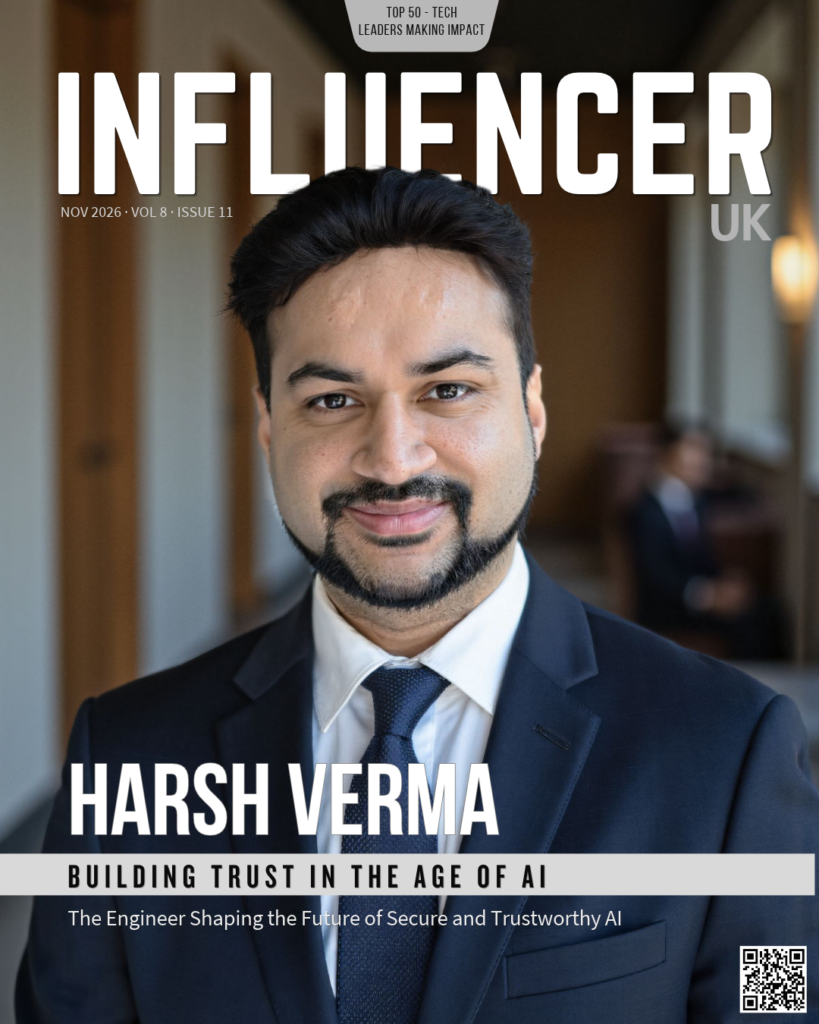
Harsh Verma is a Principal Software Engineer in AI at Palo Alto Networks. He is a Forbes Technology Council member, a BCS Fellow, an IEEE Senior Member, a Google Developer Expert in Cloud AI, and an Advisor at Berkeley SkyDeck. He is also a recipient of the Global Recognition Award 2026 for measurable advances in enterprise AI and cybersecurity, and the Globee Awards. Harsh Verma is featured on the Influencer UK November 2026 cover under Top 50 Tech Leaders Making Impact. We spoke to him about his work in Agentic AI, the security questions that keep him up at night, and his advice for the next generation of engineers.
You work at the intersection of AI, cybersecurity, and autonomous systems. Tell us about that space and what drew you to it.
I work at the intersection of artificial intelligence, cybersecurity, and autonomous systems, with a particular focus on Agentic AI, large language models, multi-agent architectures, and enterprise AI security.
As a Principal AI Engineer at Palo Alto Networks, my work centers on a fundamental challenge: How do we build AI systems that are not only intelligent enough to make decisions but also secure, reliable, and trustworthy enough to act on them?
Over the years, I have worked on AI-driven cybersecurity solutions, intelligent automation, and scalable enterprise architectures. My contributions include developing systems that improve threat detection, reduce false positives, strengthen security operations, and automate complex workflows. Some of these initiatives demonstrate how intelligent security architectures can deliver measurable operational impact.
What excites me most is the shift from AI that generates information to AI that takes action. Traditional AI systems primarily analyzed data, predicted outcomes, or generated content. Today, autonomous AI agents can reason through problems, interact with enterprise systems, collaborate with other agents, and execute tasks with limited human intervention.
This transformation is creating extraordinary opportunities, but it also raises important security questions. What happens when an AI agent has access to sensitive enterprise systems? How do we verify its intentions, control its permissions, and ensure accountability for its decisions?
These are the challenges I find most fascinating.
I believe the next major breakthrough in AI will not come solely from building larger or more powerful models. It will come from developing the trust, identity, authorization, and governance infrastructure that allows intelligent agents to operate safely in real-world environments.
Beyond my engineering work, I enjoy contributing to this evolution through research, technical writing blogs in forbes , rsac platform. speaking engagements, and mentoring emerging innovators. As a BCS Fellow, IEEE Senior Member, Google Developer Expert in Cloud AI, and Advisor at Berkeley SkyDeck, I value opportunities to bridge technical innovation with responsible leadership. My broader vision is to help shape a future where AI systems can operate autonomously without compromising security, transparency, or human accountability.
I often describe this transition in one sentence: The future of AI is not just about making machines more intelligent; it is about making intelligent machines worthy of our trust.
That is what makes this field so exciting to me. We are not simply building the next generation of software. We are defining how intelligence, autonomy, and security will coexist in the digital world.
You have mentored a lot of young engineers and spoken at accelerators like Berkeley SkyDeck. What is the one piece of advice you find yourself repeating?
My advice to aspiring technology professionals is simple: Don’t just learn technology. Learn how to solve problems with it.
Technology is evolving faster than ever, particularly with the rise of artificial intelligence. The skills that are valuable today may look very different five years from now. However, strong fundamentals, critical thinking, curiosity, and the ability to adapt will always remain relevant.
Throughout my journey in AI, cybersecurity, and software engineering, I have learned that the most successful engineers are not necessarily those who know the most programming languages or frameworks. They are the ones who understand problems deeply, ask the right questions, and build solutions that create meaningful impact.
I would encourage aspiring professionals to focus on three things.
First, build strong technical foundations. Understand computer science, system design, data structures, security, and how modern software systems operate. AI can help you write code, but understanding why something works, where it can fail, and how to improve it will differentiate you.
Second, build real things. Don’t limit your learning to certifications or tutorials. Work on projects, contribute to open source, experiment with AI, and solve problems that matter. Practical experience teaches lessons that no classroom or online course can fully replicate.
Third, invest in relationships and continuous learning. Seek mentors, participate in technical communities, share your knowledge, and remain open to feedback. Some of the most valuable opportunities in my career have come from learning alongside others and contributing beyond my immediate responsibilities.
One important lesson I have learned is that your career growth should not be measured only by your job title, compensation, or recognition, but by the problems you solve, the people you empower, and the impact you create.
As AI becomes increasingly capable, I believe the future belongs to professionals who combine technical expertise with creativity, sound judgment, ethical responsibility, and leadership.
My message to the next generation is this: Don’t compete with AI at doing what machines can automate. Develop the skills to design, guide, secure, and improve the systems that will shape our future.
You don’t need to have your entire career figured out today. Stay curious, keep building, embrace challenges, and never stop learning. The most rewarding opportunities often emerge when you step outside your comfort zone.
The future of technology will not be defined by those who simply use AI, but by those who understand how to turn its capabilities into meaningful human progress.
The pace of change in AI is relentless. How do you personally keep up without getting swept away by the hype?
I believe adaptability is one of the most valuable skills in technology, especially as AI continues to evolve at an unprecedented pace.
My approach focuses on three principles: continuous learning, hands-on experimentation, and strong technical fundamentals. I stay engaged with emerging AI research, experiment with new models and agentic architectures, and exchange ideas with industry experts and developer communities.
As a Principal AI Engineer, I also evaluate new technologies through a practical lens, focusing on security, scalability, reliability, and measurable business impact rather than simply following trends.
Writing, mentoring, and speaking at industry events further help me challenge my thinking and learn from different perspectives.
My philosophy is simple: Don’t chase every AI trend. Understand what truly matters, keep experimenting, and build the skills to adapt. The most successful professionals won’t be those who know everything, but those who never stop learning.
Harsh Verma features on the Influencer UK – November 2026 cover as part of our Top 50 Tech Leaders Making Impact, and this conversation made clear why. What stood out to us most is that he is less interested in the models everyone is racing to build and more interested in the guardrails nobody wants to own. Identity, authorization, accountability. The unglamorous plumbing that decides whether autonomy becomes an asset or a liability. It is a quieter kind of ambition, but it may well be the one that outlasts the hype cycle. For the enterprises racing to hand over the keys to their systems, that is precisely the conversation worth having.