A business issues an important letter. A university shares a certificate. A company sends a report to a partner. Each document may travel through email, messaging apps and different organisations before someone needs to rely on it. But after a file has been forwarded several times, how can the recipient determine whether the information still matches the original?
That question sits at the centre of Truthlocks, a digital verification company co-founded by Nigerian engineer Nnaa Igwiloh and Emmanuel Adeyinka. Incorporated in the United States and built for international use, Truthlocks develops tools that allow people, businesses and software systems to issue signed digital records and share evidence that others can check independently.
The idea is not to make a document look more official. It is to make meaningful changes detectable.
From a technical problem to a practical product
Igwiloh, a largely self-taught software engineer and Truthlocks’ CEO and CTO, works across cryptography, backend systems and infrastructure. Adeyinka, the company’s co-founder and COO, leads operations and business development. The two have funded the venture themselves while building its technology and pursuing commercial adoption.
The underlying problem is familiar even to people who have never written a line of code. A screenshot can be cropped. A PDF can be edited. An emailed statement can lose the context of who originally issued it. Sometimes a recipient must choose between trusting the sender and beginning a lengthy manual verification process.
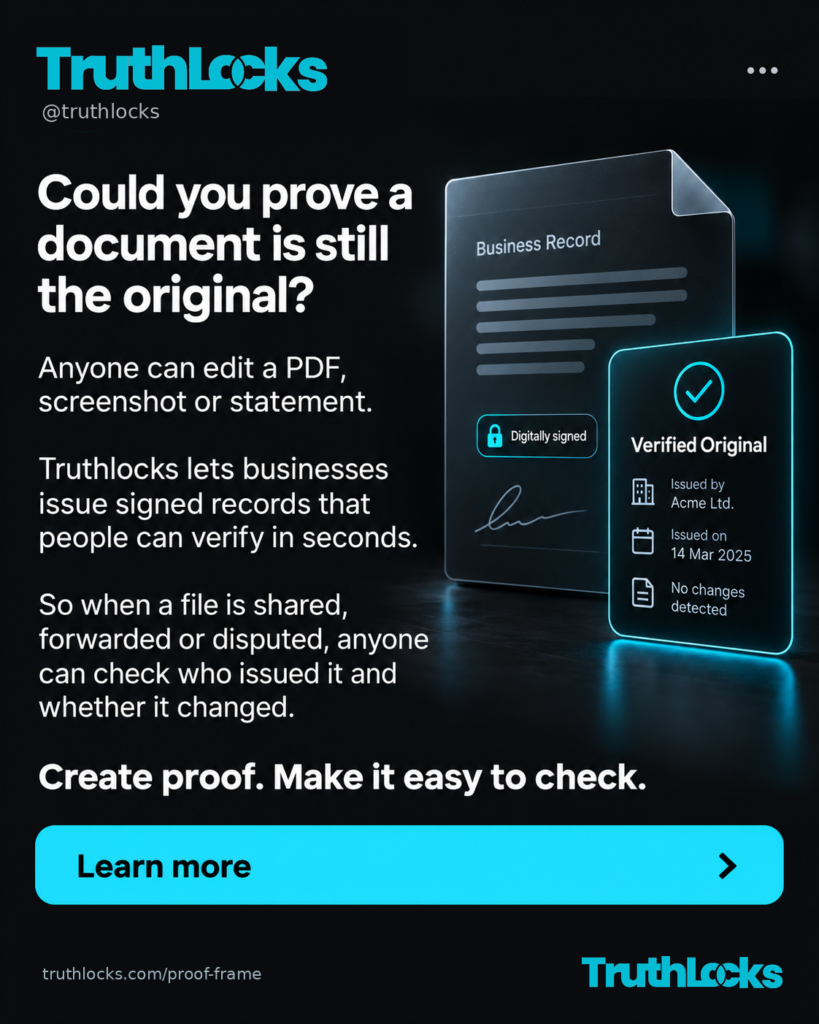
Truthlocks takes a different approach: it creates cryptographic evidence linked to a record. When a participating issuer signs information, a recipient can check whether the content being presented still matches the signed version. Depending on the record and available evidence, the verification process can also show the signing identity, the status of the record and supporting history.
There is an important boundary. A valid signature does not automatically mean every claim inside the document is accurate. Nor does it independently establish that an unfamiliar issuer is a university, government ministry or other trusted institution. The identity and authority of the issuer must be assessed separately.
A demonstration anyone can understand
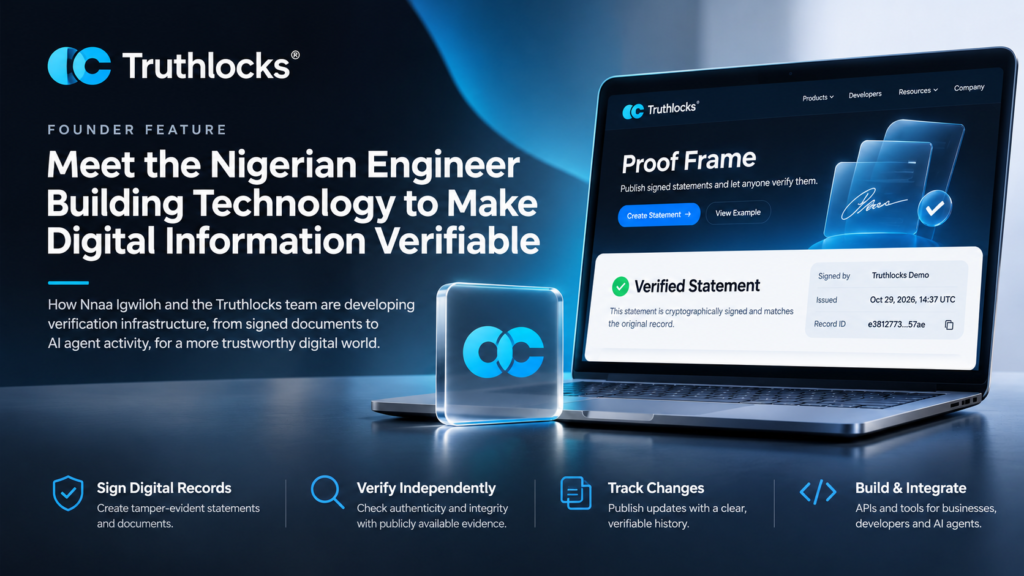
One of Truthlocks’ most accessible products is Proof Frame, a service for publishing and checking digitally signed statements.
Imagine a company publishes an announcement that includes a date, an amount or an important commitment. Instead of sharing only an ordinary statement, it can share a public proof page. A recipient can inspect the available evidence and run a current verification check without first creating an account.
The product also includes an interactive demonstration. A visitor can change a word or number in a separate copy of eligible public text and see that the modified content no longer matches the recorded fingerprint. The original signed statement remains unchanged.
It is a small interaction, but it makes an otherwise abstract technical concept immediately visible: a record’s contents can be checked against what was previously signed.
Proof Frame is available for individuals and businesses. It also supports linked revisions, so an updated statement need not silently overwrite the original. Users can control whether statement text is publicly disclosed, and private content is not automatically exposed through a public verification link.
The product can be explored at https://www.truthlocks.com/proof-frame.
Beyond documents: evidence for AI systems
Truthlocks is also developing infrastructure aimed at a world in which software agents increasingly carry out tasks on behalf of individuals and organisations.
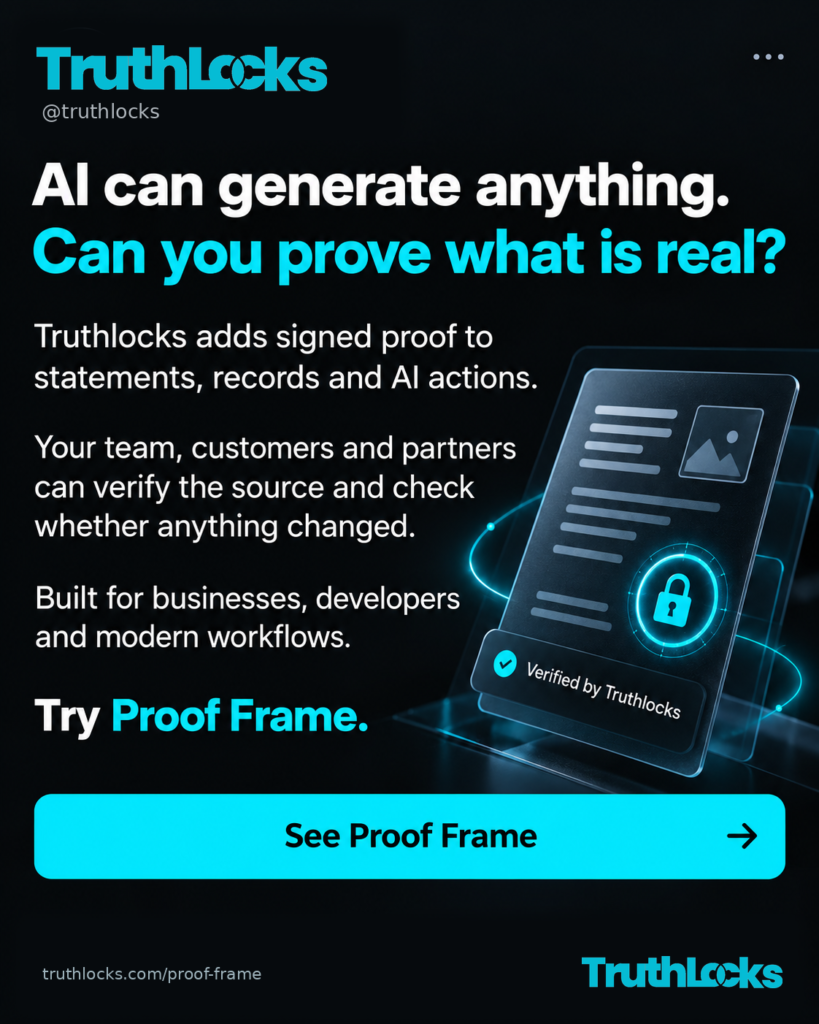
If an AI agent makes a request, updates a system or generates an operational record, knowing which agent was involved and what evidence accompanies the action may become important for accountability. Truthlocks’ developer tools address aspects of machine identity and signed action receipts, giving applications ways to associate recorded actions with cryptographic evidence.
As with signed documents, these receipts have limits. A signature can help establish the integrity and provenance of a recorded message; it does not by itself prove that the underlying real-world action occurred or that an automated decision was correct. Businesses still need reliable systems, appropriate permissions and independent checks.
The company’s public technical materials include a reproducible example showing how a valid signed receipt passes verification while altered content, a corrupted signature and an unrelated key are rejected. Those results are first-party engineering tests, not independent certification or proof of large-scale commercial adoption.
Building technology is only the first step
Truthlocks is still an early-stage, founder-funded business. Its next challenge is not simply demonstrating cryptographic verification, but making the capability useful enough for real organisations to adopt.
Potential applications include academic records, professional credentials, business statements, service reports and evidence generated by AI-enabled software. In each case, the value depends on an issuer integrating the system properly and recipients knowing what a successful check does — and does not — establish.
For Igwiloh and Adeyinka, the larger ambition is to make independent verification an ordinary part of how information moves between people and organisations. The promise is not that technology can settle every dispute over what is true. It is that an important digital record should not have to rely solely on appearance or trust in whoever forwarded it.
For more information: https://www.truthlocks.com