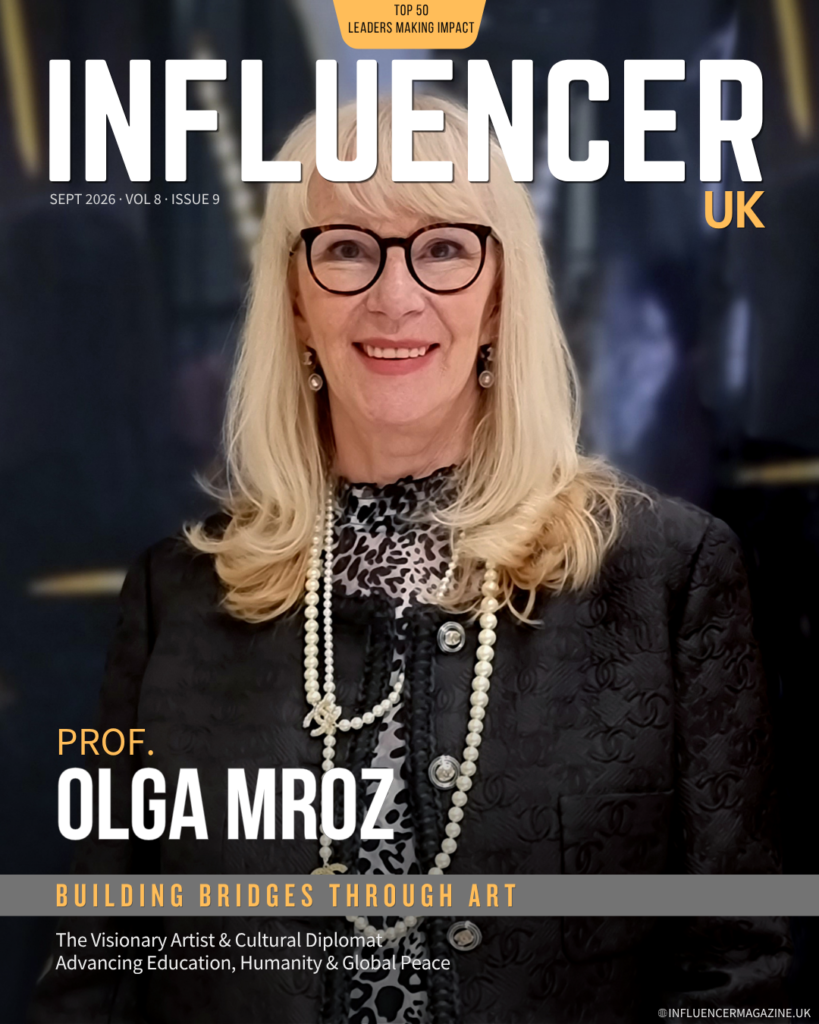
There are careers built around a single discipline, and then there are careers shaped by the connections between them. For Professor Olga Mroz, architecture, music, theatre, psychology, education and art have never existed as isolated worlds. Together, they have informed an interdisciplinary journey centred on a larger purpose: using knowledge and creativity to connect people, cultures and generations.
Based in Germany and working internationally, Mroz is an educator, academic, artist and cultural diplomat whose professional path has moved across education, the arts and international leadership. Today, she is a Professor and Honorary Doctor of Arts, Director of Al-Khalifa Business School Online in the United Kingdom, and Shareholder and President of IKONIC EDUCATIONAL HOLDING.
At the centre of those roles is a conviction that has followed her throughout her life: education can fundamentally alter not only what a person knows, but what they believe is possible.
Education as a Starting Point
Asked to describe her academic and educational work, Mroz begins not with a position or achievement, but with an idea that has guided her journey.
“If you want to change the world, start with education.” – Kofi Annan
When I think about my professional journey, I always come back to one word: education. There is a quote by Kofi Annan that has stayed with me for years: “If you want to change the world, start with education.” I deeply believe this. Education changed my own life long before it became my professional mission.
Like every child, I had my dreams. But education empowered me to turn them into something real. It also helped me face a much bigger question: what kind of person I wanted to be. I have always loved learning. I loved books, new subjects, endless questions. Curiosity has truly been the driving force of my life.
That curiosity ultimately led Mroz through fields that, on the surface, might appear markedly different from one another.
She began with architecture before moving into the history of theatre, music and the psychology of art. Rather than viewing those subjects as diversions from a conventional career trajectory, Mroz sees them as layers that gradually shaped the way she understands creativity, people and leadership.
In her own words:
My journey began with architecture. Later, I studied the history of theatre, music, and the psychology of art. At the time, I did not think of these as separate chapters that needed to lead to one conventional career. I was simply open to learning and to wherever that knowledge might take me. Looking back, I can see how much each of these fields shaped me. Architecture taught me to see structure and think on a larger scale, while music instilled a sense of harmony. Theatre opened my eyes to human emotions and the extraordinary power of expression. Finally, the psychology of art helped me understand why creativity touches us so deeply. Perhaps that is why I have never wanted to define myself by a single profession.
It is an outlook that challenges the pressure to fit professional identity neatly into one category. In Mroz’s case, interdisciplinarity is not simply a feature of her résumé; it has become fundamental to how she approaches education itself.
Opening Doors for the Next Generation
Mroz’s present work places much of that accumulated experience into education and the development of future leaders.
Today, I am a Professor and Honorary Doctor of Arts, Director of Al-Khalifa Business School Online, UK, and Shareholder and President of IKONIC EDUCATIONAL HOLDING. A vital part of my work is developing innovative educational projects and programmes for the people who will become tomorrow’s leaders, entrepreneurs, and innovators. For me, this is not simply professional work, but it is deeply personal. Education once opened doors for me, and today I want to help open doors for others. I truly believe that when we invest in education, we are shaping the future of our planet.
Her perspective places education beyond the conventional exchange of information or qualifications. Instead, it becomes a means of developing curiosity, opportunity and the capacity to participate meaningfully in a changing world.
It also explains why her work has moved naturally between academia and the arts. Where education can equip people to understand the world, Mroz believes creativity can change the way they experience and relate to it.
Can Art Accomplish What Diplomacy Cannot?
Beyond her academic and business responsibilities, Mroz is an artist, collector and cultural diplomat. Her paintings are held in private collections internationally, while her work has brought her into contact with people across different cultures, traditions and backgrounds.
That experience has reinforced her belief in art as a form of communication capable of reaching beyond political, linguistic and geographic boundaries.
Asked whether art can accomplish things that conventional diplomacy sometimes cannot, she says:
Beyond my academic and business roles, I am an artist, collector, and cultural diplomat. My paintings are now held in private collections across the globe, and through my international work, I have met people from many cultures, traditions, and backgrounds. These experiences have strengthened something I have believed for a very long time: art knows no borders. Art doesn’t need a passport or a translation to be understood. Sometimes a painting, a piece of music, or a performance can build a bridge between people more powerfully than a thousand carefully chosen words. This belief lies at the very heart of my international and public advocacy.
It is perhaps one of the clearest expressions of the philosophy connecting the different parts of her career. Architecture gave her structure, music harmony, theatre an understanding of expression and psychology an insight into why creativity affects people. Education then provided a means of sharing and applying those ideas more widely.
Cultural diplomacy, in this context, becomes less about formal institutions and more about creating spaces in which people can understand one another.
Recognition as Responsibility
Over the course of her professional journey, Mroz has received awards and honours recognising different aspects of her work. Yet she is careful not to position recognition as the objective.
For her, an award matters most because of what comes after it.
While I appreciate every award and milestone, I’ve come to see recognition through a different lens. It’s not a final destination, but rather a responsibility. It drives me to continue creating, to mentor others, and to use the opportunities I’ve been given to leave a meaningful mark. Looking back, I see that my career was never a straight line, and honestly, I wouldn’t want it any other way.
That final observation captures much of Mroz’s professional story. A career spanning architecture, music, theatre, psychology, academia, business and art may resist a simple label, but its underlying direction has remained remarkably consistent.
Each discipline has become another way of exploring how people learn, communicate, create and connect.
A Mission Built Around Bridges
When asked what she ultimately hopes to leave behind for future generations, Mroz returns to art—not only as part of her work, but as a metaphor for the life she has built.
I see it more like a painting that slowly comes to life. Architecture, music, theatre, education, art, international projects, and the extraordinary people I have met along the way, each experience has added its own color, its own layer, and its own meaning. And perhaps the most beautiful part is this: education once helped me move closer to my own childhood dreams.
Today, I want education to help others discover their potential and create their own future. I believe that knowledge and creativity are the two wings on which humanity rises. If I were asked today to describe my mission in just a few words, I would say that my mission is to build bridges between education and art, between cultures and generations, between ideas and people. Because education has the power to change the future, while art has the power to change consciousness. And together, they have the power to make our world more humane, more connected, and more peaceful.
It is a fitting philosophy for someone whose career has consistently crossed the boundaries between disciplines.
For Professor Olga Mroz, the thread connecting education, creativity and cultural diplomacy is ultimately human potential. Her journey suggests that knowledge does not have to remain within classrooms, just as art does not have to remain within galleries. Both can become instruments through which people understand themselves, encounter different perspectives and build relationships across cultures.
And perhaps that is the defining idea behind Mroz’s work: meaningful influence is not simply about being heard. It is about creating bridges that allow ideas, opportunities and understanding to travel further than any individual could alone.