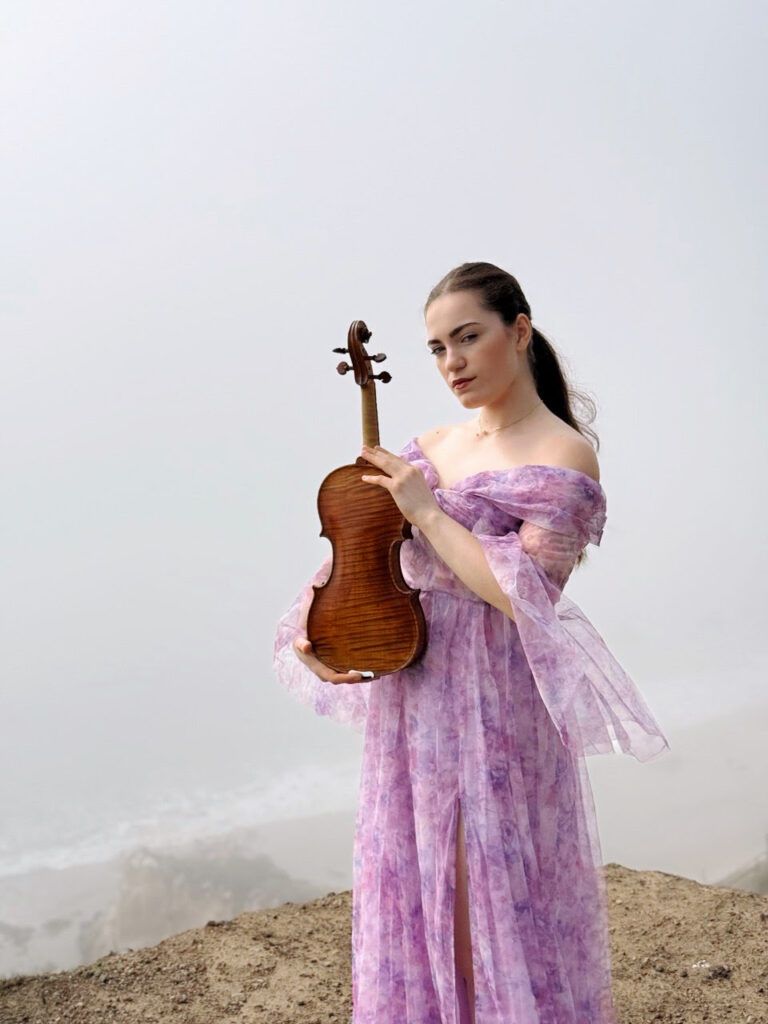
For violinist Sendi Vartanovi, a live performance is more than a sequence of works on a program. It is a fleeting encounter—between performer and listener, between people sharing the same room, and sometimes between a person and something within themselves that only music can reach.
That belief is at the heart of Light & Bloom Concert Platform, which Vartanovi founded and artistically directs. Built around the idea of presenting live classical performance as one unified work of art, Light & Bloom places music firmly at the center while thoughtfully shaping everything around it—from repertoire and artistic collaborators to space, atmosphere, and, in selected projects, other artistic disciplines. The purpose is not spectacle, but deeper listening: creating the conditions for audiences to slow down, become fully present, and experience music personally.
For Vartanovi, this mission has particular urgency in an increasingly digital world. When almost any piece of music can be accessed instantly through a screen, she believes the value of live performance lies precisely in what cannot be replayed or reproduced: the unrepeatable exchange between the artists, the music, and the people who chose to be there.
Through intimate chamber programs, cinematic concerts, and interdisciplinary projects, Light & Bloom explores how that exchange can become more meaningful without taking attention away from the music itself. Vartanovi’s vision is rooted in the transformative potential of live art—the possibility that a performance can help someone reconnect, reflect, discover something unfamiliar, hear an inner voice more clearly, or simply leave the room feeling differently from when they entered.
In this conversation, Vartanovi reflects on the journey from her beginnings as a violinist in Tbilisi, Georgia, to building an artistic life in the United States; why performing, curating, and building an artistic platform have become inseparable parts of her work; how her Georgian heritage continues to shape what she brings to American audiences; and why, for her, the future of classical music begins with something profoundly human: being fully present together when the music happens.
How did you get into what you do?
Sendi Vartanovi:
I got into this through performing. As a violinist, I have spent years experiencing concerts from the stage, and I became increasingly interested in what makes a live performance truly stay with someone. I started thinking beyond repertoire and performance itself: What makes an audience feel present? What creates a genuine connection between the people on stage and the people listening? And how can a concert become something people experience personally rather than simply observe?
That thinking became the foundation of Light & Bloom.
What does Light & Bloom offer, and what makes it unique?
Sendi Vartanovi:
What we offer is not one fixed type of concert. Light & Bloom works through three formats: intimate classical programs, cinematic concerts, and interdisciplinary projects that connect live music with other art forms. What unites all three is that every program is carefully curated as a complete experience. I think about the repertoire, the artists, the sequence of the program, the space, the atmosphere, and the audience’s relationship to what is happening.
What makes it unique to me is that we are not trying to make classical music “easier” by taking attention away from the music. It is actually the opposite. The music remains at the center; everything around it is designed to help audiences step away from the noise of everyday life, listen more deeply, and connect—with the music, with themselves, and with one another. At the same time, the platform creates space for artistic voices and repertoire that deserve wider recognition, allowing discovery to become a natural part of the live concert experience.
This fall, that vision continues through two New York City projects. On October 17, Light & Bloom presents TIME at Tenri Cultural Institute, an interdisciplinary experience exploring the idea of time through photography, documentary film, live classical performance, and audience-created visual art. At the center of the musical program is the New York premiere of Ajibola Rivers’ Einziger für Sendi, a solo violin work commissioned for me. The piece moves through musical languages that recall different periods—from Bach and the Baroque tradition to Ysaÿe and the twentieth century—yet we hear them through the language of a contemporary composer. In that sense, the work reflects something deeply connected to the idea of TIME: the way we return to our own past and memories through the understanding, experience, and perspective we have today. Placed at the heart of the program, the solo violin becomes a journey between past and present—one performer carrying traces of different centuries while creating something that exists only in that particular moment.
Our second New York project this fall, on November 8 at Opera America’s Scorca Hall, represents another Light & Bloom format: Cinematic. Film music has long had a meaningful place in the concert hall, and composers such as Ennio Morricone, John Williams, and Hans Zimmer have created scores that have taken on lives far beyond the films for which they were written. For this program, we bring iconic works from across cinema together in one live concert experience.
I find this format particularly exciting because it can speak to very different audiences. For regular concertgoers, it offers an opportunity to experience familiar cinematic music differently when it is performed live. For someone who rarely—or perhaps has never—attended a classical concert, the recognition of a melody from a beloved film can become an immediate point of connection with live instrumental and vocal performance.
It also broadens the idea of what audiences might encounter in a concert setting. Our chamber series may bring them into the worlds of Mozart, Beethoven, Debussy, or other established classical composers, while the Cinematic format explores another part of the concert tradition through composers whose music became known through film. The formats are different, but they share the same purpose: to create thoughtfully curated live music experiences that can only exist in the moment, between the artists, the music, and the people in the room.
What impact are you trying to create, and what are you most proud of so far?
Sendi Vartanovi:
The impact I want to create begins with the individual experience, but I hope it extends beyond it. I want audiences to listen deeply and respond in their own way, but I also want them to leave curious—about a composer they had never heard, an artist they have just discovered, or a way of experiencing live music they had not encountered before.
I am especially proud that Light & Bloom is developing a recognizable artistic identity while remaining open to experimentation. Its programs can place established repertoire alongside Georgian music, works by women composers, and music by living and emerging composers, while bringing together exceptional artists around a shared artistic idea.
Perhaps what means the most to me is what happens afterward—when people stay, conversations begin between audiences and artists, someone asks where they can hear more of a composer they have just discovered, or a musician wants to find the score of a work they heard that evening. To me, that is when the experience has truly continued beyond the final note.
What drives your mission and vision?
Sendi Vartanovi:
What drives my mission is a very simple belief: live performance still matters deeply, perhaps even more in a world where so much of our experience has become digital, immediate, and easily replaceable.
We can listen to almost any piece of music at any moment, but being physically present while musicians create something in real time is completely different. It asks us to stop, listen, and be present. That is what I want to protect and develop through Light & Bloom.
What core values or beliefs guide the way you run your business?
Sendi Vartanovi:
The values that guide me are artistic integrity, curiosity, connection, and quality. I never want to add something to a program simply because it is fashionable or marketable. If I bring photography, film, visual art, or audience participation into a project, there has to be an artistic reason for it. The same applies to repertoire and performers. Every element should serve the larger idea while allowing the music to remain central.
I also believe strongly in giving audiences freedom in how they experience art. I do not want to tell someone what they are supposed to feel. I would rather create the conditions for people to listen closely, reflect, and arrive at something personal. Two people can experience the same performance completely differently, and I think that is one of the beautiful things about live art.
How do you approach challenges, growth, and innovation?
Sendi Vartanovi:
When it comes to growth, I am ambitious, but I do not want growth simply for the sake of becoming bigger. I want Light & Bloom to grow in artistic depth, audience, collaborations, and reach while maintaining the intimacy and attention to detail that define it. I would rather build something with a clear identity over time than expand quickly and lose what made it meaningful in the first place.
Innovation, for me, also does not mean changing classical music to make it more fashionable. It means being willing to question the traditional concert experience: how we program, how different art forms can communicate with one another, how audiences participate, and how we create a stronger connection between the stage and the room.
Of course, building an independent artistic platform comes with challenges. There are financial realities, marketing, ticket sales, logistics, and countless decisions behind every evening that the audience never sees. I am simultaneously an artist and the person responsible for making the idea possible, and that can be very demanding.
What keeps you motivated when things get tough?
Sendi Vartanovi:
What keeps me going are the moments when I see that what we are creating has genuinely reached someone. I remember audience members telling me how happy they were that, despite a rainy evening when it would have been much easier to stay home, they came and shared the Light & Bloom experience with us. I have had frequent chamber-music concertgoers tell me that they experienced something through Light & Bloom that felt completely new and special to them.
Some responses have been even more personal. After I performed the Heifetz arrangement of Debussy’s Beau Soir, an audience member who is also a conductor told me that they had tears from the very first notes because the performance moved them so deeply. Moments like that stay with me.
Those reactions matter because they remind me that the ideas behind Light & Bloom are not only ideas in my head. Something real is happening between the artists, the music, and the people who choose to be there.
That is what motivates me when things become difficult. It reminds me why I do not want to stop and why I believe this is important to continue building. There are many challenges behind creating an independent artistic platform, but when someone tells me that an evening changed the way they experienced a piece of music, brought them unexpected joy, or simply made them grateful that they chose to come and be present, it gives all of that work a purpose.
For me, success is not only filling a room. It is creating something worth having come into the room for.
Is there anything else you’d like to share about your work, journey, or perspective that we haven’t covered?
Sendi Vartanovi:
One thing that is very important to me is that I never see Light & Bloom as something separate from my identity as a violinist. I did not step away from performing in order to become a founder. I perform, curate, and build the platform simultaneously, and each part of that work continuously changes the others.
Being responsible for an entire artistic experience has changed the way I listen and perform. When I am on stage now, I am conscious not only of my own interpretation, but of the larger journey of the evening—what the audience has just heard, what they will hear next, the atmosphere in the room, and how one musical moment can completely change the emotional direction of a program.
At the same time, being a performer keeps Light & Bloom grounded. I understand what it means to walk onto a stage, to take artistic risks in front of an audience, and to communicate something without words. That experience influences the artists I invite, the repertoire I choose, and the environment I want to create for both performers and audiences.
I also think my background has shaped the way I approach this work. I was born and raised in Georgia and am now building my artistic life in the United States. Carrying one culture into another has made me very aware of how much extraordinary music can remain unfamiliar simply because audiences have never had the opportunity to encounter it.
I experience this directly when I perform Georgian works here. After concerts, people often come to me and tell me that it was their first time hearing music by those composers and how fascinated they were by what they heard. What is especially meaningful is that the curiosity does not always end with the performance. Musicians have approached me afterward asking where they can find the scores because they want to discover and perform the music themselves, while audience members who are not musicians simply tell me how much they loved the works and ask to hear more.
Those reactions are very important to me because they show how one performance can open a door. Someone can walk into a concert having never heard the name of a Georgian composer and leave wanting to know more—or, in the case of another musician, wanting to bring that music into their own repertoire and introduce it to another audience.
That is one of the reasons I want Light & Bloom to continue creating space for Georgian composers and musicians in the United States. I do not want to present Georgian music as something separate or exotic. I want these works to exist naturally alongside Debussy, Saint-Saëns, Barber, Gershwin, Piazzolla, and other international repertoire, and to give audiences the opportunity to discover for themselves how much this music has to offer.
Perhaps the biggest thing I have learned is that performing and creating are not separate parts of my artistic life. Performing gives me the instinct behind Light & Bloom, while building the platform allows those instincts to grow into programs, collaborations, and experiences that would not otherwise exist in quite the same way.
There is still so much I want to build. I want Light & Bloom to reach larger audiences, collaborate with more extraordinary artists, create new interdisciplinary projects, continue presenting Georgian artistic voices in the United States, and eventually develop opportunities for new works and ideas to emerge through the platform.
But I also want to protect the reason it began. No matter how much Light & Bloom grows, I never want to lose the feeling that something meaningful is happening between real people in a room, in real time.
That, to me, is the future of Light & Bloom: not replacing the tradition of live performance, but creating more reasons for people to value it, seek it out, and want to be part of it.
What Vartanovi is building through Light & Bloom extends beyond any single concert format. Established repertoire can share a program with Georgian music, works by women composers, emerging contemporary voices, and new work; photography or film can enter when the artistic idea calls for it; and audiences can encounter familiar music beside something they never knew to seek out. Yet the center remains deliberately unchanged: live music, experienced between real people in real time. As Light & Bloom grows, its direction remains clear—not to reinvent classical music, but to continually reimagine the ways people can encounter it.