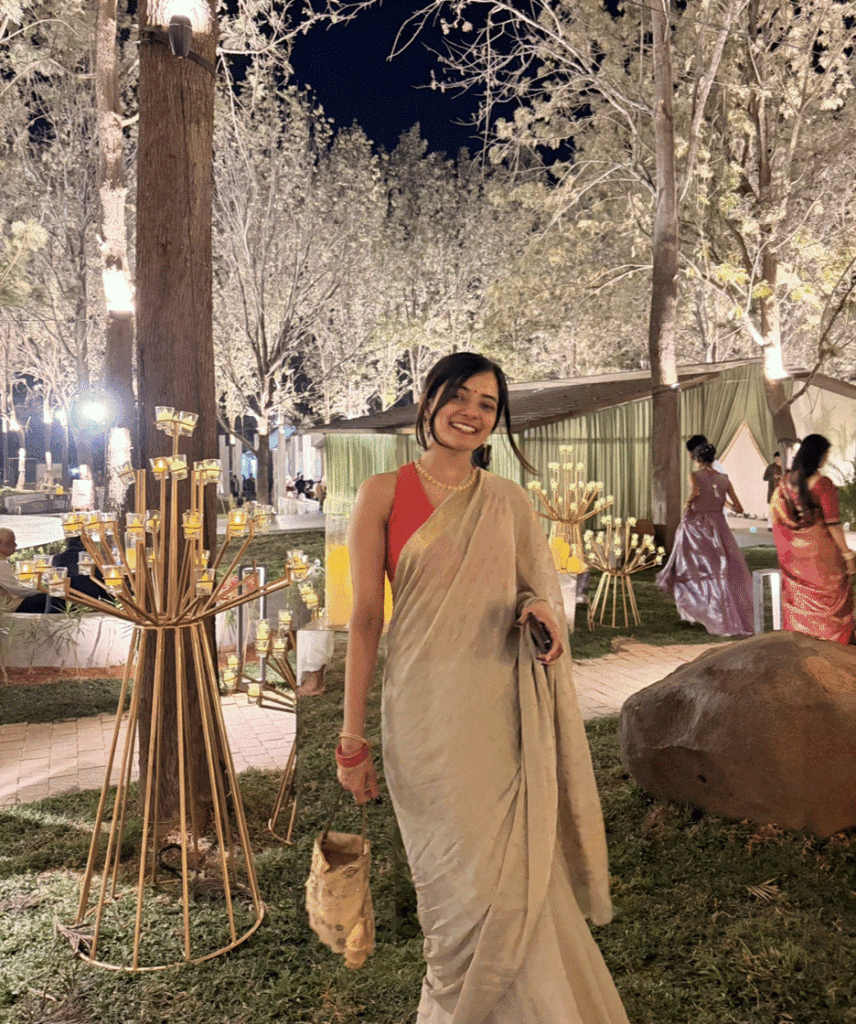
How a New York architect uses a black pen to map the uneasy truce between nature and the things we build
There is a particular kind of attention that precedes design, a way of looking at the world before deciding to change it. For Rachana Rao, a New York–based architect and emerging artist, that attention is the foundation of everything she makes, whether the medium is a drawing set for a well-known retail brand or a dense field of black ink built up stroke by stroke on a small sheet of paper. Across both halves of her practice, the architectural and the artistic, Rao is preoccupied with the same essential question: what happens at the threshold where human intention meets the living fabric of the natural world?
Her answer is not a tidy one, and that is precisely the point. Rao’s work rejects the comforting idea that the constructed and the inherent can be easily brought into harmony. Instead, she frames their relationship as a negotiation, uneven, ongoing, and never fully resolved. It is a sensibility she has carried from her time at Sanctuary Architects in Bangalore to the studios of Pratt Institute and the offices of New York’s commercial architecture firms, and it is what makes her one of the more thoughtful young voices working at the intersection of design and drawing today.
Practice Rooted in Looking
Rao’s artistic identity did not arrive late or as an afterthought to a design career. It came first. Her interest in architecture and design began at a young age, driven by a natural inclination toward art, drawing, and spatial thinking, the same instinct that pulls a child to trace the grain of a wooden table or to notice how light pools differently in one corner of a room than another. That early sensitivity to the sensorial qualities of the world, its textures, its rhythms, the subtle inconsistencies that most people walk past without registering, became the bedrock of everything that followed.
This is worth dwelling on, because it explains why Rao’s work feels so distinct from the slick, rendered perfection that dominates much of the contemporary architectural representation that we see today. While present-day design imagery aims to seduce with flawless surfaces, Rao is drawn to the imperfect and the overlooked. She finds quiet beauty in the variation rather than the ideal: the way a surface is never uniform, the way an edge is never perfectly straight in nature, the way texture carries information that a clean diagram strips away. This heightened attentiveness to tactile and sensory perception is not a stylistic affectation. It is a discipline. It trains her to understand that space is not experienced as geometry but as sensation, that how a place feels underfoot, against the eye, across the skin, is inseparable from how it is understood. How space also holds history is why imperfection makes it all the more interesting.
That conviction grounds her architectural approach in close observation, and it is also what gives her drawings their unusual density. When Rao sits down with a black ballpoint pen or pigment liner, she is not illustrating a scene so much as accumulating one. The marks gather. They layer. They build something that resists clarity even as it pulls the eye deeper.
The Hand and the Pen
Rao works primarily in pen and ink, and her choice of tool is deliberate in a way that rewards attention. The black ballpoint pen, humble, unforgiving, impossible to erase, forces a kind of honesty. Every line is permanent the moment it lands. There is no undo, no soft pencil ghost to revise, no eraser to negotiate with. To draw this way is to commit, and to commit repeatedly, until thousands of individual marks coalesce into tone, mass, and atmosphere.
What emerges from this process is a striking visual contrast that sits at the heart of her artistic voice: organic mark-making set against precise linear structure. On one side are the restless, accumulative, almost compulsive strokes that conjure natural forms, foliage, ground, the tangled depth of a landscape. On the other hand, are the deliberate, continuous, emphatic lines that describe constructed and infrastructural elements. The two register completely differently to the eye. One feels grown; the other feels imposed.
This contrast is not decorative. It is the argument of the work made visible. By rendering nature through one kind of line and human intervention through another, Rao stages the encounter between the two systems directly on the surface of the page. The drawings become a place where control and organic growth grind against each other, where the friction between them can be seen, not just described. This is the through-line of her entire artistic project: drawing is used not to depict a settled scene but to explore the unstable, charged boundary where built form emerges within and is reshaped by its surroundings.
In Negotiation: A Triptych of Coexistence
Rao’s most fully realized statement of these ideas is In Negotiation, a 2026 triptych executed in pigment liner on paper, each panel a modest 5.5 by 8.5 inches. The intimate scale is itself meaningful. These are not grand, room-sized canvases meant to overwhelm; they are dense, concentrated objects that demand that the viewer lean in, the way Rao herself leans into the textures of the world.
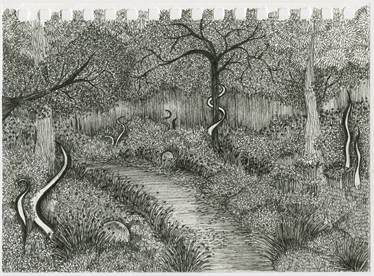
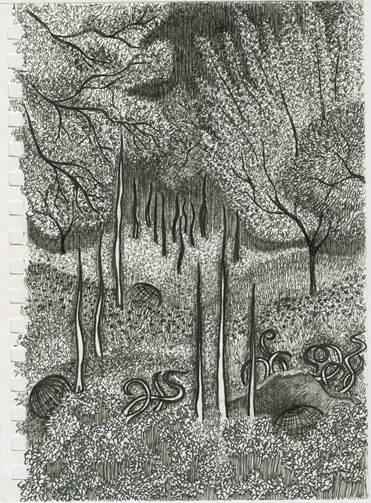
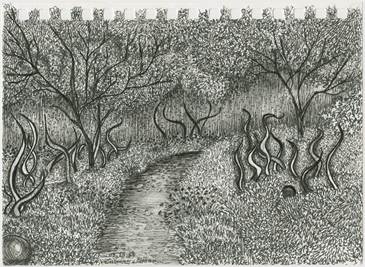
The triptych poses two questions that frame the entire body of work: What does it mean to belong to a place that does not belong to us? What does it mean to belong to a landscape we continue to alter? These are not rhetorical flourishes. They are the genuine intellectual engine of the series, and they refuse the easy answers that environmental imagery often supplies, neither the romantic fantasy of untouched wilderness nor the resigned acceptance of total human domination.
Across all three panels, the natural landscape is never a passive backdrop. It is an active, densely articulated field, constructed through layered, almost compulsive mark-making that resists clarity and control. The viewer’s eye cannot simply pass over it; the surface holds, snags, and complicates the gaze. Into this field intrude fluid, pipe-like forms, at once deliberate and ambiguous. They read as infrastructure, yet they behave with an organic, almost invasive agency, as though they had grown or seeped into the scene rather than been installed there. Their presence is never resolved. In some passages, they appear embedded, partially absorbed into the environment as if the landscape were slowly metabolizing them. In others, they assert themselves, disrupting the continuity of trees, ground, and spatial depth, refusing to be reconciled with their surroundings.
The three individual works name the conditions of this encounter rather than narrating a story. Immersion suggests the moment of absorption, the intervention folded into and nearly consumed by the landscape. Insertion: Threshold of Co-existence holds the charged in-between, the precise edge where the constructed and the organic meet and neither yields. Negotiation: Systems in Conflict lays bare the friction itself, the unresolved struggle between two orders that cannot fully merge.
What is crucial, and what distinguishes Rao’s thinking from a simpler ecological lament, is that the triptych does not depict a progression. It does not show nature giving way to development, or development being reclaimed by nature. Instead, the three works present simultaneous conditions: integration, resistance, and instability coexist. The friction is reinforced by the line work itself, with natural forms built from restless accumulative strokes and the interventions drawn with emphasis and continuity. The result is not separation but tension, an ongoing negotiation between systems that cannot fully reconcile.
Read together, the panels arrive at a conclusion that is quietly radical in its honesty: coexistence is not harmonious. It is contingent, uneven, and perpetually in flux. Balance, in an altered landscape, may not be a destination that can be reached at all, but only a condition that must be continuously and imperfectly maintained. That refusal to offer false comfort is what gives the work its intellectual weight, and it is why the series resonates well beyond its modest dimensions.
Recognition and the Wider Conversation
That resonance has not gone unnoticed. Rao’s artwork most recently received an Honorable Mention in the Shared Ground exhibition competition hosted by Rexhibit, an acknowledgment that singled out the very concerns at the center of her practice: her exploration of the evolving relationship between natural systems and the built environment. For an emerging artist, recognition of this kind matters not only as validation but as confirmation that the questions she is asking are landing in a broader cultural conversation. The themes of In Negotiation, environmental alteration, the ambiguous agency of infrastructure, and the impossibility of clean coexistence are among the defining preoccupations of our moment, and Rao addresses them not through didactic message-making but through the patient, accumulative labor of the drawn line.
It is a notable achievement that she has built this body of work while maintaining a demanding professional career in architecture. The two pursuits are not in competition; they feed one another. And understanding that exchange requires looking at the full arc of her professional path.
From Bangalore to New York: A Designer’s Trajectory
Rao earned her Bachelor of Architecture from the School of Architecture, MS Ramaiah Institute of Technology, in Bangalore, India, graduating with a CGPA of 9.3, a record that reflects the same rigor and attentiveness she brings to her drawings. Her early professional life built a strong foundation in design, construction, and the built environment.
Her first formative chapter came at Sanctuary Architects & Designers in Bangalore, where she worked across a diverse portfolio of residential and hospitality projects. Collaborating as part of a two-person team on the retrofit of a clubhouse in a luxury residential high-rise, she was involved in every design phase, from concept and schematic design through design development. She produced detailed CAD drawings for construction, handled BOQ calculations and technical documentation, coordinated MEP services, attended site meetings, and prepared the joinery and fixing drawings that guide fabrication. It was instrumental in shaping her identity as a designer. She was particularly drawn to hospitality design and the challenge of creating immersive environments through thoughtful spatial planning, materiality, and detailing, and it was here that she developed her appreciation for the technical side of architecture, learning how the practical constraints of consultant coordination and execution ultimately strengthen design rather than limit it. Her earlier internship at Peddle Thorp Nadig Architecture Design Works and The Habitainer had already given her a grounding in working drawings, master planning, and presentation craft using AutoCAD, Photoshop, SketchUp, and Revit.
Seeking to engage with design on a global scale, Rao moved to New York to pursue a Master of Fine Arts in Interior Design at Pratt Institute, where she graduated with a 4.8 GPA. Her graduate studies deepened her interest in the intersection of culture, identity, and space. Her thesis, Hybridity: Crafting Dining Experiences That Transcend Cultural Boundaries, explored hospitality, diasporic experience, and cultural hybridity, investigating how interior environments can serve as sites of memory, ritual, and belonging. The themes are telling questions of belonging, of how a place holds the people who pass through it, of how environments carry meaning. They are the same questions, transposed into space, that animate her drawings.
At Perkins Eastman, she worked on workplace hospitality projects, gaining exposure to large-scale, multidisciplinary practice and the collaborative culture of American design. She developed construction drawings and detailed documentation in Revit, coordinated furniture layouts and FFE schedules, assembled client-facing presentations centered on furniture and material finishes, and even helped build interactive workshop boxes that let clients experience design decisions hands-on, a small but revealing detail, given her conviction that space is understood through the senses. The experience broadened her grasp of how design strategies respond to evolving ways of working and gathering and introduced her to a more rigorous level of project coordination.
Today, Rao works at O’Neil Langan Architects in New York as a designer, contributing to retail projects for nationally recognized brands such as Victoria’s Secret and Faherty. Her responsibilities span the full project lifecycle: survey, schematic design, design development, construction documentation, and construction administration. She prepares and manages millwork drawings and permit sets, ensures compliance with local regulations, reviews shop drawings, coordinates with MEP consultants and contractors, and develops 3D models and design sketches in Rhino. Working within the highly regulated environment of commercial retail has sharpened her ability to balance creativity, technical precision, and practical constraints, three demands that pull in different directions and must, like nature and intervention in her drawings, be continuously negotiated.
Two Practices, One Sensibility
What unites this wide-ranging professional path, residential and hospitality work in India, workplace and hospitality design at Perkins Eastman, and retail environments in New York, is a versatility that few designers her age can claim. Each context taught her something different about how people inhabit space, and the breadth has produced an unusually adaptable design intelligence. Yet versatility alone does not explain what makes Rao compelling. What is the way her artistic practice and her design work continually inform one another.
The drawings sharpen her sensitivity to composition, atmosphere, materiality, and narrative, the very qualities that distinguish a merely functional space from a memorable one. The discipline of accumulating thousands of pen marks trains the eye to read subtle gradations of texture and tone, and that trained eye then carries into the way she perceives and shapes physical environments. Conversely, her architectural fluency, her command of how forms are constructed, how infrastructure threads through a building, how a permit drawing translates intention into reality, gives her art authority. The pipe-like forms that wind through her landscapes are drawn by someone who, from daily professional experience, understands how such systems move through buildings and terrain. The infrastructure in her art is ambiguous and invasive precisely because she knows, in her professional life, how real and consequential such systems are.
This is the rare reciprocity that defines genuine talent rather than mere competence. Many people can draw; many people can detail a millwork drawing. Far fewer can let the two practices interrogate each other, so that the artist makes the architect more attentive and the architect makes the artist more credible.
A Question Worth Returning To
In the end, Rao’s work circles back to the questions her triptych poses. What does it mean to belong to a landscape we continue to alter? It is a question without a resolution, and Rao has the artistic honesty not to pretend otherwise. Her drawings hold the friction open. They let control and growth grind against each other on the page and decline to declare a winner.
That refusal is a form of maturity. It would be easier, more marketable, even, to offer images of seamless green harmony or stark dystopian warning. Rao does neither. She insists that coexistence is a process, not a state; that it is uneven and contingent and demands continuous attention; and that the most truthful thing an artist can do is to render that instability with care rather than smooth it away.
Looking ahead, she remains motivated by the challenge of creating thoughtful, human-centered environments that combine strong concepts with technical excellence and real-world functionality, and by an artistic practice that grows more assured with each layered, deliberate, unerasable mark. Both pursuits begin in the same place: a quiet, patient act of looking and the conviction that what we notice changes how we build. For an architect and artist still early in her career, Rachana Rao has already found something rarer than a style. She has found a question worth returning to for a lifetime.