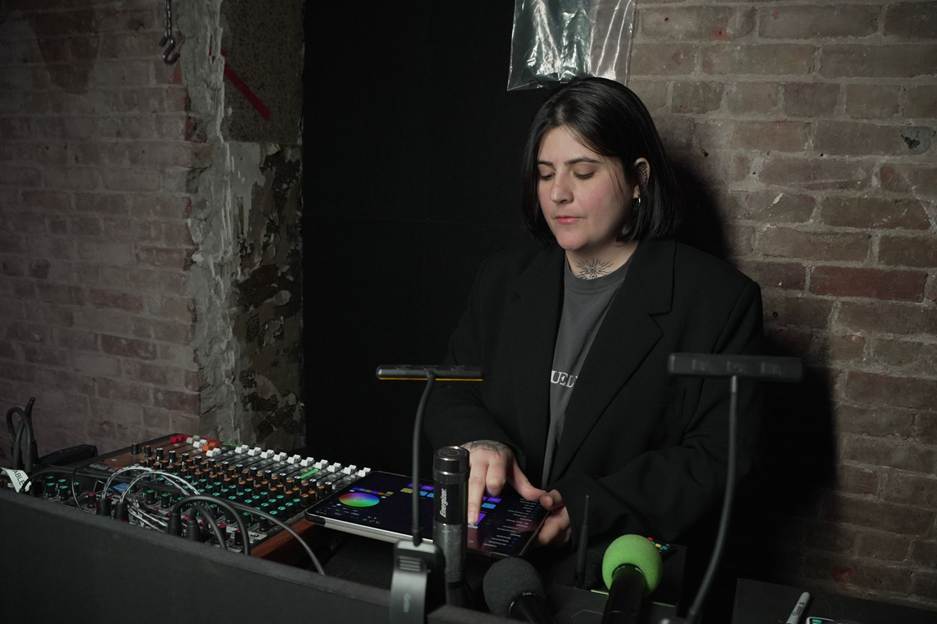
There is a particular kind of artist whose work is hard to point at, because it is everywhere in a space at once, in the way a sculpture catches the light, in the clarity of a recorded interview, in the fact that a backstage performer three floors up can hear their cue. At SoMad, the multidisciplinary arts studio in New York City, that artist is Victoria Mussi. As SoMad’s Audiovisual Lead and, in production contexts, its Audiovisual Director, she has spent several years and dozens of projects becoming the person whose practice holds the institution together: lighting designer, audiovisual producer, technical director, jury member, exhibition collaborator, and increasingly a planner of what the organization will become. Her relationship with SoMad is not a single commission or a one-off thematic statement. It is an ongoing body of work, built collaboratively, that has grown alongside the institution itself.
To understand that relationship, it helps to understand what SoMad is trying to do. Founded by Sara Arno, SoMad operates less like a conventional gallery and more like a producing studio and cultural platform, a multi-floor environment dedicated to emerging and established artists working across performance, drag, experimental film, installation, and media art. Its programming consistently returns to questions of ecology, queer community, identity, land, and belonging, treating those questions not as wall text but as live, social experiences. SoMad’s mission is fundamentally about access and continuity: building a recurring, sustainable space where artists can take risks, where audiences and artists share the same room, and where the work made there is documented, archived, and carried outward into the broader art world. Mussi’s contribution has been to give that mission a technical and creative foundation on which it can stand.
Infrastructure, operations, and identity
Mussi is a multidisciplinary artist whose own practice spans lighting design, audiovisual production, and recording environments, and she approaches SoMad’s spaces from inside that practice rather than as an outside contractor. When she looked at the studio, she saw not a finished venue but an ecosystem that could be made better at supporting other people’s work, and a great deal of her contribution has been exactly that: systems designed so that artists and the organization itself can do more.
The list is substantial, but the logic behind it is consistent. She designed and installed an internal SDI live-streaming network so that a real-time feed from the main stage reaches the upper floors, allowing performers and technicians to follow timing and cues during a show. She re-engineered the building’s audio distribution into independent speaker networks routed from a central booth, added acoustic treatment to the second-floor performance area, and took on mixing and mastering of the studio’s recorded media to ensure its videos meet professional sound standards. She built a dedicated lighting studio on the third floor around seven Aputure 300d fixtures, designed to shift between a neutral white-box, a gallery setup, and a cinematic environment. She implemented a wired HDMI projection matrix capable of driving more than eight projectors as a single coordinated visual field, and a wireless CRMX/DMX lighting network integrating more than fifteen programmable fixtures. She even introduced a broadcast-grade CRT monitor and a hybrid analog workflow to give the studio’s promotional media a distinctive visual texture.
What matters here is not the equipment but what it makes possible. Each system expands what a visiting artist or resident can attempt, and each strengthens SoMad’s ability to document and preserve its own programming, a direct expression of the institution’s commitment to building a lasting record of artists’ work. Just as importantly, this work has reached beyond individual events into the organization’s operational growth: supporting exhibition and event production, building the studio’s archival and media capacity, and helping shape aspects of SoMad’s identity, presentation, and branding. The visual texture of the studio’s promotional materials, the consistency of its documented programming, and the professional standard of its live productions all carry her hand. Infrastructure, in Mussi’s practice, is a way of caring for the mission and of helping the institution grow into itself.
Mad World, realized
The clearest demonstration of how her role has matured is Mad World, SoMad’s annual gathering around environmental art. Running for several consecutive years, it has become a recurring cultural platform that brings together visual art, performance, experimental film, and community engagement, unfolding not as a conventional exhibition but as a multi-floor live event that intentionally dissolves the line between audience and artist.
For the 2025 edition, Mussi led the technical structure and live production supporting more than a dozen artists, working individually with each artist’s installation, from David Aliperti’s sculptures to Dakota Gearhart’s headline immersive environment, Sophia Wolfe’s projection-mapped work, and pieces by the Institute of Queer Ecology, Soraya Zaman, Zulu Padilla, and Amina Gingold, each given its own calibrated, conservation-conscious lighting. The 2026 edition, A Bag to Breathe Into, has now been successfully realized as well: on view from April 18 through June 13, 2026, at the studio’s NoMad space, it activated the building with the work of 23 visual artists, 9 experimental films, and 5 video installations, drawn from an open call that attracted more than 640 submissions from 49 countries. Grounded in the framework of Intersectional Environmentalism and taking its title from a poem by Joy Priest, the exhibition refused to separate social justice from environmental concern, engaging colonialism, migration, disability justice, and Afro-surrealism. For this edition, Mussi led the audiovisual production and technical implementation across the exhibition, the lighting, projection, sound, and media systems that allowed a sprawling, multi-format program to function as a coherent whole, while also serving on the curatorial board that reviewed and selected the open-call works through a structured, criteria-based process.
That dual involvement, shaping both the program and its realization, is a good measure of how SoMad and Mussi have grown in tandem. Producing Mad World successfully, year after year, is exactly the kind of institutional continuity the studio sets out to demonstrate, and Mussi’s leadership is central to making each edition happen.
The collaboration that has meant the most: Life is Drag
Asked which collaborations have mattered most to her so far, Mussi points to Life is Drag, the SoMad residency with artist Rachel Rampleman, as one of the most meaningful works she has contributed to, a project that drew strong press visibility and reflected both her creative and production roles in full. She was deeply involved in leading the show’s development, working closely with the artist throughout the process, from concept to execution.
In practice, that meant designing and installing the complete lighting system and developing individual lighting compositions responsive to the dramaturgy, movement, and emotional tone of each act, so that every performance had its own visual identity while the program held together as a whole. It meant coordinating the recording team across performances, camera positioning, visual continuity, timing, real-time adjustments, and configuring the audio system for both live sound and precise capture. For the documentary component, she built an intimate lighting and audiovisual environment tuned to narrative depth and emotional authenticity. Throughout, she functioned simultaneously as creative author and production lead, in close and continuous dialogue with Rampleman. Life is Drag is the project where the two halves of her practice, the artist and the technician, are most visibly the same person.
Working artist to artist
Much of Mussi’s work at SoMad happens in direct collaboration with individual artists, and that intimacy shows up across very different kinds of projects. For performers including Esther the Bipedal Entity, Untitled Queen, and Amygdala, she has served as technical director and lead light designer, synchronizing projected media with live timing, directing adaptive lighting through rapid tonal shifts, and balancing sound in real time within immersive configurations, always so that the technical decisions follow the artist’s intention.
One of the most production-intensive of these collaborations was the official music video for Tōth’s “Touching,” featuring Kimbra and directed by Michael Leviton, in which Mussi served as Producer Assistant, representing SoMad. She was responsible for the audiovisual system design, in particular a lighting setup controlled through CRMX wireless systems with antennas distributed across the luminaires for precise and flexible control. The rig, two ARRI Orbiter fixtures, four ARRI S30 panels, two moving spotlights, eight Astera fixtures, and two Nanlite units created a highly adaptable lighting environment, and through it, the video achieved a rich, color-driven atmosphere that significantly enhanced its mood and cinematic quality. She also configured the space with a fully engineered surround sound system, including subwoofers and a calibrated speaker array, to support playback and deliver an immersive experience throughout the room. Representing SoMad, she provided full technical and production support to the directors and artists, ensuring the space operated at a professional broadcast and live-performance standard.
A different kind of collaboration shaped two residency exhibitions that shared a gallery at SoMad: Keith LaFuente’s Acts of Service, a body of kinetic sculptures and paintings, alongside Yi Hsuan Lai’s Rubber Rubber. Here, Mussi’s contribution was structural and spatial. She designed the booth and the overall structure for the shared show, worked through a careful run-through of the sculptures with the artists, and developed a dedicated lighting system built around eight Aputure Light Globes she configured for the works, leading the installation so that two distinct practices could coexist legibly in one space. It is a reminder that her role adapts to what each project actually needs: sometimes immersive sound and CRMX lighting, sometimes the quieter craft of structure, placement, and illumination.
Carrying SoMad’s artists outward
A producing studio’s reach is measured partly by where its artists’ work travels, and here Mussi has effectively become an institutional ambassador. She handled the exhibition lighting for SoMad’s presentation of Soraya Zaman and Paul Simon at NADA New York, and carried that outward-facing work through Miami Art Week, contributing to the studio’s presentations at NADA Miami, the Armory’s Winter Show, and AIPAD. For Keith LaFuente’s presentation at NADA, she took responsibility for the booth design, the run-through of the sculptures with the artist, and the on-site installation, while also representing the work directly to collectors, curators, and the press.
This outward-facing work is of a piece with the rest of her practice: it translates studio production into the language of international fairs without losing what made the work distinctive in the first place, extending both the artist’s visibility and SoMad’s presence in the broader art ecosystem.
Collective work and community
SoMad’s mission is community-based as much as it is artistic, and Mussi’s collaborations extend well beyond the studio’s own roster. She worked closely with Alice Austen House Museum executive director Victoria Munro to bring archival, LGBTQ+-historically significant photographic material into Mad World, handling the installation and lighting of loaned works to museum standards and later helping organize a community volunteer day and museum tour. She designed the audiovisual environment for programming tied to the New York Restoration Project, for Transgender Awareness Week events, and for a panel connected to The Okra Project. Through SoMad’s partnership with the immersive media company Moth + Flame, she served as lead light designer on a VR training production made in the studio. And for SoMad So Queer 2026, the opening anchor of the year’s residency program, curated by Amygdala, she takes on the role of Audiovisual Director, responsible for the technical and aesthetic framework holding together a roster of nationally and internationally recognized performers. SoMad’s program for Upstate Art Weekend, presented with Upstate Films and drawn from the Mad World open call, is one more recent extension of this community-facing work into a regional festival, with Mussi on the selection jury and leading the live audio and lighting production.
Designing the next chapter
Perhaps the strongest evidence that this is a long-term relationship rather than a series of gigs is that Mussi is now helping design SoMad’s future. The audiovisual infrastructure for the institution’s new facility, planned for 2026–2027, is being developed through weekly meetings involving Beth Hansen, Erick Ruiz, Christina Rodriguez, Mussi herself, the TAD engineering team, project manager Richard Coley, and founder Sara Arno. The plan treats each floor as a distinct programmatic intention while insisting on interoperability, systems that can function independently yet share signal and content across the building for complex multi-floor productions. Mussi’s advocacy in those rooms comes directly from experience: she pushed for a reconfigurable stage system because of what she learned producing Mad World, Life is Drag, and Pride programming, where no two events share a stage layout, and for live-streaming and ADA-compliant assistive listening as defaults rather than upgrades, reflecting an institution that programs publicly and takes disability justice seriously in its curatorial practice.
Among the possibilities she has been discussing with the team is a dedicated music residency, a format SoMad doesn’t yet have room for, but one she hopes to help build and run when a slot opens, extending the studio’s residency model into sustained, long-form work with musicians. It is the natural next step for someone whose recording, mixing, and live-sound practice already runs through so much of what the studio produces.
That she is shaping the building SoMad will grow into is the natural conclusion of everything that came before. From the first internal streaming run between floors to a floor-by-floor design strategy for a new home, Victoria Mussi’s work has followed one consistent principle: build the room so the work can happen, and build it well enough that it keeps happening. Her relationship with SoMad is best understood not as authorship of any single piece but as a sustained, collective practice, years of technical and artistic collaboration in service of an institution whose purpose is to make space for others.