James McAvoy has never been an actor who keeps his inner life at arm’s length from public conversation. The Scottish actor, now 46, has spent the better part of two decades building one of the most versatile careers in contemporary Hollywood, and yet it is his reflections on fatherhood, sleepless nights, and the peculiar geography of Scottish stardom that have recently drawn some of the most genuine attention. In a candid interview with The Guardian, McAvoy opened up about what it means to become a father again in his forties, what it costs to direct your first film at an age when most directors are already on their third or fourth feature, and why Scotland keeps producing world-class talent that the industry somehow never quite makes room for.
The actor became a father for the first time in 2010, when his son was born during his marriage to actress Anne-Marie Duff. The relationship ended, and McAvoy eventually married Lisa Liberati. In 2022, the couple welcomed a son together, making McAvoy a father for the second time at the age of 42. The gap between those two experiences, separated by over a decade of life, loss, professional evolution and personal change, has given him a perspective on parenthood that feels earned rather than theoretical.
He told The Guardian, “Having a kid at 42 is definitely easier in some ways. I worry less. I’m a bit more philosophical. But it’s also harder, because you’re just older and tiered.” That balance of ease and exhaustion is something many parents who came to the role later in life will recognise immediately. The anxiety that tends to accompany first-time parenthood in your twenties, that low-level hum of catastrophizing and second-guessing, does tend to soften with age and experience. You have lived enough by your forties to understand that most things pass, that children are more resilient than they appear, and that the relentless pressure to do everything perfectly is largely self-imposed. What does not soften, of course, is the physical reality of keeping pace with a small child when your body is operating on a different timeline than it was fifteen years ago.
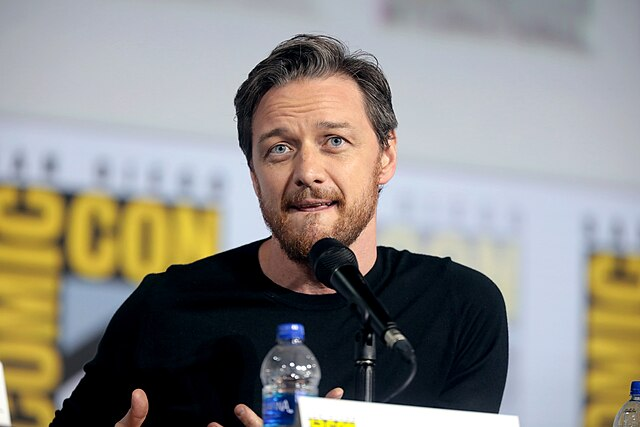
There is something quietly affecting about McAvoy‘s honesty here. Fatherhood at any age carries its own specific weight, but the particular texture of becoming a parent later, with more self-awareness and less stamina, is not discussed nearly as often as it deserves to be. Men in their forties who become fathers for the first or second time are navigating a set of contradictions that do not resolve neatly, and McAvoy’s willingness to name both the relief and the tiredness simultaneously feels like a more complete picture than the triumphant narratives that tend to dominate these conversations.
The theme of doing something for the first time in your forties extends beyond fatherhood in McAvoy’s current chapter. He has stepped behind the camera to direct his debut feature film, California Schemin’, and the experience has apparently brought with it a very particular kind of stress that he had not anticipated encountering at this stage of his career. He said, “I’m getting all that first-timer stress in my 40s. When we were shooting the film, I’d wake up at 2.30am with the film buzzing in my head. That’s the time that you work your socks off, burn the midnight oil, run the extra mile, and usually when you’re doing that, you’re in your 20s.”
The image of McAvoy lying awake at half past two, his mind working through shot lists and edit decisions, is both familiar and unexpectedly moving. That particular kind of sleepless creative anxiety is usually associated with youth, with the hunger and uncertainty of someone at the beginning of their path. To encounter it again, or perhaps for the first time in a new discipline, in your mid-forties, is its own kind of reckoning. It suggests that genuine creative ambition does not plateau with experience, and that the vulnerability of making something new does not diminish just because you have already made a great deal in a different form.
California Schemin’ tells the true story of two Scottish rappers who abandoned their accents and adopted American personas in an attempt to break into a music industry that had little commercial appetite for authenticity from their particular corner of the world. The story resonated with McAvoy, and it is not difficult to understand why. He said, “If I was making this film set in Boston about the exact same age group, there’d be two movie stars playing those roles.” Instead, the film features Samuel Bottomley and Seamus McLean Ross, talented actors who are considerably less well known than the names McAvoy might have attracted with a different postcode on the script.
His observations about the structural limitations facing Scottish entertainers in the global industry are pointed and worth sitting with. He said, “There’s maybe five actors in Scotland who could get stuff greenlit, and not definitely, if it’s set in Scotland, Gerry, Karen Gillan, me, Richard Madden.” He then added, “And we’re all over 35 and only one of them is a woman. I don’t know why that is, because it’s not like we don’t make actors. So where’s that 21-year-old movie star?”
It is a genuinely interesting question, and one without a tidy answer. Scotland has produced extraordinary creative talent across generations, in literature, music, theatre, and film, and yet the pipeline from that talent to genuine international star power remains narrow and inconsistent. Whether that reflects something about how the industry values regional identity, how Scottish stories are packaged and sold, or simply the unpredictable mathematics of who breaks through at any given moment is difficult to say with certainty. What McAvoy’s question does is hold the gap open rather than explain it away, which is perhaps the more honest position.