Another episode in the expanding history of private spaceflight was SpaceX Starlink 6-104 mission, which took off the night of February 21, 2026, and shot a Falcon 9 rocket into black Florida skies. The rocket took off at Launch Complex 40 at Cape Canaveral Space Force Station at exactly 10:47 p.m. EST to deliver a new set of satellites to the low-Earth orbit as part of Starlink. To most of the spectators on the Space Coast in Florida, the launch was not just another mission. It was another sign of how regularly and assuredly SpaceX frequently flies into space.
This Falcon 9 was loaded with 28 Starlink satellites of the vast network of broadband satellites being launched by SpaceX. Although 29 satellites were mentioned in first accounts, the mission data confirmed 28 satellites were put into the low-Earth orbit. These satellites will be added to thousands of existing satellites that surround the planet, creating a mesh network that is meant to supply the internet with high-speed internet services all over the world. With Starlink program, the discussion on the topic of connectivity has been continuously redefined, particularly in under-serviced and remote areas where conventional infrastructure remains inaccessible.
Cape Canaveral Space Force Station appears to have Launch Complex 40, which is one of the most used pads by SpaceX. This was a fine February evening, and the countdown was carried out with the usual exactness. When the engines started, the 9 Merlin engines of the Falcon 9 shot up a blazing shower in the sky and the rave reverberated along the coastline. It was within minutes and seconds that the rocket shot up into the air and its course was viewed by the darkness. The view of a late-night launch has now been almost a daily occurrence to the onlookers close by, but it continues to attract people to the out-of-doors with their cameras in readiness, waiting until they see that yellow streak of light.
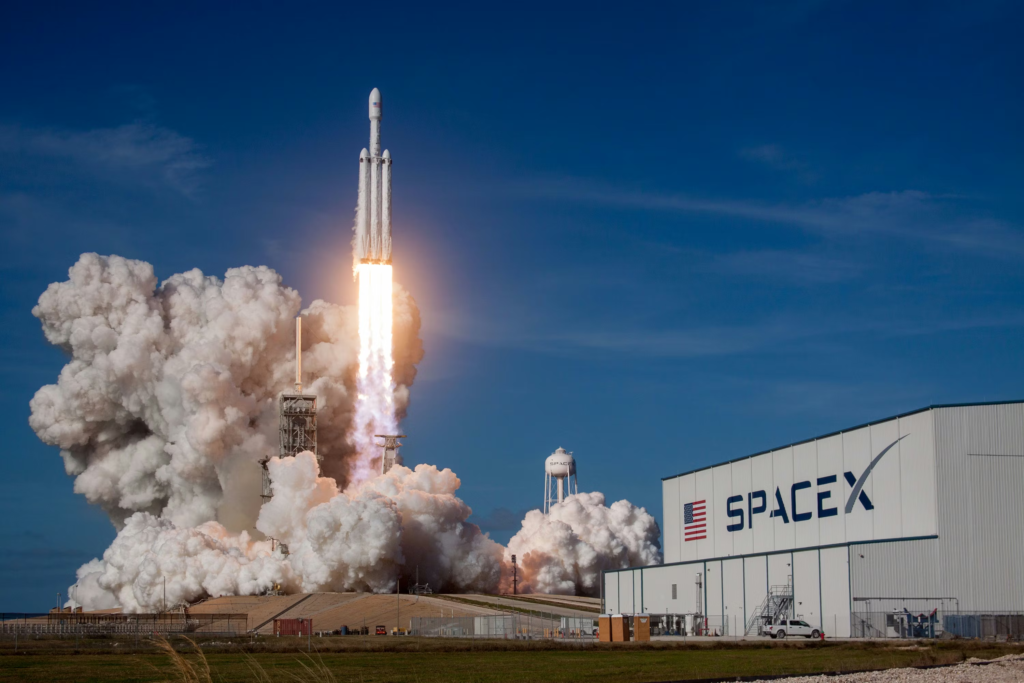
The Starlink 6-104 mission is an example of an impressive pace that SpaceX has reached in the last ten years. SpaceX, which was founded by Elon Musk, has driven the notion that spaceflight could be reusable and, in fact, cost-effective. What was once viewed as an ambitious reusability experiment the Falcon 9 rocket has become proven workhorse. Its initial stage booster is set to be re-entering the earth vertically after launch and this drastically lowers the cost of launching payloads into space. Even though it is usually the spectacle of the liftoff that captures the attention, the silent technical ballet behind every launch mission is what shows the greater success of the company, which is reliability.
The Starlink satellites operate at low-Earth orbit which is approximately 300-1200 miles above the surface of the earth. Satellites are able to orbit the world at this altitude at a time span of 90 minutes. In the case of internet service, distance is important. The low orbits minimize latency or the speed of the signals between the user terminals and satellites is higher. Such technical advantage has enabled Starlink to compete with traditional satellite internet providers which operate in much higher geostationary orbits.
Starlink has evolved over the years to become a fully operational network of the world, and it began as a radical idea. Starlink terminals are increasingly visible in rural areas, during maritime operations, disaster areas, or even the commercial planes. The service is frequently referred to as the lifeline by the users especially where fiber cables or cell towers are unfeasible. In terms of the industry, the Starlink constellation is an essential change in the mode of deployment of satellite infrastructure. SpaceX does not use a few large satellites; the company uses thousands of smaller, interconnected devices which operate and interact dynamically.
Nevertheless, the astronomers and environmental activists have been arguing due to the sudden rise of satellites being launched. Other scientists have been alarmed at the issue of light pollution, as well as the affects of satellite constellations on the observations of the ground. Others doubt the sustainability of the placement of such a number of objects in orbit in the long term. SpaceX has reacted by trying various satellite coating and orientation changes that aim at lowering the reflectivity. The company has also focused on collision avoidance systems and good deorbiting procedures once every satellite has ended its working life.
Operationally, the missions (Starlink 6-104) have demonstrated the standardization of the launch process. And what used to take years of planning and infrequent windows of launch opportunity now occurs with phenomenal frequency. The fact that the Falcon 9 is reusable is vital in ensuring the same pace is kept. Another successive recovery and refurbishment develops institutional knowledge, streamlining procedures and reducing risk. That repetition has changed launches into a few national events to near weekly events along the Florida coast.
A wider economic aspect also has to be taken into account. The Space Coast in Florida has been renewed with the frequent commercial launches. Ripple effects are felt by hotels, Restaurants, tourism operators and even local contractors. The availability of SpaceX, combined with NASA and other aerospace companies, has assisted in the renaissance of an area that was unsure of its future following the retirement of Space Shuttle program. Stable radiance of rockets setting the night sky has now become a symbol of strength as much as of invention.
The Starlink network is still technologically developing. Newer satellites have inter-satellite laser links meaning that they can communicate directly with each other in space instead of passing all signals through ground stations. The expansion increases the coverage on the oceans and remote locations where the coverage of terrestrial infrastructure is sparse. With every incremental launch, such as Starlink 6-104, that web of connectivity becomes stronger.
But despite all the engineering accomplishments, there remains an element of wonder with a launch. It gives the impression that the ambition of humankind is alive and looking to the future watching a Falcon 9 ascend the night sky. SpaceX has got used to what would have been regarded as a miracle, and normalization does not remove the wonder. In a way, though, it is an indicator of how swiftly the space exploration process is turning into an arena where governmental programs are rapidly giving way to a period of more guest-and-host interaction between the two sectors.
When the satellites of Starlink 6-104 fall in position, they become a part of a network that is still reinventing technology and the world economy. The advocates view this increased internet connectivity as revolutionary particularly to the third world. Critics caution on orbital cluttering and sustainability in the long term. Both schools of thought bring out the fact that space industry is currently functioning in a huge measure than ever before.