The billionaire moon race has taken the decisive new phase with Elon Musk of SpaceX and Jeff Bezos of Blue Origin now fully accelerating their lunar plans each with a goal to carve out the next phase of human space exploration before China follows through with a planned mission to the moon by 2030. A previously symbolic competition between two of the richest businesspeople in the world has developed into a strategic one that has an impact to technology, national policy, and future of private spaceflight.
In Washington or the world aerospace community, it is increasingly being realized that the moon is not a far-off dream or an echo of the Apollo days. It is turning into a testing ground of economic infrastructure, artificial intelligence systems, satellite networks, and sustainable habitation of humans. Both SpaceX and Blue Origin are not just seeking to become contractors in manned missions into space but they are building an architecture of enduring human presence in space.
Elon Musk, the SpaceX founder, has over recent months become more focused on the moon than ever, which comes as a surprise even to those who pay close attention. Over the years, Musk only talked about Mars almost all the time, often referring to the moon as a distraction and the Red Planet as a final insurance policy of humanity. Just a few months ago, in supporting the possibility of an uncrewed mission to Mars on a Starship, he was optimistic about this. However, currently, as another large public offering is around the corner that may allegedly value SpaceX at greater than one trillion dollars, the brief-term story about the company has transformed.
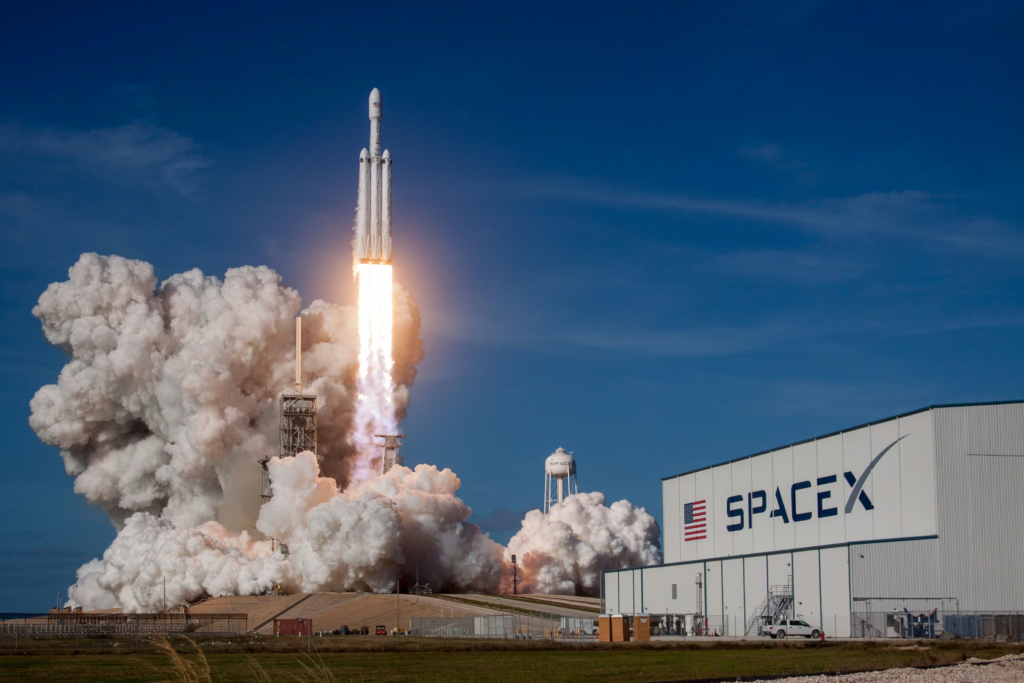
Musk has informed his employees and podcast listeners that he would like to construct Moonbase Alpha, as well as put a launcher on the moon to launch satellites into orbit. The goal is not just symbolic. The lunar base would host an extended artificial intelligence-driven satellite network which Musk potentially envisions containing as many as one million satellites in the future. This vision allows the moon to be a logistical support station as well as a technological enhancer, where launch costs are minimized and the moon acts as a launching pad to further space expeditions.
This repricing is timely in terms of finances. An eventual SpaceX IPO has led Musk to highlight the fact that the company is a leader in the area of launch capability, deployment of satellites, and reusable rocket technology. Shareholders will probably scrutinize the ability of the SpaceX not just to dominate the Earth orbit, but also the cislunar space. NASA Artemis plans are primarily anchored on the Starship program that has yet to complete a significant technical checklist before it can consistently deliver astronauts to the surface of the moon. Every flight trial would have colossal stakes operationally and reputationally.
In the meantime, Jeff Bezos has been reorganizing the activities of Blue Origin privately. Having been known originally as a suborbital tourism flight provider in its New Shepard vehicle, Blue Origin has decided to focus the major portion of its resources out of that business line. The company has also switched focus to its Blue Moon lunar lander and become very aligned with the Artemis program of NASA. The launch of an uncrewed lunar mission is planned this year and it means that Blue Origin is planning to prove its operational credibility in the deep space.
Bezos has long expressed the idea of taking heavy industry out of the Earth to save the environment of the planet, and he makes his argument to place millions of people working and living in space. In this philosophy, the lunar surface is not a goal, but an industrial presence. Focusing on the Blue Moon lander and overall lunar infrastructure, Blue Origin seems to be hastening that roadmap. The move to keep space tourism as a secondary consideration implies that being prestigious is not enough; actual lunar exploits will mark the next phase.
It is impossible to disregard the wider geopolitical context. The space agency of China has made plans to launch astronauts to the moon by 2030 and this has revived the analogy of the cold war space race. The symbolism is strong even though nowadays the competitiveness is between individual companies and not only the governments of countries. American policy makers are deathly conscious that lunar leadership has a strategic implication, with technology supply chains, defense capacity, and world impact.
To a great extent, the billionaire moon race indicates a change in the funding and implementation of the space exploration. The national pride and geopolitical competition of the Apollo era led to the massive expenditure of the state. In the modern world, capital and business initiative are equally influential. The reusable spacecrafts at SpaceX have significantly lowered the price of launch, which has transformed the nature of spaceflight economics. The long-term infrastructure and sustainability of Blue Origin is based on the systematic style of engineering. The two approaches have one point of destination the lunar surface.
Technical challenges are still daunting as far as the industry is concerned. To construct a permanent or semi-permanent lunar base, it is necessary to have dependable life support infrastructure, radiation shielding, power supply and effective logistics of transportation. Sentencing heavy equipment into space in the earth is costly and complicated. Even Musk with his conception of a satellite-slinging machine on the moon would mean taking advantage of the reduced lunar gravity to minimize the amount of energy needed, however, converting theory to practice will take decades of intense testing.
There is also the issue of the perception of the people. Musk is a big picture thinker with successful and unsuccessful timing. Critics observe that the big talk can usually follow technical immaturity. Bezos, in turn, is less communicative but puts Blue Origin on the stable and calculated path. These two opposing leadership styles have to be considered by investors and policymakers, and which firm is capable of bringing a steady improvement.