When international media began paying attention to the rise of English-language stand-up comedy in the Netherlands, it confirmed what performers and audiences had already sensed. The country, long known for its openness and sharp social awareness, has quietly become one of Europe’s most fertile grounds for comedy in English.
What started as an expat-driven niche in Amsterdam has grown into a nationwide circuit. English comedy nights now run regularly across cities like Rotterdam, Utrecht, Haarlem, Alkmaar, and Maastricht. Audiences are no longer limited to tourists or internationals craving familiarity. Increasingly, Dutch locals attend as well, drawn to comedy that reflects a globalised society with Dutch directness at its core.
This expansion has done more than increase the number of shows. It has changed who feels entitled to step on stage. The Dutch English comedy scene has become a place where unconventional voices not only fit, but thrive. Performers arrive from different countries, cultures, and, increasingly, professions that have little to do with entertainment.
One of those performers did not come from theatre, improv, or writing, but from neuroscience and entrepreneurship.
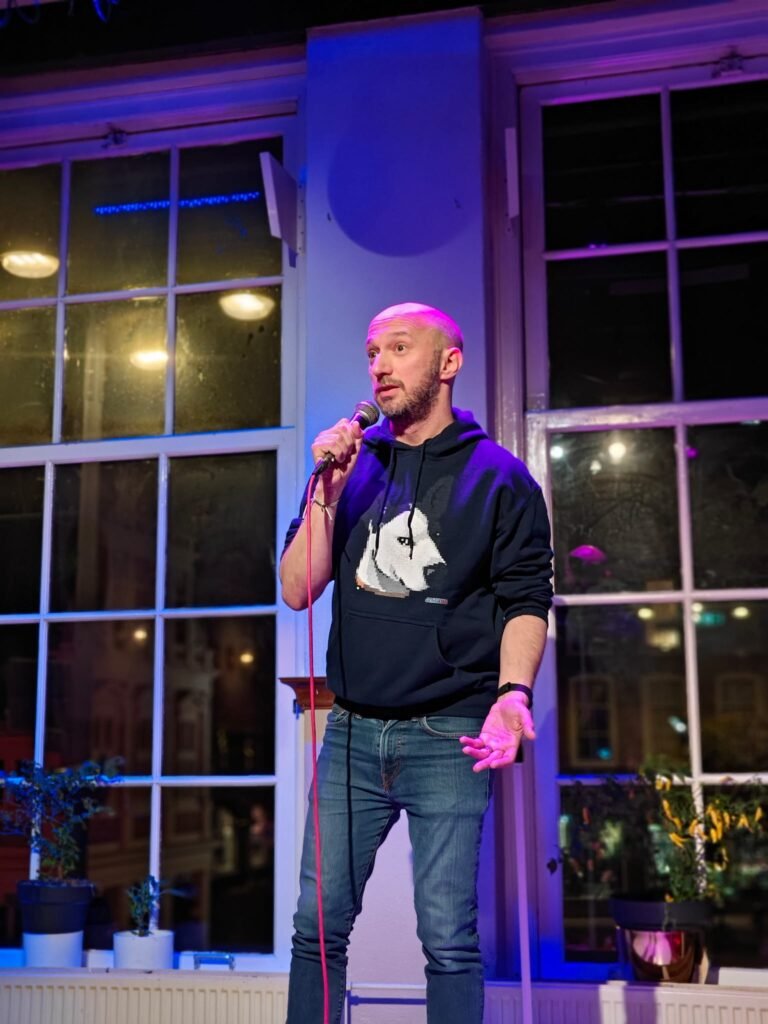
In mid-2025, Roy Cohen, a neuroscientist and tech entrepreneur, entered the Dutch stand-up circuit almost by accident. Comedy was not a planned career move. It began as an experiment. From a scientific perspective, the appeal made sense. Neuroscience studies how humans process emotion, anticipate outcomes, and react to surprise. Stand-up comedy relies on the same mechanisms, only the data arrives instantly, in laughter or silence.
The Netherlands turned out to be the ideal environment for such an experiment. With near-universal English fluency and a cultural tolerance for bluntness, the barrier to entry was low, but the expectations were high. Institutions like Boom Chicago, whose stand-up training program has become a central gateway into the English comedy scene, play a crucial role. The program focuses less on crafting perfect jokes and more on learning how to fail publicly, recover quickly, and build material from personal truth rather than performance personas.
After completing the program, Cohen began performing across the country, moving through the full spectrum of rooms that define the Dutch circuit. From packed venues in Amsterdam to intimate bars in smaller cities, each audience revealed a different rhythm. Amsterdam crowds tended to reward darker, more conceptual material. Rotterdam leaned into blunt honesty and social critique. Smaller cities often surprised with their openness, especially when offered perspectives that felt lived-in rather than imported.
The material itself reflected both the scene and the performer’s background. Cohen’s comedy often centers on identity and contradiction. On stage, he describes himself as gay, Jewish, of Russian descent, and born in Israel, a combination he refers to as “the perfect hate crime starter pack.” These jokes are not shock tactics, but entry points into shared discomforts audiences already recognize. They sit alongside distinctly Dutch observations that only emerge after living in the country long enough: bicycles enjoying more rights than humans, pigeons and ducks quietly running the nation, and cars so progressive they seem to have political identities of their own.
This blend of outsider perspective and local familiarity mirrors the experience of many internationals in the Netherlands. Over time, the jokes shift from observing Dutch life to belonging within it. The comedy evolves as the performer does.
What makes Cohen’s trajectory representative of this moment is not speed or virality, but process. Credibility in the Dutch comedy scene is earned slowly. It comes from showing up repeatedly, performing in rooms of twelve people one night and eighty the next, bombing publicly and returning anyway. Over dozens of performances across the country, trust builds, with bookers, fellow comedians, and audiences who come back and bring friends. Visibility grows not through hype, but through consistency.
This slow-burn approach mirrors Cohen’s background in science and entrepreneurship, where iteration, failure, and long-term signals matter more than short-term wins. Comedy, in this sense, becomes less a departure from his previous work and more a continuation of it, another system to observe, test, and refine.
The broader context makes this story possible. As English comedy in the Netherlands matures, it is no longer defined by imitation of American or British scenes. Instead, it is shaped by migration, queerness, multiculturalism, and Dutch directness. Audiences are not just consuming jokes; they are participating in shared reflection. The scene rewards honesty over polish and perspective over pedigree.
Cohen’s presence on Dutch stages reflects that shift. A neuroscientist-turned-entrepreneur who performs stand-up across the Netherlands is no longer an anomaly here. It is evidence of a scene confident enough to absorb unlikely voices and let them shape its future.
For audiences, this means sharper, more honest comedy. For performers, it means space to experiment. And for the Dutch comedy scene as a whole, it signals that its most interesting stories may come from places far outside comedy itself, one open mic at a time.