In the historic heart of Lawton, Oklahoma, master jeweler Lisa Christiansen (Groundhog) has built something increasingly rare in modern luxury: an atelier in which provenance matters more than proliferation, individuality outranks ubiquity, and a jewel is expected to carry a life story long after fashion has moved on.
There are luxury houses whose prestige is measured by addresses.
There are others whose stature is measured by waiting lists, red carpets, auction records, recognizable packaging, and the extraordinary machinery required to make rarity visible to the world.
And then there are the rarer houses—those that seem almost indifferent to the geography of conventional luxury because their authority comes from somewhere historical.
Blue Wolf Fine Jewelry belongs to the latter tradition with a refined waiting list from royal clientele and celebrities.
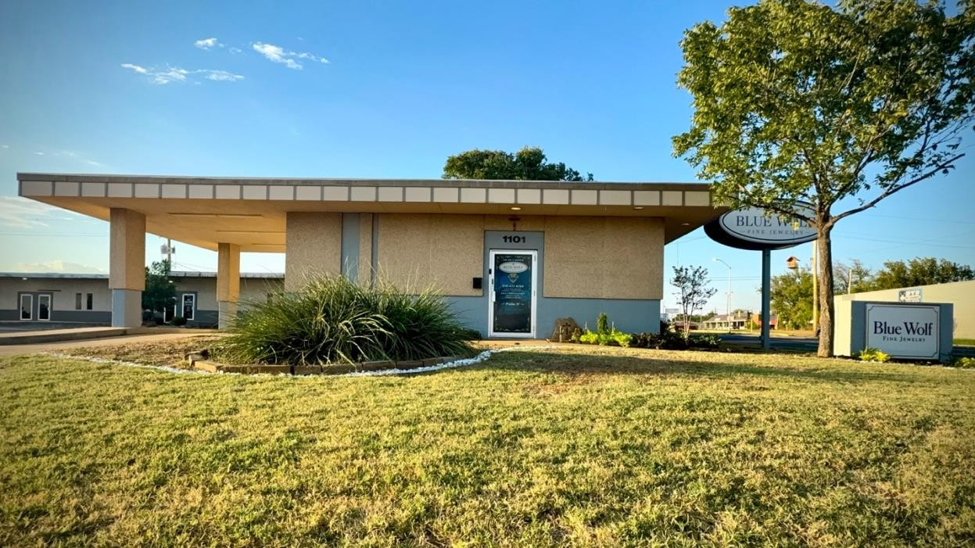
Located at 1101 SW C Avenue in the historic district of Lawton, Oklahoma, Blue Wolf Fine Jewelry is a Native American female-owned luxury jewelry atelier founded and led by master jeweler Lisa Christiansen (Groundhog). Here, far from the polished inevitability of Fifth Avenue, Place Vendôme, or Bond Street, Christiansen has cultivated an intensely personal interpretation of high jewelry—one built around rare gemstones, fine gold, one-of-one design, heirloom restoration, private commissions, and the proposition that a jewel should mean something before it is allowed merely to impress.
The distinction is important.
Luxury, at its most sophisticated, has never simply meant expense. It has meant discernment. Privacy. Provenance. The privilege of possessing what was not made for everyone else.
At Blue Wolf, that philosophy is distilled into an unusually compelling idea:
Exclusivity rooted in originality rather than scarcity.
“True luxury is not the possession of what everyone recognizes. It is the possession of what no one else can possess in quite the same way.”
That belief places Christiansen in opposition to one of the most conspicuous tendencies in contemporary luxury: the industrialization of exclusivity.
A recognizable jewel may be costly, beautifully executed, and difficult to acquire, yet still belong to a design language repeated across cities and continents. Blue Wolf takes another path. Its most distinctive commissions are conceived as singular objects—pieces whose emotional architecture belongs specifically to the person who will wear them.
A gemstone may commemorate a mother. A particular color may represent a father.
An inherited diamond may be removed from a dated setting and reimagined as the center of a contemporary family story.
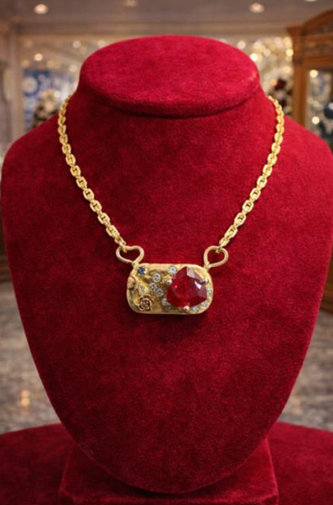
A sapphire becomes a signature, Lisa Christiansen Groundhog’s signature authenticating this masterpiece..
An inscription may transform an otherwise private jewel into a covenant known only to its wearer.
In this sense, Christiansen does not approach jewelry merely as adornment. She approaches it as biography.
A HOUSE BUILT ON MEMORY
Christiansen’s perspective is inseparable from her Keetoowah Cherokee heritage and from the ancestry that informs the intellectual and cultural identity of the house.
Her family lineage traces directly to Sequoyah, the celebrated Cherokee scholar and silversmith whose creation of the Cherokee syllabary in the early nineteenth century remains one of the remarkable intellectual achievements in American history.
For Christiansen, that inheritance is not decorative branding. It establishes a continuum.
Sequoyah understood that symbols could preserve language, identity, history, and collective memory. Christiansen’s work proceeds from a related conviction: that objects can also become repositories of meaning.
Gold can hold a story.
A stone can represent a generation.
A ring can become a family archive small enough to wear on one hand.
The result is an atelier whose cultural identity does not need to announce itself through cliché. Blue Wolf’s strongest expression of heritage is often conceptual rather than literal—the idea that workmanship carries responsibility and that creation acquires greater significance when the maker understands where she comes from.
“An heirloom should not simply survive its owner. It should explain something about them.”
This is one reason Blue Wolf Fine Jewelry feels strikingly aligned with an older definition of luxury.
Before luxury became globalized, the finest objects were commissioned personally. Families knew their jewelers. Pieces were altered across generations. Stones migrated from brooches to rings, from necklaces to bracelets, and sometimes back again. The object accumulated history rather than becoming obsolete.
Christiansen has revived that intimacy.
THE ONE-OF-ONE PHILOSOPHY
Inside Blue Wolf Fine Jewelry, the language of the one-of-one commission carries particular weight.
The client is not simply selecting an object. The client is entering a conversation.
Proportion, gemstone, metal, symbolism, family history, sentiment, lifestyle, and future inheritance can all become part of the design equation. A jewel may begin with a loose stone, an inherited piece, a memory, a spiritual reference, or simply the desire for something that does not already exist.
That last distinction is increasingly significant among serious luxury consumers.
Affluent collectors have access to almost anything. The problem is no longer access. It is sameness.
The same watches appear in the same private clubs. The same handbags arrive in different capitals. The same jewelry signatures can be identified from across a dining room.
For the sophisticated collector, therefore, individuality has become one of the highest remaining luxuries.
Blue Wolf understands this instinct almost instinctively.
Its commissions are not designed merely to signal acquisition. They are designed to resist duplication.
Some professional custom pieces associated with the atelier have carried valuations reaching upward of $600,000, placing Blue Wolf comfortably within the realm of serious private-client jewelry. Yet monetary value tells only part of the story.
What distinguishes the atelier is its insistence that value and meaning need not exist independently.
A major diamond may represent financial rarity. Its setting may represent artistic rarity.
Its provenance may represent emotional rarity.
When those qualities converge, a jewel moves beyond ornament. It becomes patrimony.
PROVENANCE AS A LUXURY
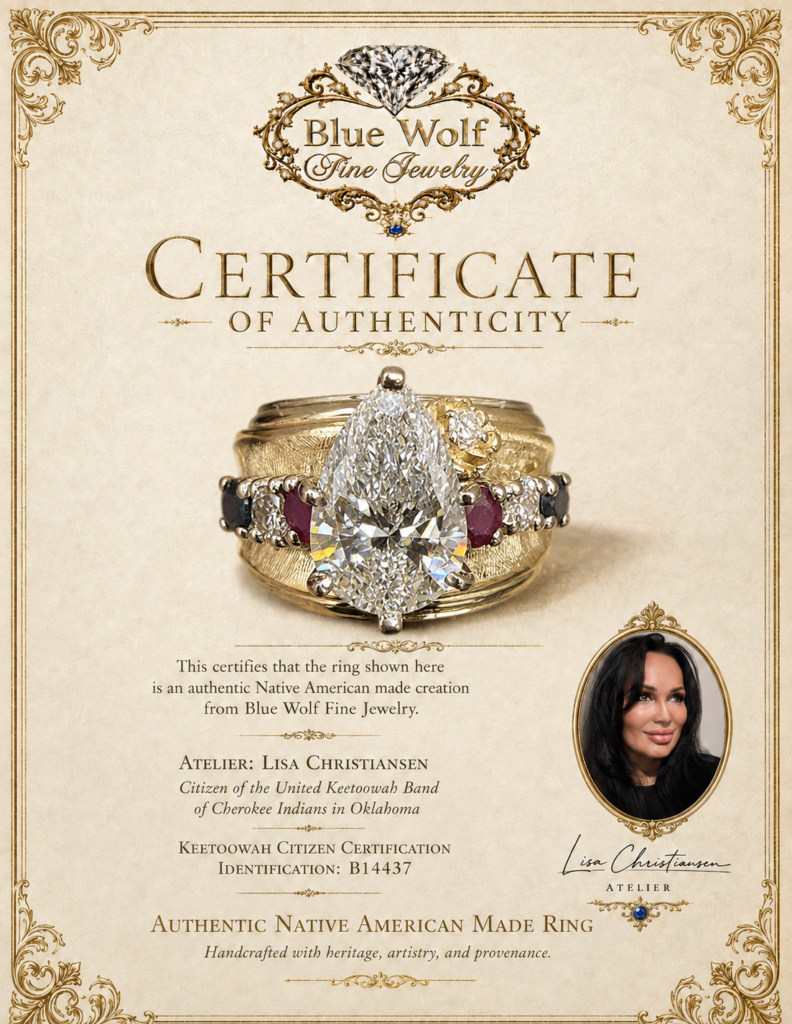
There is another detail at Blue Wolf that speaks quietly but eloquently to the house philosophy: the Certificate of Authenticity.
Each qualifying creation is accompanied by formal documentation recording authorship and provenance, reinforcing the belief that a jewel’s history should not be allowed to disappear when it changes hands.
For collectors, this is more significant than it may first appear.
The great secondary markets of art, watches, jewelry, furniture, automobiles, and couture all eventually arrive at the same question:
What is the story, and can it be documented?
Provenance converts memory into record.
At Blue Wolf, the certificate becomes part of the object’s future biography—a bridge between the person who commissioned the piece and the generations who may one day inherit it.
That sensibility is fundamentally aristocratic in the oldest meaning of the word. The value of a possession is understood not merely through what it cost at acquisition, but through what it becomes over time.
“Blue Wolf does not merely make jewelry for an occasion. Its most ambitious pieces are conceived for succession.”
This is where the atelier’s work feels particularly resonant for established families and private collectors.
Old money has never needed everything to be new.
Quite the opposite.
The sophisticated household understands restoration, continuity, stewardship, and the quiet prestige of possessing objects with a past.
Christiansen’s work in heirloom restoration and redesign enters precisely this territory.
Rather than discarding an inherited jewel because its original setting no longer suits the present generation, the atelier can reinterpret it—preserving the emotional substance while allowing the object to live again.
A grandmother’s diamond may become a granddaughter’s ring. A mother’s jewelry can become a new family piece.
Birthstones can be introduced. Gold can be reworked.
A forgotten object can once again become intimate.
There is enormous emotional intelligence in this form of jewelry making because restoration acknowledges a truth luxury marketing often avoids:
People do not become attached to precious objects solely because they are precious. They become attached because someone touched them before.
AN OKLAHOMA DESTINATION WITH INTERNATIONAL RECOGNITION
Lawton is perhaps not the first location an international collector would associate with contemporary high jewelry.
That is precisely why Blue Wolf Fine Jewelry is interesting.
The newly remodeled historic venue operates increasingly as what might be described as a destination atelier, a place worth seeking rather than merely encountering.
For collectors accustomed to buying in New York, Paris, London, Beverly Hills, Geneva, or Milan, the decision to travel elsewhere for a jewel can itself become part of the luxury.
There is an undeniable romance in commissioning something important outside the expected centers of commerce.
One arrives not at a corporate flagship replicated around the world, but at a house with a specific geography, a specific proprietor, a specific cultural inheritance, and a specific point of view.
The journey becomes part of the provenance.
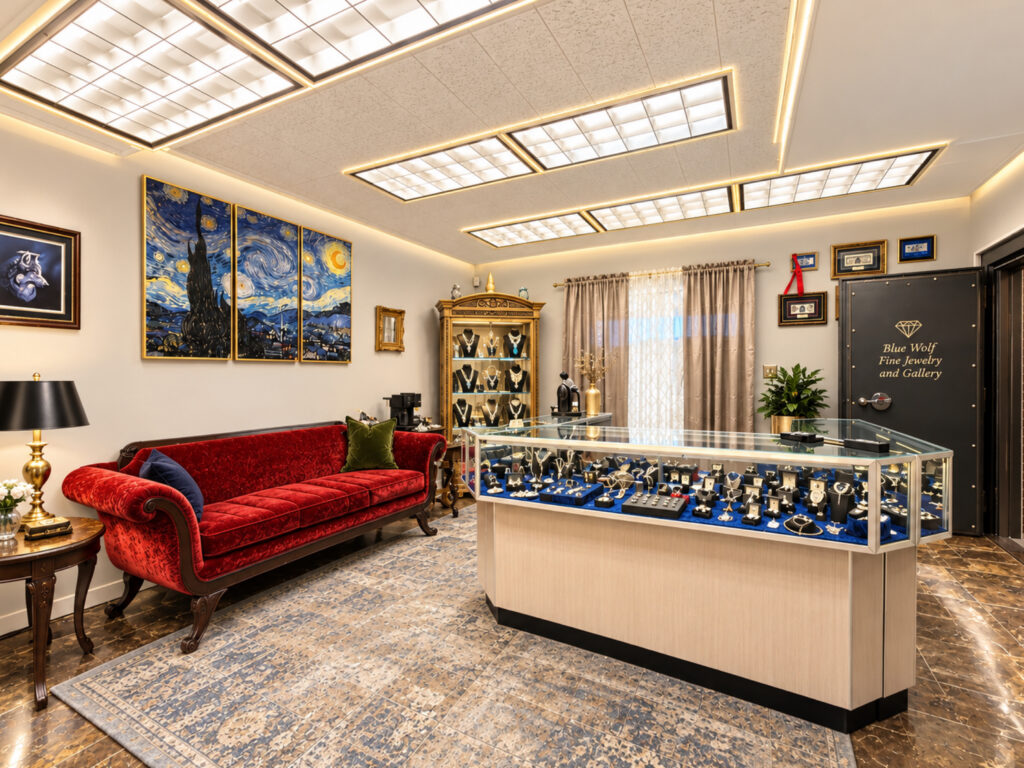
The atelier’s location in Lawton’s historic district reinforces that sense of place. The architecture and atmosphere offer an alternative to the bright anonymity of contemporary luxury retail. This is not a jewelry experience designed to feel identical in every city.
It belongs where it stands.
And increasingly, that quality has cachet.
Sophisticated luxury consumers have become remarkably adept at detecting manufactured authenticity. They have seen every marble boutique, every velvet salon, every champagne ritual.
What they often seek now is something less reproducible: a reason to remember where they bought the object.
Blue Wolf Fine Jewelry provides one.
RECOGNITION BEYOND OKLAHOMA
The atelier’s ambitions have not remained purely regional.
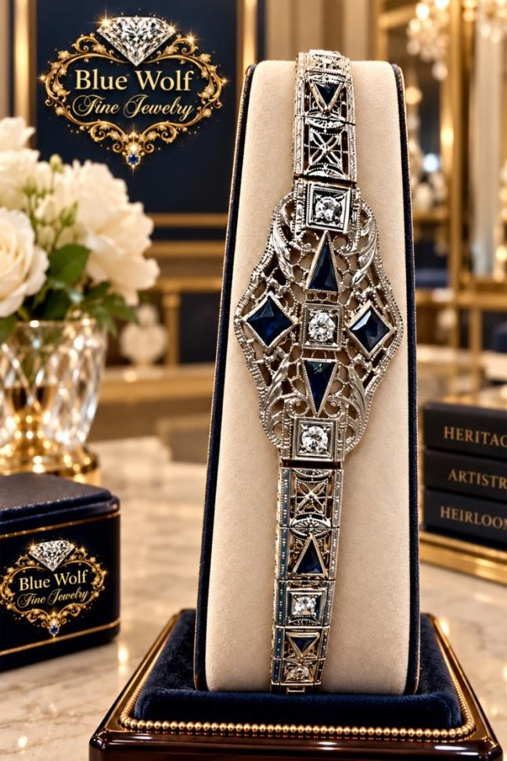
Blue Wolf Fine Jewelry has received recognition from the UK-based luxury publication LUXlife Magazine, including distinction for the “Most Innovative Contemporary Gemstone and Fossil Jewelry Collection.”
Such recognition is particularly apt because experimentation has long occupied an important place within serious jewelry design.
Historically, the most memorable houses were not those that simply sourced expensive materials. They were those that developed a recognizable intelligence around them, Lisa Christiansen has surpassed such with Blue Wolf Fine Jewelry through her one-of-one masterpieces.
Christiansen’s interest in rare stones, unusual combinations, custom symbolism, and individualized
composition contributes to the sense that Blue Wolf is building not merely an inventory, but a vocabulary.
The gemstone is not selected only for market prestige. Its color may matter.
Its origin may matter.
Its relationship to another stone may matter. Its symbolism may matter most of all.
This layering of significance explains why the work often appeals to collectors who see jewelry as more than decoration.
The client is not simply buying brilliance.
The client is commissioning meaning.
THE WOMAN BEHIND THE HOUSE
Luxury brands frequently spend decades manufacturing mystique around founders who are no longer alive.
Blue Wolf offers the inverse experience.
Its founder remains visibly and personally central to the atelier. That matters.
In an era when luxury conglomerates operate at extraordinary scale, there is something almost radical about knowing whose imagination shaped the object.
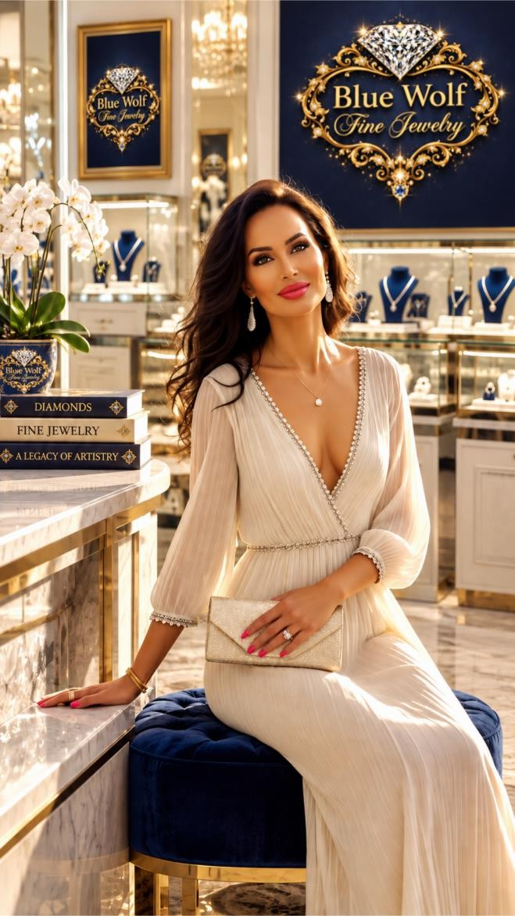
Lisa Christiansen (Groundhog) is not merely the name behind the brand. She is its creative center, cultural memory, storyteller, and principal interpreter.
Her Cherokee lineage informs the ethos.
Her eye informs the design.
Her insistence on personal symbolism informs the commission process.
Her understanding of inheritance informs the house’s approach to restoration.
This personal authorship gives Blue Wolf the quality once associated with the great independent ateliers of Europe—places where the reputation of the house was inseparable from the reputation of the maker.
“The rarest signature in luxury may no longer be a logo. It may be the unmistakable presence of the person who made the object.”
For celebrity clients, collectors, and individuals accustomed to privacy, that relationship can be especially compelling.
At a certain level of affluence, service is assumed. Discretion is assumed.
Quality is assumed.
What cannot be assumed is connection.
The most memorable luxury experiences are therefore often the ones in which the owner remembers the conversation behind the purchase.
The story of the stone. Why it was chosen.
Who it honored.
What it was meant to become.
WHERE HISTORY STILL HAS AN ADDRESS
Blue Wolf Fine Jewelry occupies an unusual position within American luxury. It is proudly regional without being provincial.
Culturally grounded without becoming costume. Emotionally expressive without surrendering sophistication.
And luxurious without relying entirely upon the familiar machinery of European prestige.
Perhaps most importantly, it proposes that American high jewelry need not imitate Paris, New York, or Geneva in order to earn seriousness.
It can emerge from Oklahoma.
It can be Native American female-owned.
It can carry Cherokee history into contemporary design.
It can restore an inherited diamond one afternoon and conceive a major private commission the next.
It can welcome the collector who understands carat weight while equally respecting the client for whom the smallest stone may carry the greatest emotional value.
That duality may ultimately be the secret of Blue Wolf’s appeal. The atelier understands that preciousness has two currencies.
One is financial.
The other is personal.
The finest jewels possess both.
And so Blue Wolf Fine Jewelry is perhaps best understood not simply as a boutique, nor even solely as an atelier, but as a keeper of objects intended to outlive the moment in which they were made.
Its philosophy belongs to an older and increasingly desirable school of luxury—the world of commissioning rather than consuming, preserving rather than replacing, knowing the maker rather than merely recognizing the marque.
For the established collector, this is familiar territory.
For the new generation of connoisseurs, it may feel almost revolutionary.
Because the future of genuine luxury may not belong to the loudest house, the largest flagship, or the longest queue.
It may belong to the maker capable of giving an object what money alone cannot guarantee:
identity.
In Lawton, Oklahoma, Lisa Christiansen has built an atelier around precisely that proposition.
The diamonds may command attention. The gold may endure.
The gemstones may possess extraordinary rarity.
But the deeper purpose of Blue Wolf Fine Jewelry is found in what remains after admiration has passed—family, authorship, memory, provenance, and the understanding that a truly important jewel should carry something of its owner into the future.
That is not simply ornament. That is legacy.
And at Blue Wolf Fine Jewelry, legacy remains the ultimate luxury.
1101 SW C Avenue · Historic District · Lawton, Oklahoma
Native American Female-Owned · Bespoke Fine Jewelry · One-of-One Commissions · Rare Gemstones · Heirloom Restoration
WHERE HERITAGE MEETS HEIRLOOM.
Where History Still Has an Address.