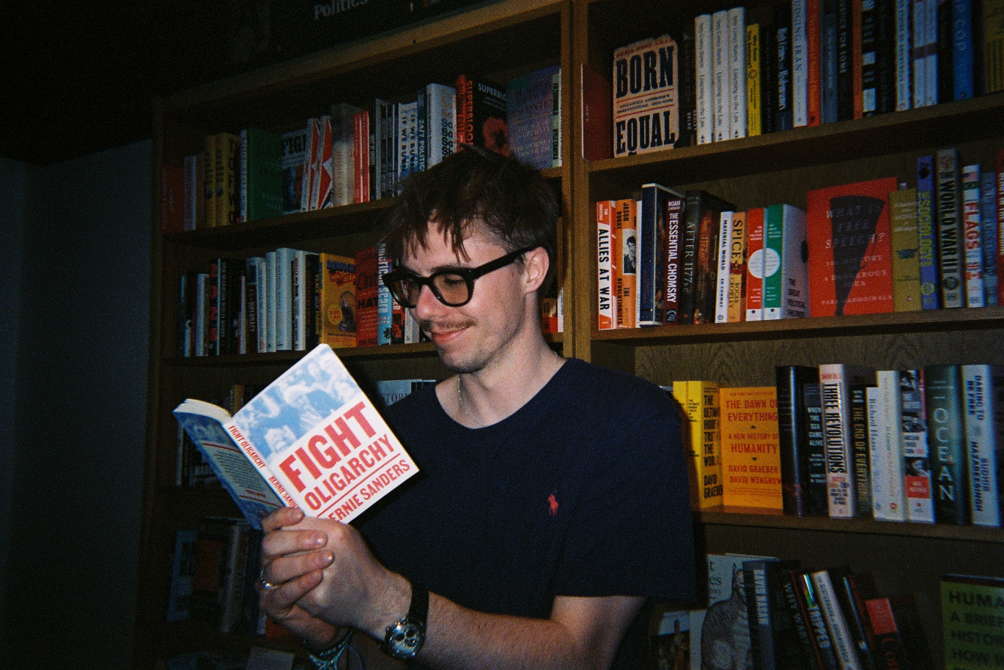
Jonathan Tinne is a London-based creative and production leader whose career has moved between music, film, technology and advertising — with an unconventional route into each.
Originally from Italy and raised in Ireland, Tinne moved to Edinburgh to study Theatre and Communications, developing an early interest in the relationship between storytelling, performance and audiences. Music was already a significant part of his life, but during and after university that interest increasingly shifted towards the screen.
As a songwriter and composer, Tinne began working across film and television, with his music ultimately appearing in productions associated with companies including Netflix, HBO, Warner Bros., Tubi and Apple TV+. His work in entertainment would later extend beyond music, including time working in production support at Apple TV+.
His latest venture named “Double Trouble” in theaters Oct 9th, 2026.
But it was an eventual move into advertising that brought those different strands of his career together.
Within a few years of moving to London, Tinne joined Catalyst Performance, initially working within UGC marketing. He quickly identified what he saw as a widening gap in the way brands were producing advertising.
At one end was UGC — user-generated content. It had transformed performance marketing by allowing brands to produce enormous volumes of creative quickly and relatively cheaply. A creator, a smartphone and a bedroom could produce an advert capable of generating millions of impressions.
It worked.
But it also created a sea of advertising that increasingly looked the same.
At the opposite end of the spectrum sat the traditional commercial: large crews, expensive equipment, elaborate locations, lengthy pre-production and, in some cases, budgets running into the hundreds of thousands. The results could be beautiful, but that model had been designed for an era when a brand might produce a handful of major campaigns each year — not an advertising environment where platforms demanded new creative constantly. Tinne became interested in the space between the two.
What if the production quality and storytelling discipline of a commercial could be combined with the speed, volume and performance mentality of UGC?
That question became fundamental to the production department he went on to establish at Catalyst. Rather than treating polished production and performance advertising as opposing philosophies, Tinne began moulding the two together.
The result was a kind of performance-production hybrid: advertising that could look considered, cinematic and deliberately produced, while still being designed for the language, pace and economics of social media. Instead of spending months producing one hero commercial, a shoot could be designed modularly from the beginning. Multiple hooks, performances, scenes, products, CTAs and visual concepts could be captured and recombined into numerous pieces of creative.
A production was no longer necessarily built to create one film. It was built to create a system of content.
That distinction became increasingly important.
Traditional production often optimised for the finished film. UGC optimised for speed and quantity. Tinne’s approach attempted to optimise for quality, volume and performance simultaneously.
It meant borrowing from both worlds. From traditional production came cinematography, lighting, casting, art direction, locations, sound, structured pre-production and narrative craft.
From performance marketing came rapid iteration, hook testing, modular editing, multiple creative variations and an acceptance that the audience — not the production team — ultimately decides which advert works.
The philosophy was simple: production value should not come at the expense of performance, and performance should not require sacrificing production value.
Under Tinne, that philosophy developed into a dedicated production operation within Catalyst. What began as an emerging function grew into a multidisciplinary department spanning production strategy, creative production, videography and post-production, capable of delivering polished advertising repeatedly rather than treating high-quality production as an occasional event.
Today, Tinne serves as Head of Production at Catalyst, overseeing the department he helped build and the production model behind it. His approach also reflects the unusual combination of industries that preceded it. Theatre taught him about performance. Music taught him about emotion and timing. Film taught him about visual storytelling and production. Technology exposed him to systems and scale. Performance marketing introduced perhaps the most unforgiving element of all: measurable results.
Together, those experiences shaped a view of advertising that sits somewhere between a production company and a performance-marketing machine.
Because the advertising landscape has changed.
Brands no longer need to choose between a creator filming an advert in their bedroom and a six-figure commercial produced twice a year. Between those extremes sits an increasingly important middle ground: creative that feels premium enough to build a brand, native enough to belong on social media, efficient enough to produce continuously and strategic enough to be measured against performance.
That is the space Jonathan Tinne has spent his career at Catalyst helping to define.
Not quite UGC.
Not quite a TV commercial.
Something in between — built for an era where brands need the craft of traditional advertising at the speed of the internet.