
Inside a Berlin café, the Sierra Leonean-American author and recording artist is turning one man’s journey into an Afropolitan superhero mythology spanning books, albums, artificial intelligence, family, Berlin, and seven mapped dimensions.
A LONG-FORM PROFILE, REPORTED IN GERMANY
Berlin seems like an unlikely place to discuss a Black superhero character who can dissolve into thousands of bees. Outside the café window, the German capital is doing what Berlin does best. Looking simultaneously vintage and polished. Cars move past buildings carrying centuries of history on the same block. Wilfred sits across the table with black coffee, a MacBook Pro 16” Max, and enough literary works stored inside it to make the conversation considerably more complicated than the word superhero initially suggests.
The name of the man across the table is Wilfred Kanu Jr. Freddy Will is his stage name, the identity under which the Sierra Leonean-American author, emcee, and businessman released hip hop albums and books for years. Except today, even that requires clarification. Because somewhere along the way, Freddy Will stopped being just his artist’s name. Freddy Will became the superhero’s name, too. “Bee Mann is Freddy Will,” He explains. Not Wilfred Kanu Jr.? “No. In the mythology, he is Freddy Will.” That distinction will become memorable.
Very little about Bee Mann is quite as
completely straightforward as it initially appears.
Q: You released three albums this year?
FW: Yes. I’m dropping every album from the Bee Mann trilogy this year.
Q: What are these albums, anyway?
FW: They’re concept albums. Three are companion albums for the books, and the other is a spin-off of those three records, with songs chosen by the fans.
Q: What’s the motivation behind making these albums?
FW: I wanted companion albums for the books, and I wanted to produce some crossover styles I’d been developing over the years.
Q: When was the last time you released an album before this?
FW: My last full-length album with all new material before these was another concept album, companion music to a book.
Q: Which one was that?
FW: My third book and album, made in Canada. The book was called Hip Hop Kru Zade, and the companion album was Laboramus Exspectantes Volume 1.
Q: Volume 1?
FW: I later re-released that project in Germany and dropped the “Volume” part. It was meant to be a trilogy, but I later dropped the idea.
Q: When was that album released in Canada?
FW: I started working on it in 2012 and released it in 2014.
Q: What happened after that?
FW: I released the album and decided to take a break from making music. Then I enrolled in a paramedic training program in Burlington, Ontario, but before I knew it, I was moving to Brussels, Belgium. That was around 2015 and 2016.
Q: Now you live in Berlin, Germany. Do you miss Toronto?
FW: Absolutely. That city will always have a special place in my heart.
Q: It’s 2026 now. What happened between then and now?
FW: As I said, I was planning to hang up the mic and move on to other things, so I released a mixed album in 2017, and again in 2020, mostly unreleased versions of my popular songs and different remixes. Mainly, I was trying to reissue my old books and publish some new ones.
Q: Your albums prior to 2014 were also companion albums to books.
FW: Yes. My first and second books both came with companion albums.
Q: I listened to these new Bee Mann albums. They’re on fire. Is this your comeback?
FW: I don’t know. I’ve been one foot in and one foot out for a while now. Musically, I wouldn’t call it a comeback, because I’ve been thinking about hanging up the mic.
Q: Why is that?
FW: It goes back to the beginning. I always thought I was supposed to come out in the mid-to-late ’90s. That’s when I believe I was at my prime.
Q: When did you come out?
FW: I never did. Life took me in different directions, and before I knew it, my window had closed.
Q: Closed? You’re sitting here now with a huge catalog.
FW: I know. But that was mostly me doing it on my own, to get some of my music out.
Q: I don’t understand.
FW: I turned 20 in 1997. That’s when I was at my prime as an emcee. I had a unique musical background, but I didn’t get to do it for real until 2006, when I moved to Toronto. By then I was almost 30, so I wasn’t as enthusiastic, because the window had already closed. You asked about a comeback in 2026, when I’m 49. I say no, because this project isn’t meant to be my breakthrough as a rapper in the music industry.
Q: If it’s not a comeback, then what is it?
FW: When I released my debut album, I was 31, and it was independent. At that point, I simply wanted to record some of my music and get a few joints out there. Then I met Ken Cowle from Soul Asylum Poetry & Publishing, and he signed me to write a book about my story. Once I wrote that book, I paired it with my debut album, and from then on, the idea of releasing books with accompanying music was sparked.
Q: You’d been quietly writing books as well?
FW: I’d always been writing, but nothing was out yet.
Q: What had you been writing?
FW: Movie scripts and lyrics for music.
Q: From movie scripts to books.
FW: As I said, opportunities never came for what I was actually good at. I was always given opportunities to do something else. I wasn’t even a rapper. I considered myself an emcee, and I had a few movie scripts written. But once I started making music independently and the buzz started, I met Ken, a book publisher, and turned the scripts into books.
Q: That’s interesting.
FW: Yeah. Once I became an author, that became my new focus.
Q: You transitioned from rapping to writing books.
FW: That was the spark. I saw I could publish books and still record an album to go with them. So, in reality, I’m a former emcee who became an author.
Q: And that’s how Bee Mann ended up with companion albums.
FW: Yeah. That’s my signature. My first three books came in that combination.
Q: Book plus album.
FW: Yes. And after the third one, I took a long hiatus until this year.
Q: So Freddy, if I’m hearing you right, you’re saying Bee Mann is books with music accompanying them. You’re not a 50-year-old rapper making a comeback. You’re a 50-year-old author who also makes music to accompany his books.
FW: I’m not quite 50 yet. Next year, when I turn 50, I’ll drop four EPs to commemorate that year. After that, I don’t know what happens musically, but I intend to keep going as an author.
Q: Four final EPs to commemorate your 50th birthday, but you’ll always be musical, since you’re also an executive producer, so you could work with other artists.
FW: Yeah. I can still tour, work with other artists on their projects, and record more companion music for future books. But after 50, I plan to hang up the mic.
Q: You said earlier you thought you were supposed to be signed in the late 1990s. That’s exactly when the East Coast/West Coast beef happened. As an avid hip-hop fan, what’s your take on the Tupac murder trial?
FW: Listen, all these trials in hip-hop give me a lot of mixed feelings. One minute they’re accusing a rapper of rape or sexual assault under RICO, and the next they’re indicting a killer who murdered the rapper. On one hand, I feel encouraged, because rapping is probably one of the most difficult and dangerous jobs in the world, so it feels great to see the system go after our killers even thirty years later. We saw them arrest the killers of Nipsey Hussle, Pop Smoke, Young Dolph, Foolio, FBG, and so on. That’s reassuring, in a way. If someone hurt one of us, the system will lock them up and throw away the key. Tupac and Biggie deserve justice, and as an emcee, it’s great to see the system taking action to protect us.
Q: Do you think Keefe D did it?
FW: I wasn’t there. How would I know who killed Tupac? If you ask me, it looks like some higher-ups were behind that. Las Vegas, on a Mike Tyson fight night, with all those people on the Strip? That hit looks too professional. I’m not saying Keefe D did it or didn’t, but if he did, why wait this long to try him? They might just hang it on him and close the case.
THE MAN INSIDE THE HIVE
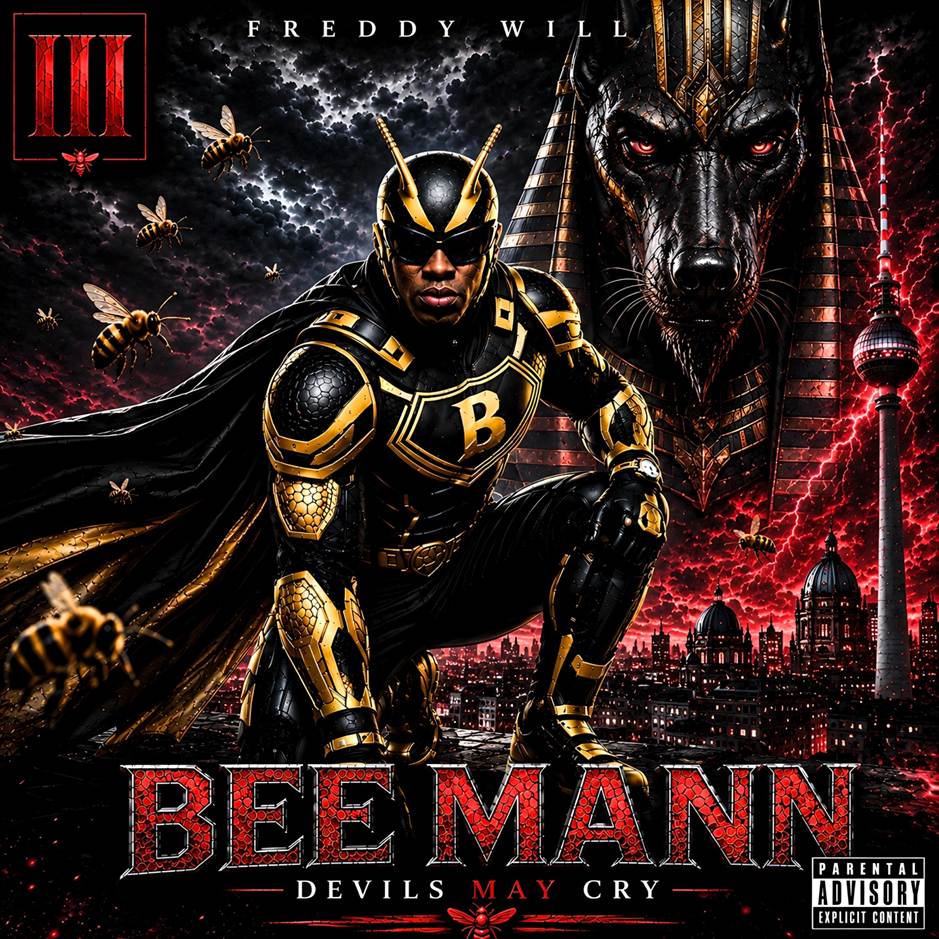
At its simplest, Bee Mann, Wilfred “Freddy Will” Kanu Jr.’s latest book series, is the story of an Afropolitan superhero whose extraordinary relationship with his family, bees, frequencies, and consciousness grants him abilities that extend far beyond conventional physical human strength. At its largest, his mythology grows into something vast. The mythology spans a trilogy of books, multiple musical album projects, visual world-building, and an increasingly elaborate cosmology involving civilizations separated by dimensional membranes.
Yet its emotional center remains surprisingly domestic. Bee Mann is Freddy Will, husband of Amira Will, who eventually emerges as Bee Woman, and mother of Jasmine, Nia, and Austin Will. Together, they form the Will family and inhabit a fictionalized version of Berlin, where their Wannsee home becomes the center of a conflict that eventually extends beyond Earth. Bee Mann’s recurring nemesis, Wasp Mann (named Chad Miller), another interdimensional traveler, turns the family’s home (the Wannsee Estate) into a battlefield.
The first and second Viper Queens and their Viper Clan introduce another layer of enemies, via venom technology, and threats from their primary realm, Vel’nara. Amira’s Hornet Sisterhood emerges as a formidable protective force. And contact with Aura Prime and the Auri, an advanced humanoid civilization beyond Earth’s dimensional boundary, transforms what begins as a struggle to defend one family into a conflict involving worlds. It sounds enormous when summarized this way. Wilfred smiles. “It didn’t start enormous.”
How did it start? “With me.”
That may be the most honest answer of the gray afternoon.
SIX WAYS TO STING
Bee Mann does not possess one superpower. His abilities form an interconnected system. Physical supremacy is his enhanced strength, speed, endurance, and regenerative capacity. There is his psychic foresight and swarm command, his ability to communicate with and command bees. There are sonic force and interdimensional flight, including the sophisticated ability to move through spaces beyond ordinary human reality. And then there is what Wilfred calls “ill intuition”: an almost extrasensory synthesis of the other abilities, allowing Bee Mann to perceive threats and patterns beyond conventional sensory information.
Many of these abilities are frequently mentioned in the companion hip-hop albums to the books. His most visually spectacular ability may also be the most appropriately bee-like. Bee Mann can disperse his physical form into tens of thousands of bees and reconstitute himself, symbolizing his multitalented nature. The powers draw simultaneously from speculative fiction and biological reality. They are then filtered through the African and diasporic cultural attributes underlying the mythology. Crucially, his superpower suit does not create him.
“The power was already there,” Wilfred says.
“The power was already there.”
Bee Mann’s armor amplifies, protects, and extends what Bee Mann could already do. That distinction becomes important as the mythology expands, since he operates both as a civilian and a superhero. Interestingly, Bee Mann acquires state-of-the-art technology, equipment, deep knowledge, advanced training, and multiversal allies, yet he remains vulnerable to injury, exhaustion, disorientation, and death. This hero is not a god discovering increasingly convenient ways to win. Wasp Mann would be considerably less interesting if it were.
THIS IS BERLIN BUT NOT QUITE
The Berlin outside our café window is not exactly the Berlin or the world inside Bee Mann. That is deliberate. Wilfred uses the geography, history, and cultural character of Germany’s capital as the foundation for the mythology, then permits speculative fiction to alter it. The fictional Berlin has a different skyline. There are skyscrapers where contemporary Berlin has few. Familiar institutions and districts can coexist with advanced technology, superheroes, and the consequences of interdimensional contact. Reality provides the foundation.
It does not provide the boundary.
At the center is Wannsee and the Will family’s lakeside estate.
A home gradually turns into a hive, a protected compound, a dimensional contact point, and, eventually, a fierce battlefield. Why Berlin? Wilfred looks almost surprised by the question. “Because that’s where I live, right now.” The answer reveals something fundamental about his Afropolitanism. Bee Mann does not need to explain why an African-descended superhero belongs in Europe. Berlin is simply home. The mythology’s geography consequently works differently from stories in which Africa exists primarily as an ancestral destination.
Europe is not a foreign territory. Sierra Leone can be ancestral memory. Colombia can be that too. Germany can be home. America can be home. None invalidates the others.
DISCOVER THE UNIVERSE
The trilogy escalates intentionally. Bee Mann: Stings from a One-Man Hive (and its companion hip-hop album) establishes the hero, the home, the Will family, the superpowers, their vulnerabilities, and the enemies as they assemble around them. Then comes Bee Mann II: The Siege of Wannsee. The subtitle tells you what happens. The hive comes under attack. The mythology’s private world opens to warfare as the Will family’s Berlin estate is besieged, and Bee Mann, Bee Woman, and their allies are forced into sustained defense.
Then Bee Mann III: Devils May Cry widens the map again. Governmental institutions, alien civilizations, and dimensional encounters become entangled with conflicts that once seemed personal. The progression can almost be reduced to three instructions: Build the hive. Defend the hive. Discover how far the consequences can reach. What prevents that expansion from becoming generic cosmic science fiction is the thing Wilfred refuses to abandon. Family. The universe itself becomes larger. The emotional geography stays tight-knit.
THE QUEEN IS COLOMBIAN
Amira Will (formerly Amira Rodríguez) is a devoted wife and mother. Sometimes she is the reason Bee Mann survives. Bee Woman is Colombian on her father’s side and German on her mother’s, giving the Will household several cultural axes. Her character combines spirituality, discipline, and formidable physical ability. Amira Will is a third-dan black belt in taekwondo, amplifying her supernatural abilities. Her abilities do not duplicate her husband’s. Among the most interesting is what mythology calls a sacred feminine frequency: an intuitive capacity to detect emotional manipulation, counterfeit intentions, and other hidden intentions.
She has tactical intelligence.
And Amira brings Colombia with her.
When the siege closes around Wannsee, Jasmine and Nia are removed from Berlin and sent to Bogotá. Colombia stops functioning as a line in their mother’s biography and becomes part of the defensive strategy. The Will sisters are hidden outside the Colombian capital among white walls, red tiles, flowering trees, and morning arepas while the Hornet Sisterhood quietly establishes a protective perimeter around them. Then the enemy follows. Suddenly, a conflict known as the Siege of Wannsee has spilled over from across the Atlantic into Cartagena.
Colombia becomes another family refuge, and Colombian kitchens, grandparents, language, memory, and warmth recur throughout Amira’s emotional arc. “She’s not there because Bee Mann needs a wife,” Wilfred says. Then why is she there? “Because the hive has a Queen.” The distinction is demonstrated rather than stated. Amira fights. She organizes. She protects. She makes decisions without hesitation. And when Bee Mann disappears, becomes injured, or cannot hold the line, the hive does not become defenseless. It still has its Queen.
THE SUPERHERO MAY BE THE FAMILY
Then there are the children. Jasmine is the writer. Nia is the analyst. Austin is instinct, the most mysterious. The Will children are not simply hostages-in-waiting to be saved. Jasmine increasingly becomes the keeper of history, wrestling with who has the right to record the events surrounding them and who might have the right to reveal them. Nia approaches the world differently. She analyzes. She questions. She recognizes patterns and understands that information can be dangerous depending on the person who possesses it. Austin senses.
The structure resembles the thing Wilfred has been talking about all afternoon. A hive. A beehive does not survive because one spectacular bee does everything. The Drone and the Queen each play different roles. It survives through specialization, communication, collective protection, and so on. That creates an interesting question. Is Bee Mann the superhero? Or is the superhero the system of people around him? Wilfred considers it. “The name on the emblem is Bee Mann,” he says. A pause. “But he can’t be Bee Mann without the hive.”
“The name on the emblem is Bee Mann. But he can’t be Bee Mann without the hive.”
SEVEN MAPPED DIMENSIONS
At some point, the conversation leaves Earth. Seven dimensions?
“Seven mapped dimensions,” Wilfred corrects. Earth is humanity’s anchor within a much larger multiverse. Beyond it lie mapped realities including Kha’zah, home of the Kha’Zari. The Dead Field, a desolate region surrounding a dead star. The Veiled Shore, a matrilineal realm possessing extensive knowledge and history. Quinto, a quiet bioluminescent world of floating islands and crystalline infrastructure. The Ashen Deep, a hostile sunless realm. And Aura Prime, home of the technologically advanced Auri. Those are the mapped dimensions.
There are also unnumbered spaces. Vel’nara belongs to that broader geography. The Null Plane and the Interstitial corridor further complicate the architecture. This distinction allows the mythology to remain open to expansion without pretending that its characters understand it in its entirety. Dimensional travel is conceived beyond conventional distance. Different planes carry distinct signatures. Membranes separate them. Navigation requires the ability to perceive, to identify, and to cross. Bee Mann therefore does not fly very far to reach another universe. Reality has layers. Earth, unsettlingly, is not the center but a coordinate.
WHAT DOES THIS HIVE LOOK LIKE?
Wilfred turns the MacBook around, making the mythology visible. Black armor. Vibrant gold. Antennae. Honeycomb. Wings. Hexagons. An altered Berlin skyline. Alien landscapes. The recurring visual of Bee Mann extends the hive beyond the superhero costume. Bee-derived symbolism appears in architecture, technology, and design. Different forces have their visual identities. The Hornets sharpen the black-and-gold language. The Viper forces become more predatory. Quinto glows. Aura Prime’s technology reflects its civilization’s relationship with resonance. Berlin remains Berlin, but the version capable of containing all of this.
Another important distinction came to light on Wilfred’s MacBook. He explains that these images are not documentary evidence of a fictional universe, nor is every developmental image automatically canon. The books establish the primary narrative canon. The imagery visualizes it. That leaves him free to revise a costume, skyline, or environment without accidentally rewriting the mythology. The technology behind much of this visualization is also impossible to ignore. Artificial intelligence. Wilfred also does not avoid the term. Quite the opposite. He honestly reveals that the images were AI-generated from his descriptions.
I almost forgot we were discussing a book. The simplest description of Bee Mann is “a Black superhero.” It may also be the least interesting. Western superhero mythology has repeatedly found power in scientific accidents, technological experimentation, extraterrestrial origins, inherited abilities, and gods drawn from traditions ranging from Greco-Roman mythology to the Norse pantheon. Wilfred went somewhere else. Not by inserting a Black character into an existing template, but by asking what the template might become if its cultural foundation emerged from African and diasporic experience. Bee biology supplies one layer.

“I didn’t invent Bee Mann. I discovered him in my own life and gave him to the world.”
West African cosmological ideas supply another. Mandingo, Akan, Loko, Wolof, Igbo, and Yoruba-derived concepts enter into conversation with griot traditions, migration, spirituality, speculative science, frequencies, and dimensional membranes. And beneath all of that is Wilfred’s biography. Sierra Leone. Civil War. Displacement. Migration through West Africa. North America. Europe. Publishing. Hip-hop. Berlin. Only that particular accumulation of worlds could have produced this particular superhero. “I didn’t invent Bee Mann,” Wilfred says. What did you do? “I discovered him in my own life and gave him to the world.”
It sounds grandiose. It probably makes more sense the longer he explains it. Bee Mann’s origin, beneath the fiction, isn’t radioactive waste or a visitor from another planet.
It is accumulated experience.
THE CREATOR BECOMES THE CHARACTER
There is another reason Bee Mann looks so familiar. Wilfred Kanu Jr. deliberately used his own image and likeness as the visual foundation for the book’s main character. Partly, it was practical. Building the superhero around himself helped establish an original visual identity while reducing potential conflicts over likeness with actors, celebrities, or other recognizable people. But the decision also collapses the distance between creator and creation. The face underneath Bee Mann’s armor begins with Freddy Will’s, and the name does too.
In reality, Freddy Will is the artistic identity of Wilfred Kanu Jr., and his household is the Kanu family. Inside this Bee Mann mythology, that distinction becomes literal fiction. Bee Mann’s civilian identity is Freddy Will. His household is therefore the Will family. “So you’re playing yourself?” “No,” Wilfred says immediately. That requires explanation. The fictional Freddy borrows his creator’s artistic name, appearance, and selected biographical material, but develops an independent history. The same process governs the Will family.
The mythology is autobiographically rooted.
It is not autobiographically literal. And that becomes even clearer.
FROM SANDMANN TO BEE MANN
Even the second n has history. In 2014, after releasing his third book with its companion album in Toronto, Wilfred was looking for a way to preserve and develop writings from the blog he had maintained since 2008. He created an alter ego named Sandmann, drawing inspiration from Sandman, a character in the 2006 video game Scarface: The World Is Yours. The result became The Sandmann’s Journal, seven volumes of opinion and cultural criticism. Years later, living in Germany, Wilfred encountered another Sandmann.
The German literature of E. T. A. Hoffmann’s 1816 Der Sandmann. He retired his Sandmann project and reorganized much of the material into the four-volume Brazenitout paperback series. But the extra n survived. Meanwhile, another creative project had been underway during his hiatus from recording music. Its working title was Diplomica. In 2022, he substantially rewrote it. Bee Man became Bee Mann. In German, Mann means “man.” For an Afropolitan superhero living in Berlin, the spelling had finally found another purpose.
A BOOK REFUSES TO STAY ONE KIND OF BOOK
Trying to place Bee Mann on a single shelf creates problems. Book One, Bee Mann: Stings from a One-Man Hive, is classified as poetry for retail and library purposes. That description is accurate. It is also incomplete. The book functions simultaneously as an annotated hip-hop poetry collection, a work of cultural criticism, and an artistic memoir. Lyrics restored from recorded music become poems on the page. Annotations move between Freddy Will speaking as artist and third-person examinations of Bee Mann as mythological figure.
Essays broaden the discussion to include theology, accusation culture, sacred femininity, and the griot tradition. Then the format changes. The Siege of Wannsee and Devils May Cry abandon the annotated-poetry structure and continue the mythology through prose. Novels. There is also a separate Bee Mann comic-book concept in early development. So what exactly is this thing? Wilfred laughs. “That’s been my problem with this project.” The most useful answer may be “Afrofuturist superhero mythology for older teens and adults.”
The literary and musical work broadly falls within Afrofuturism, Black speculative fiction, and African superhero mythology, while moving through literary fiction, hip-hop poetics, memoir, cultural criticism, science fiction, and fantasy. The three albums are all concept albums, and that becomes increasingly obvious by the third LP. It is not conventional simply because teenagers can read it. And it is certainly not children’s superhero fiction. The content is clean and mature, yet it takes various forms for multiple sensory interaction and enjoyment.
THE ALBUMS AREN’T SOUNDTRACKS
The music complicates classification further. Bee Mann does not simply have a soundtrack. The musical projects function as parallel expressions of the same mythology. A scene can become a rap or a skit. A character’s emotional condition can become a song. An event can be revisited from an angle that prose does not provide. The albums do not need to retell the books literally, and the books do not require the listener to have heard the albums.
Each can stand independently. Together they reveal Wilfred’s larger experiment. What happens when the novelist and the emcee are the same storyteller? A confrontation can exist as prose in one medium and become rhythm, anger, interior monologue, or cultural commentary in another. That makes Bee Mann neither an author making promotional music for his books nor a rapper attaching fiction to an album campaign. Wilfred is attempting to make literature and hip-hop behave as components of the same storytelling system.
THE WILL FAMILY IS NOT THE KANU FAMILY
The Will family resemblance needs its own explanation. Jasmine exists in real life. But the Jasmine Will of Bee Mann is not a direct representation of Wilfred Kanu Jr.’s daughter. The mythology radically alters her image, giving her an independent personality and narrative function. Austin also takes his name from Kanu’s real son, while becoming another fictional character whose relationship with bees and frequency is entirely the story’s invention. Nia is different. She doesn’t exist in Kanu’s real household. “I have two children,” he says.
Nia is a fictional middle daughter, named in tribute to actress Nia Long. Bee Woman, Amira Will, does not literally exist either. The Colombian-German character represents aspects of Wilfred’s real-life partner but possesses her own biography, cultural inheritance, abilities, and fictional history. This is where calling Bee Mann autobiographical without qualification becomes misleading. This family is not the Kanu Jr. family wearing superhero costumes. It is a fictional household constructed from autobiography, imagination, symbolism, and narrative necessity. Real emotion supplies roots. Fiction decides what grows from them.
WHICH FREDDY ARE WE TALKING ABOUT?
By now, names require traffic control. In the real world: Wilfred Kanu Jr. is a person. Freddy Will is his artistic identity. Inside this mythology: Freddy Will is Bee Mann’s civilian identity. The family readers meet on the page answers to Will, not Kanu. This sounds unnecessarily complicated until one realizes what Wilfred has done. He has allowed his artistic identity to cross into fiction. The artist Freddy Will belongs to Wilfred Kanu Jr. The fictional Freddy Will belongs to Bee Mann. The face travels with the name. The life does not.
CROSSING THE MEMBRANE
As stated earlier, dimensional travel in the Bee Mann mythology is not treated as ordinary physical distance. Frequency identifies. Membranes separate. Crossing connects. Mapping creates knowledge. As Bee Mann’s understanding develops across the books and mediums, dimensional signatures become increasingly important for navigation, communication, and defense. And knowledge is not evenly distributed. The Auri know things humans do not. Other civilizations possess their own histories of the membranes. Bee Mann’s abilities alone do not make him master of the cosmology. That limitation is crucial. The multiverse remains larger than the superhero. And sometimes larger than the civilizations attempting to map it.
BEFORE THE SUPERHERO
There is a photograph from 2011 that now seems accidentally prophetic. Wilfred is standing at a formal ceremony in Toronto holding an oversized commemorative folio. Inside is his own face. Four times. Years before he placed that face beneath Bee Mann’s armor, IGPC had already placed Freddy Will’s image on postage stamps. The honor followed his participation in Healthy Food for Thought: Good Enough to Eat, the philanthropic recording that was nominated for the Best Spoken Word Album for Children at the 53rd Grammy Awards.
The stamps were formally unveiled in Toronto on 22 October 2011, during the Freddy Will Hope Foundation’s invitation-only “Athens of West Africa” fundraiser.
The CEO of the Inter-Governmental Philatelic Corporation unveiled the commemorative folio. Wilfred’s father delivered the keynote address. Dignitaries and invited guests attended the event. It is an impressive biographical credential. In the context of Bee Mann, however, it becomes something more interesting. Sierra Leone put Freddy Will’s face on a stamp before Freddy Will put it behind a superhero’s mask. The man sitting across the café table appears amused by the connection. “Yeah,” he says. “I never thought about it like that.”
ARTIFICIAL INTELLIGENCE ENTERS
Then comes the subject capable of changing the temperature of almost any contemporary conversation about art. AI. Wilfred is unapologetic about it. The Bee Mann visual universe has been developed through generative artificial intelligence under his creative direction. He uses detailed prompts, references, revisions, and continuity to visualize characters, environments, and dimensions. He describes the process less as asking a machine to invent his mythology than as finally possessing a tool capable of showing him what he has already written.
The story comes first, he says. Then the visualization. But the process can become reciprocal. Seeing a character can expose a contradiction. An environment can suddenly require another detail. A face that existed only in prose becomes somebody the writer can look at. Wilfred remembers seeing Aura Prime visualized for the first time. Goosebumps. For an independent creator, the significance is quite obvious. Production capabilities once requiring illustrators, concept artists, studios, and substantial budgets are becoming available at radically lower cost. That democratization is also precisely why the technology is controversial.
Wilfred understands the objections. He simply does not accept the premise that using a new creative tool automatically invalidates the creativity preceding it. His music career, after all, was already computer-assisted long before contemporary generative AI: digital recording, MIDI, virtual instruments, DAWs, plug-ins, pitch correction, graphic software, and remote creative collaboration across email. To him, AI is simply another form of acceleration. Not the imagination itself. The tool attached to it. This is the hill he said he is willing to die on.
“Don’t change what makes it Bee Mann.”
ONE MYTHOLOGY, SEVERAL LANGUAGES
The companion music streams on global platforms. The underlying creative method may be older than the technology. Wilfred returns to the griot. Story. Rhythm. Performance. Memory. Different modes carrying the same cultural information. Bee Mann operates according to a technologically updated version of that principle. The books establish the primary narrative canon. Music provides another emotional pathway. Generated imagery makes the world and characters visible. A developing comic concept would translate it into sequential art.
And Wilfred wants more. He wants German editions of the books. He wants comic books. And he wants the big screen. How big is the dream? He doesn’t hesitate. Netflix. HBO. Hulu. Marvel. Spike Lee. Tyler Perry. Curtis “50 Cent” Jackson. A German studio. A Nigerian studio. Anybody, essentially, capable of doing the job properly. “I can’t even pretend here,” he says. “I’ve dreamed about it.” Marvel? “Absolutely.” He laughs, but he isn’t joking. “I’ve imagined Bee Mann as a Netflix, HBO, or Hulu series. I’ve dreamed about Marvel picking it up and making several films.” There is a condition. “Don’t change what makes it Bee Mann.”
Wilfred is realistic enough to understand that adaptation requires structural change. A novel cannot simply be photographed page by page. Pacing changes. Dialogue changes. Characters can often be compressed. Events move. What he wants preserved is the architecture. The Afropolitan identity. The family. Berlin. Colombia. The cultural foundations. The characters. The dimensional geography. The hive. And the right collaborator does not necessarily need a Hollywood address. “If a German studio can do it, I’m there. Nigerian studio? I’m there.
Spike Lee, Tyler Perry, 50 Cent, whoever genuinely sees it and has the ability to make it happen. I would embrace them wholeheartedly.” And if nobody comes? “If I had the means, I’d make it myself.” That answer is the least surprising thing he has said all afternoon.
NEW SUN RISIN’
The coffee has been sitting untouched for a while. Outside, Berlin remains stubbornly real. No dimensional membrane opens above the street. No swarm assembles around the café. No Bee Mann in his superhero suit. No seven Auri craft descend over Wannsee. Wilfred closes one window on the MacBook and opens another. There is always another image. Another chapter. Another song. Another revision. That may ultimately be the most useful way to understand Bee Mann. It is not merely a superhero created by an author who happens to rap.
Bee Mann is not an album concept that became unusually elaborate. It is an attempt by one creator to literally make the different languages he has accumulated throughout his life, African memory, American citizenship, Hip-Hop, European cultural experience, literature, music, cultural criticism, family, technology, and speculative fiction, all speak to one another within the same mythology. That ambition is enormous. And he jokes about making copycats have to actually do the work this time. No more just observing and then mimicking.
Whether Bee Mann eventually reaches the big screen, becomes part of the comic-book universe, or remains primarily an independent literary and musical project will depend on factors Wilfred cannot entirely control: readership, resources, collaborators, deals, and whether someone with much deeper pockets sees what he sees. But the mythology exists. And perhaps that matters. For much of Wilfred’s creative life, access determined what could become visible. Studios cost money. Musicians cost money. Designers cost money.
Film costs significantly more money. Publishing has its gates. Distribution has others. Bee Mann emerged partly from the decision to keep creating anyway. The result is appropriately hive-like: one piece built beside another until the accumulation becomes architecture. Before we leave, I return to something he said earlier. You said you didn’t invent Bee Mann. “No.” You discovered him. “Exactly.” Where? He pauses. Then he gives the answer that, after several hours of bees, superheroes, Colombia, Berlin, Sierra Leone, artificial intelligence, seven dimensions, and dreams of Hollywood, suddenly seems remarkably simple.
“In my life.”
Outside the window is Berlin. Inside the MacBook is another Berlin entirely. And somewhere between the two, Freddy Will is building a hive.