The films made these places famous. What they left out is the more interesting story.
Exhibo has a simple question at its heart: what was already here before the cameras showed up? Denis Villeneuve didn’t invent the alien world of Dune — he drove out to Liwa, on the rim of the Rub’ al Khali, the largest sand sea on Earth, and pointed a camera at a desert that had been there for millennia. A few years earlier, a crew bolted into the side of the Burj Khalifa so Tom Cruise could hang off the tallest building humans have ever finished.
We keep the movie. We rarely ask what the place was doing before Hollywood arrived.
The answer, almost everywhere, is: living a full cultural life that never made it into the frame. And nowhere is that gap wider than in a city like Dubai — not because the culture is thin, but because it has been almost impossible to see whole.
The Map That Only Lives In People’s Heads
Here is the strange thing about art in most cities. It isn’t missing. It’s unconnected.
The galleries are there, folded into warehouse districts and stacked above design studios. The exhibitions open and close in a matter of weeks. The artists work and show and move on. What’s missing is the thread between them — the sense of how one thing leads to another, which opening matters this month, which quiet room three streets away is about to become the place everyone talks about next season.
That thread does exist. It just isn’t written down anywhere. Every art city quietly runs on an oral map — passed between gallerists over coffee, kept in the memory of a few people who have been around long enough, shared on private mailing lists you’re on or you aren’t. Ask any curator how they know what’s worth seeing and they’ll describe a network of people, not a website. Every serious collector has that one friend who always seems to know.
If you’re inside that circle, it’s a thrill. If you’re not, the city’s culture is less a place than a rumour you can’t quite hear.
A City Is A Set Of Relationships, Not A List Of Addresses
Everything starts with one observation: nobody experiences a place in isolation.
You don’t fall for a city because of one gallery, any more than you fall for it because of one restaurant or one street. You fall for the way things connect — the show that sends you to the neighbourhood, the neighbourhood that explains the artist, the artist who makes you see the whole city differently on the walk home. Culture doesn’t live inside individual venues. It lives in the space between them.
Most tools built for discovering art still begin with individual venues rather than the relationships between them. They give you addresses — a gallery here, a listing there, a page that loads once and forgets you. They tell you where things are. They rarely tell you how they belong to each other.
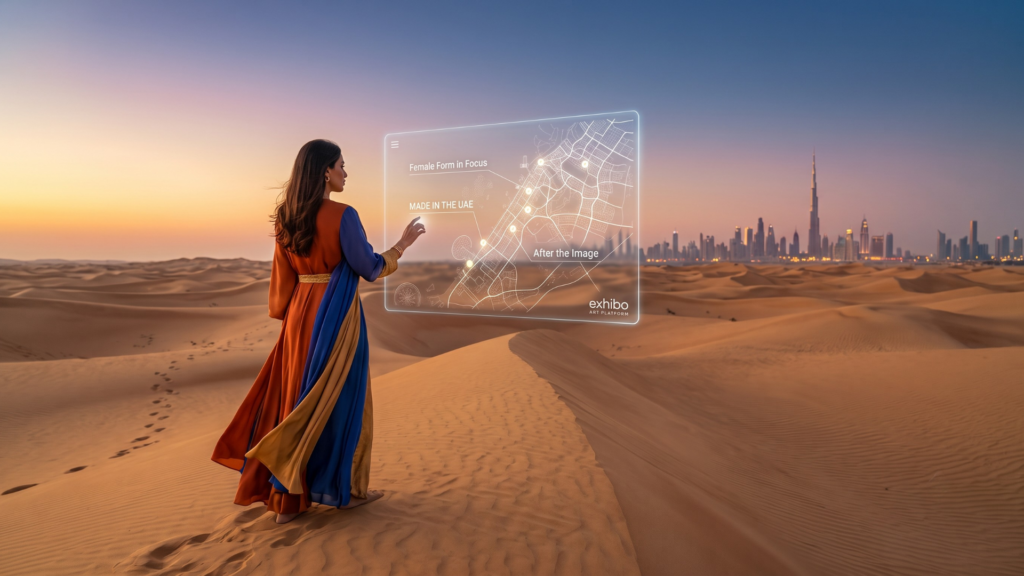
Exhibo starts from the opposite end. It treats a city as a web of relationships and tries, patiently, to draw the whole web — the galleries and the artists they show, the exhibitions and the districts that hold them, the movements that run underneath all of it. Not a map, exactly. A map shows you where things sit. This is closer to a memory of the city — the connected version that used to live only in the heads of the people who’d been there longest, finally written down where anyone can read it.
Why It Starts In Dubai
If the idea is universal, the proof is regional. Exhibo is built MENA-first, and Dubai is where it goes deepest — the largest gallery presence of any city on the platform, from established names to spaces most visitors would never find on their own.
Open the city and it moves in real time: what’s on this month, the artists behind it, the district to walk toward. But the point isn’t the individual listing. It’s that you can start anywhere — a single painting that caught your eye — and follow the connections outward until you understand the scene it came from. The knowledge that used to require a decade in the city and the right phone contacts is simply there, for a traveller with a free afternoon or a resident who never knew where to start.
From Dubai the same logic reaches outward — Beirut, Cairo, Marrakech, Sharjah, Abu Dhabi — and on to the art capitals of the world, New York, London, Berlin, Tokyo, Seoul. Same bet in every one: a city’s culture should be legible to the people standing in it.
What Exhibo Is Actually Building
And here the ambition quietly gets bigger than art.
Once you begin drawing the relationships between galleries, you notice something: there’s no reason the drawing should stop at galleries. Culture isn’t divided the way digital tools divide it. The lines between a gallery, a museum, a historic district, a piece of public sculpture, a rooftop, a restaurant that’s really an institution — those lines were never drawn by the people living in the city. They were drawn by the apps built to find each thing, every one trapped in its own list, its own silo.
To a person actually walking through a place, it’s all one fabric. The only thing that ever kept it apart was the tooling.
Which is why Exhibo’s real project isn’t art discovery. That’s a side effect. What it’s building is a way of making a city legible — of turning the scattered, siloed, insider knowledge of a place into something anyone can read. Art is simply the hardest, richest place to start.
There’s a line worth sitting with here.
The internet got very good at helping us buy tickets to a place. It almost forgot how to explain why the place mattered.
That’s the space Exhibo is trying to occupy. Not the transaction — the understanding. A city doesn’t become invisible because nobody made anything there. It becomes invisible when nobody remembers how it all connected.
Explore the cities Exhibo has begun to read at exhibo.art— Dubai’s a good place to start.