Few companies have managed to redefine an entire industry the way SpaceX has over the past two decades. Founded in 2002 by Elon Musk, the company has grown from an ambitious startup into the most dominant private force in global spaceflight. Now, as it prepares for what could become the largest public listing in history, its financial structure, technological ambitions, and strategic bets reveal a business that is far more complex than rockets alone.
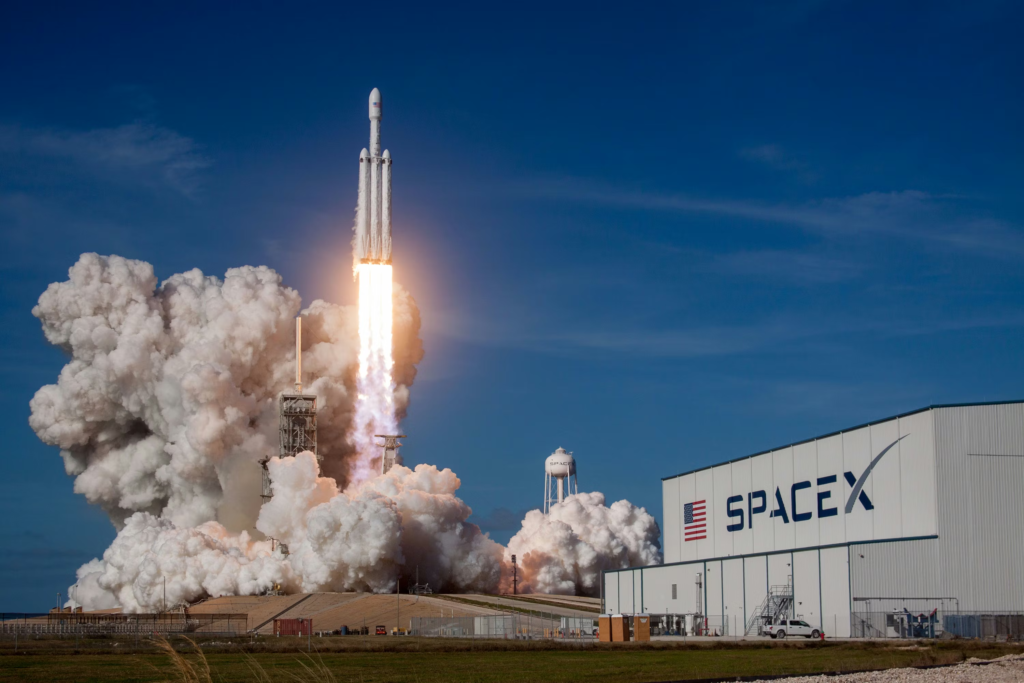
At its core, SpaceX is still a launch company, but reducing it to that would miss the bigger picture. Its reusable Falcon 9 rockets have transformed the economics of space travel, allowing the company to conduct more launches annually than any other organization worldwide. Reusability, once dismissed as impractical, has become the foundation of SpaceX’s competitive edge. Watching a Falcon booster return and land upright after deployment is no longer surprising, yet it remains one of the clearest symbols of how the company reshaped expectations in aerospace engineering.
Beyond launches, however, SpaceX has quietly built what may be its most powerful revenue engine. Its satellite internet division, Starlink, has evolved into a global communications network with thousands of satellites orbiting Earth. With more than 9,500 satellites deployed since 2019 and millions of users relying on its services, Starlink has shifted SpaceX from a project-based revenue model to a recurring income stream. In fact, estimates suggest that Starlink contributes anywhere between half to the majority of the company’s total revenue. This shift matters because it gives SpaceX something rare in the space industry: predictable, scalable cash flow.
The growing importance of Starlink also reflects a broader realization within the company. Space is no longer just about exploration or government contracts; it is increasingly about infrastructure. Internet connectivity, defense applications, and data transmission have become central to how space-based assets generate value. SpaceX has positioned itself at the intersection of these trends, serving not only commercial customers but also major institutions like NASA and the U.S. Department of Defense.
Another significant development in SpaceX’s evolution is its recent merger with xAI, Musk’s fast-growing artificial intelligence venture. The move raised eyebrows, particularly because xAI is still in a heavy investment phase and reportedly operating at a loss. Yet, from a strategic standpoint, the integration hints at a long-term vision where space infrastructure and artificial intelligence are deeply interconnected. Running a satellite network at global scale generates enormous amounts of data, and AI systems could play a critical role in optimizing operations, analyzing communications traffic, and even supporting autonomous missions in the future.
This blending of industries is not without risk. AI development requires massive spending on data centers and computing power, and tying it to a capital-intensive aerospace business could strain financial resources. Still, it reflects Musk’s tendency to think in systems rather than silos. SpaceX is no longer just building rockets; it is assembling an ecosystem where transportation, communication, and computation converge.
Central to that vision is Starship, the company’s next-generation launch system. Designed as a fully reusable spacecraft, Starship represents SpaceX’s most ambitious engineering project to date. The system combines the Super Heavy booster with the Starship upper stage, both intended to be rapidly reusable. If successful, it could dramatically reduce the cost of sending cargo and humans into space, opening the door to missions that were previously considered economically unfeasible.
Progress, however, has not been smooth. The company conducted multiple Starship test flights over the past year, with early attempts ending in complex and highly visible explosions. These setbacks, while dramatic, are not unusual in the context of experimental aerospace development. What stands out is how quickly SpaceX iterates. Later test flights demonstrated significant improvements, culminating in successful missions that validated key aspects of the design. This rapid cycle of failure and refinement has become part of the company’s identity, though it also raises questions about regulatory scrutiny and safety standards as the stakes grow higher.
Pressure from partners like NASA has added urgency to Starship’s development. The spacecraft is expected to play a crucial role in future lunar missions, and delays could ripple across broader space exploration timelines. At the same time, Musk continues to frame Starship as the vehicle that will eventually carry humans to Mars, a goal that remains both inspiring and deeply uncertain. The gap between demonstration flights and sustained interplanetary travel is vast, and even SpaceX’s remarkable pace does not eliminate the technical and logistical challenges ahead.
Financially, the anticipation surrounding SpaceX’s potential initial public offering reflects both its achievements and its ambitions. A valuation exceeding $1.75 trillion would place it among the most valuable companies in the world, a remarkable milestone for a business that once struggled to secure funding. Yet such a valuation also invites scrutiny. Investors will likely look beyond the excitement of space exploration and examine the durability of its revenue streams, the costs associated with scaling Starship, and the risks tied to its AI investments.
What makes SpaceX particularly compelling is how it balances proven success with speculative bets. Its launch business is mature and highly competitive, its satellite network is rapidly expanding, and its next-generation technologies promise transformative change. At the same time, each of these areas carries its own uncertainties, from regulatory hurdles to technological limitations and market competition.
Public perception of SpaceX often swings between admiration and skepticism. On one hand, it has achieved what many thought impossible, making spaceflight more accessible and commercially viable. On the other, its bold timelines and ambitious promises invite questions about execution and long-term sustainability. The merging of aerospace with artificial intelligence adds another layer of complexity, blurring the lines between industries in ways that are still unfolding.