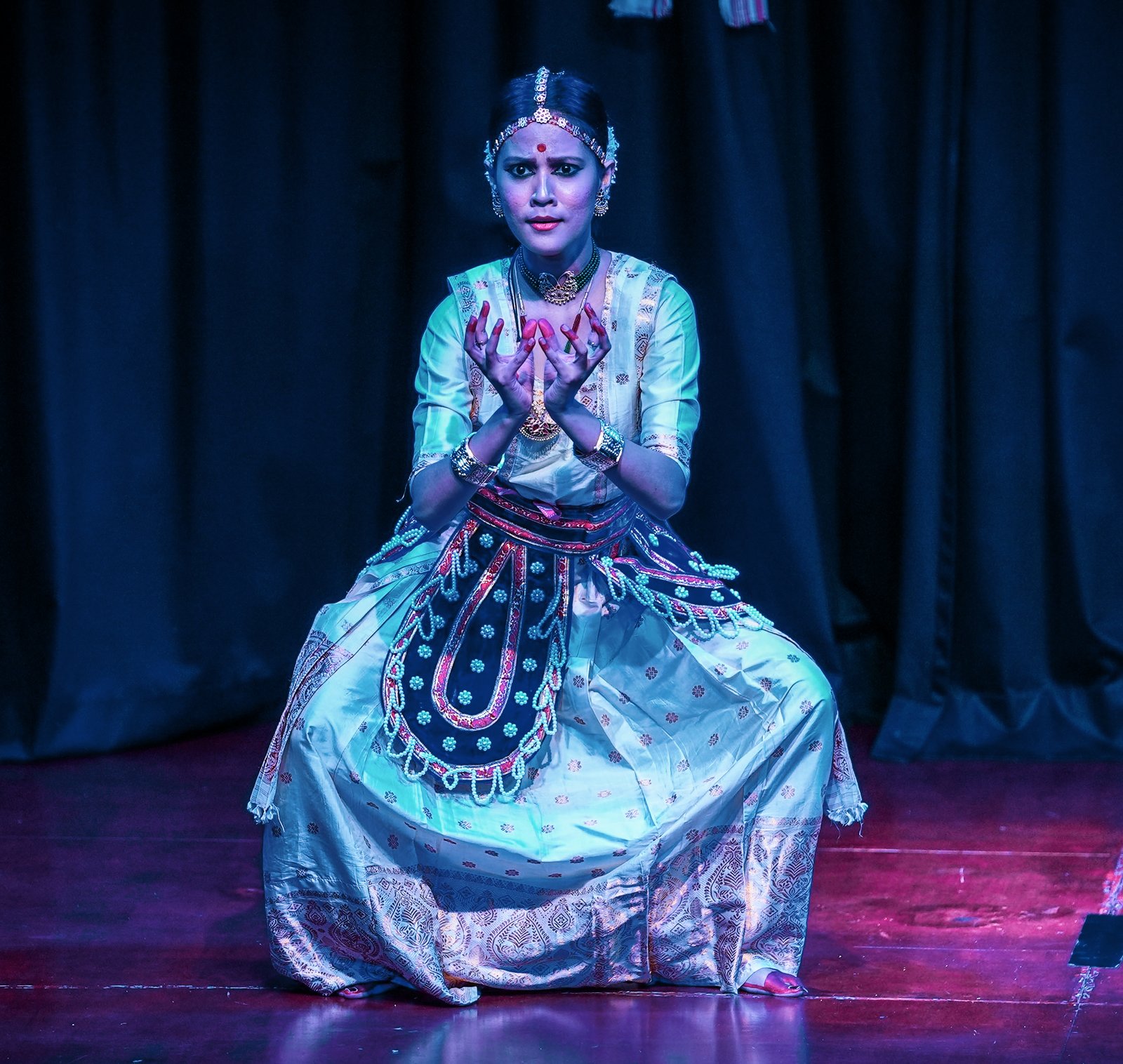
Anannya Mahanta is a professional certified South Asian dancer, performer, and movement artist based in London, United Kingdom, with over two decades of artistic experience. One of the prominent aspiring exponents of Sattriya Nritya—the classical dance tradition of Assam—her journey is deeply rooted in the sanctity of the Sattra tradition. Trained from the age of three and shaped by some of the most respected gurus in the field, Anannya represents a powerful blend of devotion, discipline, and cultural scholarship. Alongside her artistic achievements, she is also a Gold Medalist in Astrophysics, reflecting a rare confluence of intellect and artistry.
What specific medium or performance style do you work in?
Anannya Mahanta:
I specialise in Sattriya, the classical dance tradition of Assam that originated in the 15th century under the vision of the Vaishnavite saint Mahapurush Srimanta Sankardeva. What draws me deeply to this form is the way it blends devotion, storytelling, music, and movement into a single artistic language. Sattriya was originally nurtured inside the Sattras, the monastic institutions of Assam, where it was performed as part of the ritual and dramatic presentations(Ankiya Naat). For centuries the tradition was preserved by male monks, but over time it gradually found its way beyond the monastery walls and opened itself to a wider community of artists, including women. Today it is one of India’s recognised classical dance forms, acknowledged by the Sangeet Natak Akademi in the year 2000, and it continues to flourish both as a sacred practice and as a dynamic stage art.
My own work in Sattriya is rooted in this heritage while also engaging with the possibilities of contemporary performance. The style demands a balance of precision and expressiveness—pure rhythmic passages, nuanced ‘Abhinaya’, dramatic interpretation, and musicality that is deeply connected to the traditions of Assam. Whenever I perform, I try to bring forward the devotional essence of the form along with its aesthetic beauty, so that the audience not only sees a dance but experiences a cultural and spiritual journey that has been alive for more than five hundred years. For me, Sattriya is not just a medium of performance; it is a living tradition that I feel responsible to carry forward, honour, and share with audiences wherever I go.
What inspired you to pursue this creative path?
Anannya Mahanta:
My inspiration to pursue this creative path really begins with my roots. I was born in an environment of Sattriya Art and Culture, and my family traces its lineage to the Moira Mora Satra of Sivasagar district. Sattriya was not something I discovered later in life—it was a world I was born into. From the moment I arrived, I was surrounded by its devotion, its discipline, and its quiet spiritual beauty. My mother, especially, carried a deep desire that I should grow up with an understanding of the tradition I belonged to. It was never forced upon me, but rather offered as a gentle guidance, a reminder that I carried a heritage that was precious and alive. She wanted me to learn Sattriya not just as a dance form but as an identity, as something that had shaped generations before me.
Interestingly, my earliest steps in dance were actually in creative movement. So when Sattriya finally entered my life, I was a little girl who had no idea what this classical form demanded. It felt difficult, almost overwhelming, and I struggled to understand its depth. That changed only when my mother enrolled me in “Rangayan : An Academy of Dance, Theatre and Music”. Unlike the usual weekend classes, Rangayan held training sessions from Monday to Friday, three hours every day. It was intense, disciplined, and devotional. And this is where I met the person who changed everything for me—my guru, Adhyapak Dr. Bhabananda Borbayan. Under his guidance, what once felt heavy slowly became meaningful. The daily practice, the corrections, the stories, the rhythm of the khol, the devotion embedded in each movement—all of this began to shape me from within.
By the time I received my diploma in 2008, I realised that my real journey was only beginning. That was the moment I understood what it meant to be an artist, to devote myself to a tradition, and to carry it forward with sincerity. From 2008 to now, in 2026, the path has been long and full of learning, performing, practising, growing, falling, rising, and rediscovering myself again and again. I was fortunate to have the blessings of my parents, the guidance of my guru, and the support of everyone who believed in my ability to carry this art form ahead. Even today, with family responsibilities and the demands of personal life, the fire within me has only grown stronger. I have been dancing since I was three years old, and Sattriya has become more than a practice—it has become a calling, a way of living, and a responsibility I hold with pride. That lifelong companionship with my art is what truly inspires me to continue this creative journey with the same passion, if not more, every single day.
Anannya Mahanta continues to represent the rich heritage of Sattriya Nritya on international stages, bridging tradition with contemporary cultural dialogue. Through performance, education, and advocacy, her work reflects a deep commitment to preserving a sacred classical form while making it accessible to global audiences, embodying the very spirit of cultural continuity and artistic devotion.