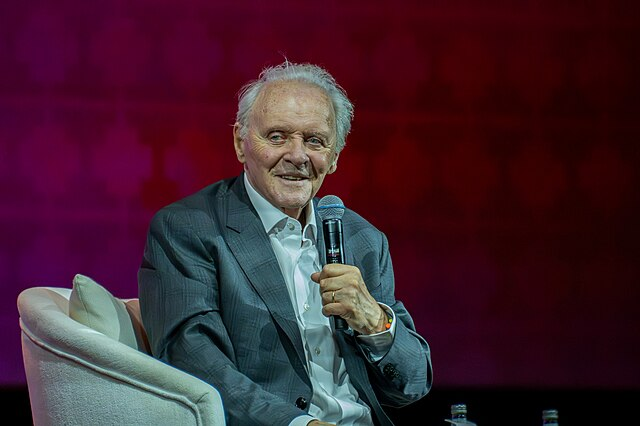
Anthony Hopkins has never been an actor who hides behind performance when it comes to life. In a recent, deeply personal conversation, the legendary Welsh actor spoke with rare openness about family estrangement, emotional boundaries, and the long, difficult work of letting go of resentment. His reflections were not dramatic confessions or attempts at public reconciliation. Instead, they felt measured, reflective, and rooted in lived experience, shaped by decades of success, regret, and emotional reckoning.
Speaking on The Interview, a podcast produced by The New York Times, Anthony Hopkins addressed his distant relationship with his daughter, a subject he has touched on before but never dissected publicly in great detail. From the start, there was an understanding that this was tender ground. The host acknowledged the sensitivity of the topic and made it clear he did not want to pry. Even so, the conversation naturally drifted toward the theme of estrangement, especially since Hopkins had written about it in his memoir, We Did OK, Kid. The host shared that the passage struck a personal chord, revealing that he had seen his own father only twice in the last two decades and had chosen to speak to him voluntarily just once.
Hopkins, clearly aware of where the conversation was heading, responded with visible restraint. “I know what you’re gonna talk about my domestic life,” he said, signaling both awareness and discomfort. Rather than offering a detailed account of the past, he chose to speak about the emotional principles he now lives by, principles shaped by time, mistakes, and acceptance.
When asked broadly about reconciliation between estranged parents and children, Hopkins shared a brief but telling moment. It was not a dramatic turning point, just a quiet attempt that went unanswered. “My wife, Stella, sent an invitation to come and see us,” he said. “Not a word of response.” There was no bitterness in the statement, no accusation. Just a fact, delivered plainly.
What followed was perhaps the most revealing part of his reflection. Hopkins described how he chose to respond internally to that silence. “So I think, okay, fine. I wish her well. But I’m not gonna waste blood over that,” he said. The phrase carried weight, suggesting a conscious decision to preserve emotional energy rather than expend it on something beyond his control. For Hopkins, this was not about denial or emotional coldness, but about survival and peace.
Throughout the conversation, Anthony Hopkins returned again and again to the destructive power of resentment. His words were blunt, almost confrontational, as if directed as much at himself as at anyone listening. “If you wanna waste your life being in resentment, oh, 50 years later, 58 years later, fine, go ahead,” he said. “It’s not in my can.” The statement reflected a hard-earned philosophy, one forged not in idealism but in lived consequence.
Hopkins explained that clinging to old wounds is a slow erosion of the self. “See, I could carry resentment over the past, this and the other. But that’s death. You’re not living,” he said. The simplicity of the language made the message sharper. For him, resentment was not a moral failing but a life-draining habit, one that quietly consumes joy, presence, and emotional freedom.
Rather than positioning himself as a victim or a hero, Hopkins framed his story within a broader understanding of human imperfection. “You have to acknowledge one thing, that we are imperfect. We’re not saints,” he said. “We’re all sinners and saints, or whatever we are. We do the best we can. Life is painful.” This framing stripped the story of blame and replaced it with realism. Estrangement, in his view, is not always the result of one person’s failure, but often the outcome of complex, imperfect relationships colliding with time.
Hopkins spoke candidly about reaching an emotional limit, a point beyond which revisiting the past no longer served him. “But you can’t live like that,” he said. “You have to say, get over it. And if you can’t get over it, fine. Good luck to you. But I have no judgment. I did what I could.” There was no triumph in the words, only resignation and acceptance. It was the voice of someone who has stopped arguing with reality.
When the conversation turned to whether he hoped his daughter might one day read his memoir, Hopkins shut the door gently but firmly. “I’m not gonna answer that, no. I don’t care,” he said, before adding, “Because I don’t wanna hurt her.” The pause between the statements mattered. Beneath the bluntness was restraint, and perhaps a quiet form of care that did not require reconciliation to exist.
Anthony Hopkins’s reflections resonate because they resist easy narratives. There is no promise that forgiveness fixes everything, no suggestion that time heals all wounds. Instead, there is an acknowledgment that some relationships remain unresolved, and that peace sometimes comes not from closure, but from release.
This perspective feels particularly grounded coming from an actor whose career has spanned over six decades. Hopkins has portrayed some of cinema’s most complex characters, from the chilling intellect of Hannibal Lecter in The Silence of the Lambs to the quiet emotional erosion of an aging man in The Father. Off-screen, his life appears no less layered. He has won two Academy Awards, earned global acclaim, and continued working well into his eighties, with recent projects including the 2025 thriller Locked and the 2024 Netflix film Mary.
Yet in this conversation, none of that mattered as much as the inner work he described. His message was not prescriptive or sentimental. It was simply an account of how one man chose not to let unresolved pain define the rest of his life.
There is something quietly unsettling about Hopkins’s honesty. It challenges the comforting belief that every story finds resolution, that love always finds its way back. Instead, he offers a different truth, one that many experience but few articulate. Sometimes, you reach the end of what you can give. Sometimes, peace comes from stepping back, not pushing forward.